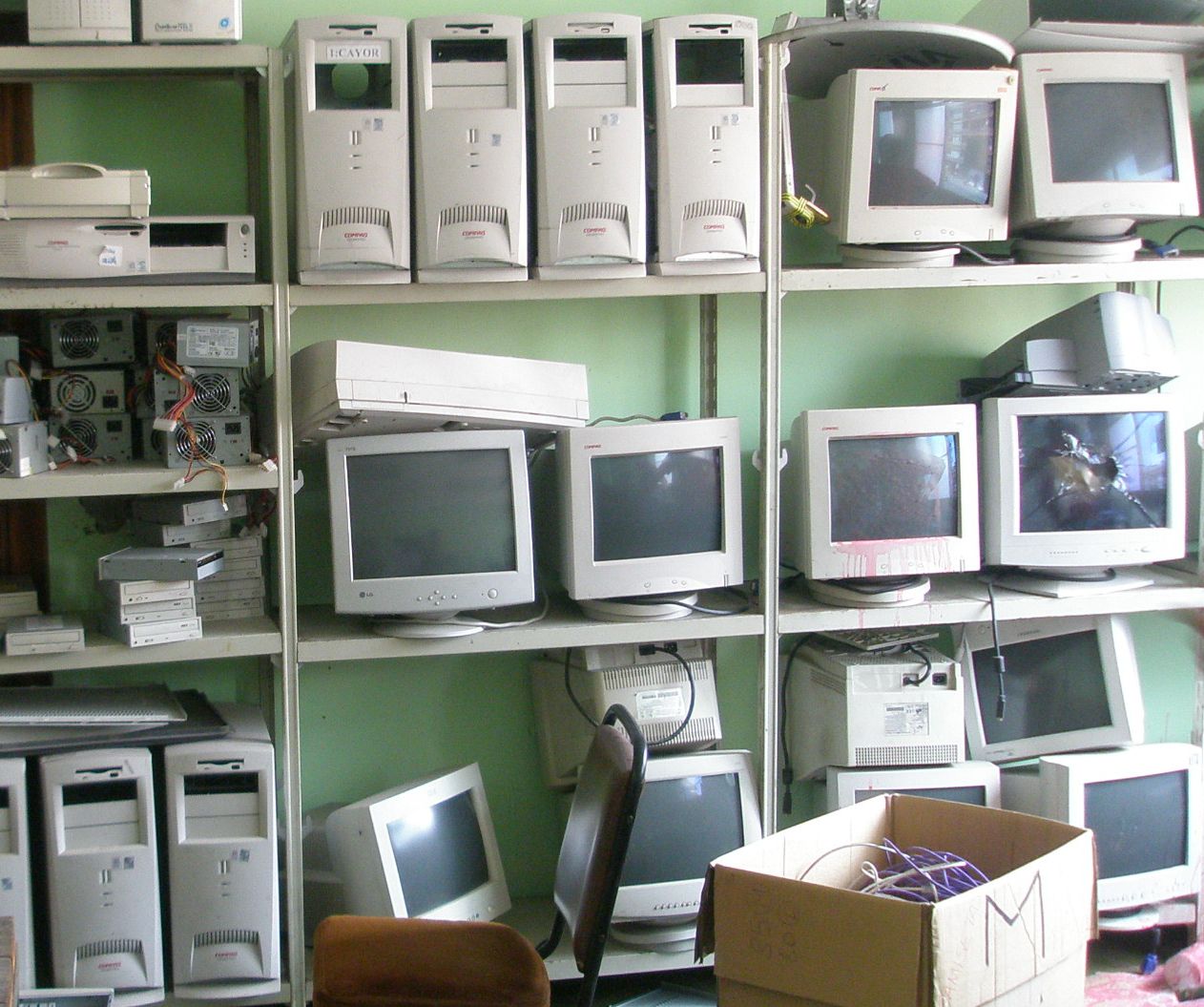
A picture of electronic waste.
Americans throw away more than almost anyone on earth. The average US resident produces about 4.5 pounds of trash per day against a global average of under 2 pounds. This adds up to nearly 300 million tons a year. A large share of that gets sorted into a second stream we call recycling: corrugated cardboard and office paper, aluminum and steel cans, glass bottles, plastic containers, and increasingly the electronics we replace every few years. The case for recycling is made usually with two arguments. First, it recovers scarce and expensive material such as copper, aluminum and steel. Second, it keeps heavy metals, solvents and plastics out of landfills and the environment generally thus protecting our groundwater and food supply from contamination. What almost nobody mentions is what this article is about, which is not the material involved but rather the information they contain. To understand why that matters, you first have to know where America's recyclables have actually been going.
The modern American recycling system has a year of origin, and it's 1987. On March 22nd that year a barge called the Mobro 4000 left New York carrying more than 3,000 tons of trash and was turned away by more than a dozen destinations. It wandered from North Carolina to Alabama then to Louisiana. It continued to Texas and then to Mexico. At every stop, it was rejected. And with every stop, it garnered more and more national attention. It spurred a national conversation about America's trash and what to do with it. Within three years, most states passed laws requiring municipal recycling and the country went from roughly 600 cities with curbside programs to almost 10,000. In the same year of the meandering Mobro barge, the 73-year-old National Association of Recycling Industries merged with the 58-year-old Institute of Scrap Iron and Steel to form ISRI. This resulted in a single trade body representing most of the nation's recyclers of metals, paper, electronics, plastics and glass. And this consolidated lobbying group lobbied to send America's trash abroad. The foreign exporting already existed in some form since the US was shipping rerolling scrap metal to China by 1985 with iron and steel scrap exports to China rising to over 40,000 metric tons by 1989. But the shift in the late 1980s was more than just the amount being shipped.
The Mobro 4000 spent five months and roughly 6,000 miles being rejected by multiple US states, the Bahamas, Mexico and Belize. It came home off the cost of Brooklyn while lawyers fought about what to do about it. Its cargo was finally burned at Brooklyn's Southwest Incinerator in September 1987. Greenpeace boarded the barge in Gravesend Bay that August with a banner reading "Next Time…Try Recycling."
Paper waste and electronic waste soon were being shipped to China along with the scrap metals. Both flowed for the same reason ostensibly--labor. Container ships arrived in the US loaded with imports and returned to Asia largely empty, so shipping lines discounted the backhaul heavily. This made it cheaper to ship scrap from Los Angeles to China than to rail it from Los Angeles to Chicago. American collection got simpler and dirtier at the same time. In 1995 only five US cities used single-stream recycling. By 2003 it rose to 93 cities and continued growing. This meant that one bin had everything mixed together. It was convenient but it meant that roughly a quarter of it was contaminated with things that could not be recycled. Chinese plants offered a solution since thousands of workers could hand-sort greasy pizza boxes and unwashed containers at a fraction of the cost American workers could. Electronics went to places like Guiyu in Guangdong, where thousands of family workshops dismantled old machines to extract lead, gold and copper. And they also went to Ziya in Tianjin, where wire-stripping had been the local specialty since the 1980s. For the most part, Americans weren't checking what valuable information was being shipped off along with the recyclable materials. Things like office files, corporate correspondence, and municipal and state records were part of the mix. And increasingly, inside the old computers from banks, hospitals and contractors, hard drives that were never wiped were also being sent. Few American exporters actually knew who recycled their material since a lot of it was sold to brokers. And then those brokers sold to importers near ports, who resold to small traders.
One case showing what all can be gleaned from trash comes from a research team looking in Africa. In 2009 Canadian journalism students bought seven hard drives at a market in Tema, Ghana for about $40 each. One had belonged to a Northrop Grumman employee in Fairfax, Virginia and held hundreds of unencrypted documents marked "competitive sensitive," covering contracts with the Defense Intelligence Agency, NASA and the TSA. Northrop Grumman had thrown the computer away and it found its way from Virginia to Ghana where the Canadian students found them and recovered the sensitive information. And that's just one case we know about because some students decided to look into it. The investigation was part of a PBS Frontline documentary called "Ghana: Digital Dumping Ground" that aired in June 2009. Peter Klein, a journalism professor at the University of British Columbia, led the project along with several of his graduate students. The Northrop Grumman drive is what got the headlines, but the cybercrime angle was what the reporters went looking for in the first place. The market they bought from sits in the port of Tema, one of the main entry points for electronic waste coming into Africa from Europe and North America. Off camera, locals told the team that data thieves routinely go through these drives hunting for anything they can use. The other six drives backed that up. They held credit card numbers, resumes, online account information, and the personal data and family photographs of people other parts of the world.
Zhang Yin moved to Pomona, California in 1990 and ran a paper-collection business out of her apartment. She bought refuse from garbage dumps with her husband. America Chung Nam became the largest exporter of wastepaper from the United States. She went back to China in 1995 to found Nine Dragons Paper, and by 2006 she was the richest person in the country.
And it's not a matter of fantasy to think the Chinese wouldn't be doing the same thing those journalism students did. But it definitely wouldn't be to warn people to be more careful about their data. For decades, Chinese national security strategy has looked at all aspects of a nation state's society as fair game in warfare and in peacetime. Whether it's trading relationships or educational exchanges, the Chinese government has structured almost all external interactions to benefit their national aims with the biggest aim at surpassing the United States in both power and influence. And during that same time frame, China has been consistently the top destination for America's old cell phones, computers, hard drives, and other things simply tossed out. And you might think you were careful with your devices since you disposed of them with a reputable company. But once you handed it off, most of those initial companies then sent the items to brokers who then chipped them to other countries like China.
Although the landscape has changed a bit with China now coming in second in some metrics as the major recipient of America's trash, it's still a huge risk. And it doesn't make it better that other foreign countries have been added to the list. Securely and properly recycling our trash is not just something that will help our environment. It's not just something that will protect our drinking water and food supplies from getting filled with heavy metals and carcinogens. It will also protect our personal data from criminals and foreign adversaries. Currently, America's recycling lobby is geared toward keeping our recyclable materials flowing out of the country. It's not a mystery why this is--their biggest members benefit financially from this outsourcing arrangement. And most economists will just point out that it's cheaper for foreigners to strip the pieces from old electronics instead of paying Americans to do it. But those economists and industry lobbyists don't seem to care about what else is being stripped in the process. Do you?