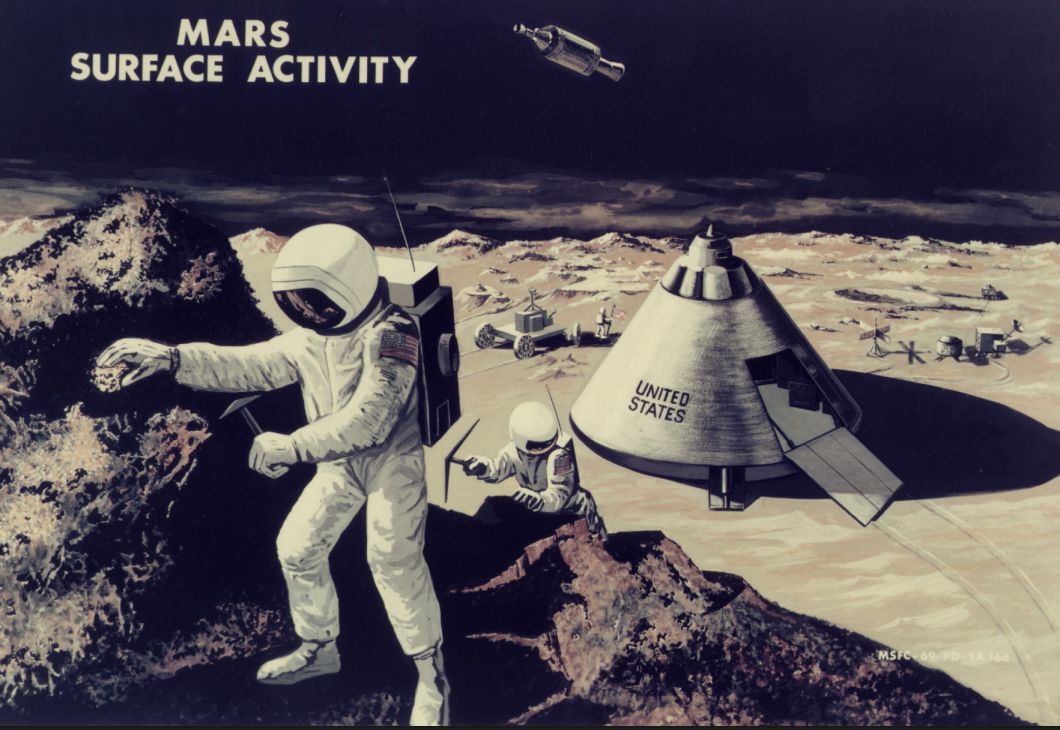
An illustration of a planned US landing in Mars in the 1980s. Shown in a report to President Nixon in 1969
In 1969, the United States of America first landed astronauts on the moon. To get there, the country devoted roughly two percent of its national output for years as well creating a research and industrial complex that spanned the country and involved hundreds of thousands of people. But the moon wasn't supposed to be the only destination. With planned flybys of Venus and Saturn as well as a landing on Mars, the United States had detailed plans to have Americans out in the solar system extending human reach. But right as we made the first major milestone as landing men on the moon, the president was already figuring out how to end it. Not only did Nixon end the work and plans to get beyond the moon, he even cancelled the last two Apollo missions to the moon even though the rockets and equipment were already paid for. He would have cut even more but his science advisors talked him out of that. With obvious success and fully scoped out plans, why did we just give up on space?
There is a popular tale of the Saturn V rocket plans being lost after the last moon mission. That's not true. They're maintained on microfilm at Marshall Space Center in Huntsville, Alabama. But in terms of capability, once the program was stopped we did see the end of experience in turning those plans into reality. The manufacturing process knowledge and experience was what actually was lost following the last moon mission.
There are a few key reasons why America's leadership drifted away from space. One of the most obvious reasons was politics. With the Vietnam War committing more and more resources and political will, many in middle America and in the halls of Congress started to view space as a bit detached from the life and death struggles on Earth. But that's just one of a few big reasons we didn't go beyond the moon with the other reasons detailed in the video. And it goes far beyond Nixon. In fact, the same factors that were at play in Richard Nixon's decision in 1969 stopped America's later attempts to get back on track. In the Reagan era, it was the investment in a nuclear space-based defense system that took up the major focus and funding that could have gone to manned explortation. When George H.W. Bush laid out a multi-decade vision, he was hounded by the press and critics who pointed to problems on the ground to include a recession. And when the younger Bush rolled out a plan for Mars in 2004, it was doomed by increased commitments in Iraq and massive spending devoted to fighting the Global War on Terror.
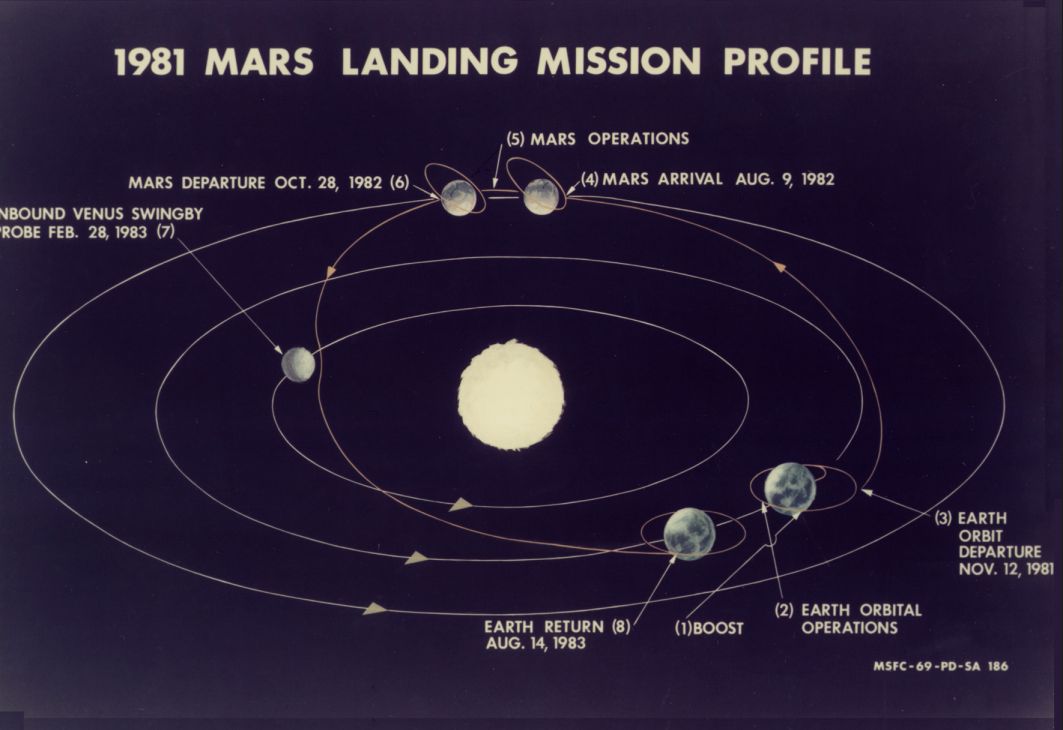
A mission profile of a projected 1982 Mars surface landing.
Although we seem to be back on track picking up where we left of in the early 1970s with a return to the moon planned later this decade, there are signs that the same reasons that stopped us all those previous times could happen again. The Space Launch System's limitations and the policy preferance of having private corporations take the lead in space systems is a huge risk. Particularly regarding the corporate pivot since that has the danger of creating something that looks more like a jobs program than a space program. We saw this already with the Space Shuttle. And that aspect--the corporate profits and jobs piece--were some of the reasons Nixon chose only that program to go forward instead of the others that would have actually had humans living and working on other worlds. But our current trajectory and a deep dive in the Artemis era will have to wait for another article and, eventually, video. For the time being, check out "Why We Never Made It to Mars By 1982" on YouTube to see where we should have already been and what stopped us from getting there.