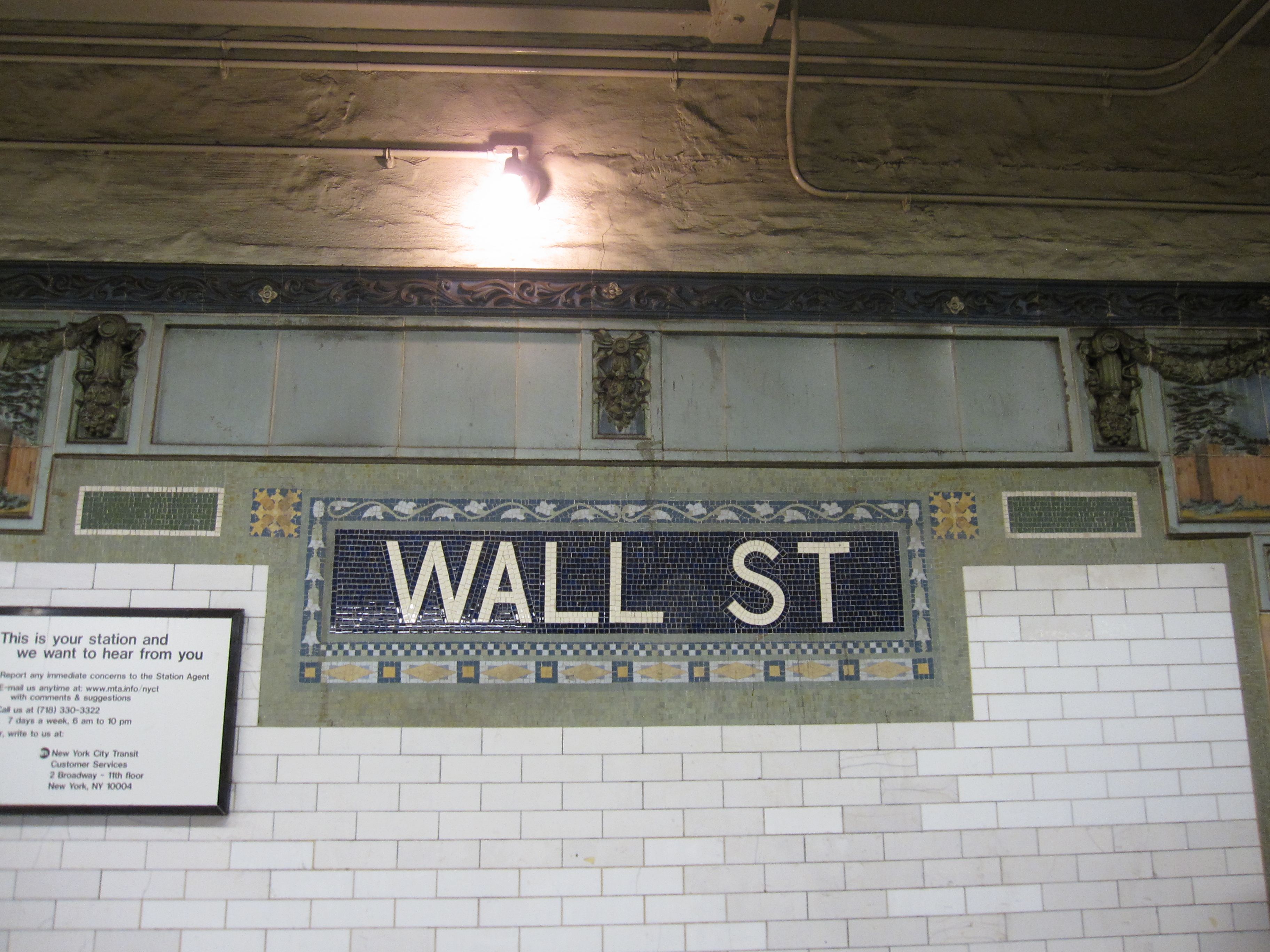
A Wall Street sign at a New York transit stop.
A leveraged buyout involves buying a company using mostly borrowed money and then making the acquired company itself responsible for paying back that debt. The strategy originated in the 1980s with the firm Kohlberg Kravis Roberts (KKR) being most known for it through their 1989 takeover of RJR Nabisco, which was later chronicled in the book Barbarians at the Gate. That deal became the symbol of an era defined by hostile takeovers, corporate raiders, and the discovery that virtually any company, even massive conglomerates, could be acquired without the buyer risking much of their own money. The pitch to investors tries to smooth over the debt-centric aspect by using the term leverage instead. But make no mistake, the core strategy of these types of deals is the loading of deby by one entity onto another. If a company grows and its debt gets paid down, the institutional investors that funded the deal get a profit. But when the acquired company can't succeed under the choking debt that it was placed under as part of the acquisition, then the institional fund investors--which is mostly made up of pension funds that technically belong to individuals like state and federal workers--lose considerably and are left holding the bag. The firms that structured the deal like KKR, however, almost always walk away with profits. But it shouldn't be surprising since that's exactly the outcome they structured these deals to produce.
The anatomy of a leveraged buyout starts with the down payment. When a private equity firm announces a multibillion-dollar acquisition, the firm itself typically isn't the one writing that check. The equity portion of the deal is raised from a fund the firm manages, and that fund is filled almost entirely with money from limited partners, or LPs. This is where "institutional investors" enter the picture. Institutional investors usually mean pooled cash like public pension funds for teachers, firefighters, or municipal workers. California's Public Employees' Retirement System and California State Teachers' Retirement System are two of the largest institutional investment funds in the country. But it also include other pools of public money like university endowments. These are the entities that supply the actual dollars behind the equity check, in exchange for a promised share of the eventual profits. And they're the ones who often have no say in how the funds are used and carry most of the costs when a takeover results in the destruction of a company the "investment firm" like KKR conducted.


The rest of the purchase price, which is usually most of the total purchase amount, comes from debt. That debt isn't borrowed by the private equity firm. It's placed directly onto the balance sheet of the company being acquired. To put it simply, the target company is made to borrow the money used to buy itself and then handed the bill. A company that was debt-free the day before an acquisition can wake up the next morning owing billions of dollars to banks and bondholders with none of that debt having anything to do with its own operations, growth plans, or capital needs. Servicing that debt becomes the acquired company's first obligation, ahead of investing in equipment, staffing, or wages. This is why there is a clear pattern of the acquired company going through lay-offs and downsizing within weeks of being acquired. And at this point, the "investment firm" that orchestrated the take over with other people's money and debt they piled onto the acquired company is already making profits since they get paid management fees and other payouts that often equate to hundreds of millions of dollars for just making the deal happen.
With these arrangements the private equity firm or "investment firm" is positioned to win almost no matter what happens to the acquired company or with the institutional investment funds. From the day the deal closes, the firm begins collecting management fees on the fund's committed capital, transaction fees for arranging the deal, and monitoring fees charged to the acquired company itself for the ongoing "service" of owning it. These fees flow whether the company pulls itself out from under the debt or slowly disintegrates under the heavy burden. The risks and burden go to the acquired company's employees as well as those whose money was used to fund the deal. The risk goes to all those whose work created the value in the first place--the teachers and sanitation workers who funded the retirement accounts and the employees who made the acquired company successful in the first place. And the "investment firm" gets to walk away clean when things go bad and do so via state bankruptcy proceedings where the firm's assets are often walled off from everything else.
A write-down is when a company lowers the value it reports for an investment on its books, admitting it's now worth less. KKR did this quarterly for its holdings of Envision up until it went bankrupt. KKR still made money off the purchase of Envision through fees despite the write-downs.
Envision Healthcare is a good example that shows how the levaraged buyout is destroying healthcare companies too. In 2018, KKR took Envision, a physician-staffing company, private in a $9 billion deal using roughly $3.5 billion in equity from KKR's fund (remember, this is mostly money from pension funds) and about $7 billion of debt loaded directly onto Envision's books. That debt survived as long as Envision's most profitable business line did, and even that required huge changes and cuts after it was taken over. Once the No Surprises Act banned the out-of-network billing practices that had artificially inflated the company's margins, revenue collapsed under the debt load. Envision filed for bankruptcy in 2023. The institutional investment (the pension funds' investment mostly) was wiped out but KKR itself had already profited. The doctors, patients, and hospitals that depended on Envision were left with picking up the pieces.
And how KKR profited as they piled on the debt cuts into the efficiency myth of firms like KKR. I'm not saying efficiency doesn't come. The problem is what the efficiency is geared toward. And one of the biggest ways KKR extracted higher margins from Envision is seen clearly with how it delt with the most crucial part of care from a patient's perspective--and that's the direct interaction with a trained doctor. During KKR's management, Envision replaced physicians in many instances with physician assistants and nurse practitioners, who had salaries much lower than physicians. The physicians that were retained then would be loaded with more individual cases that now were now more directly handled by physician assistants with the physician acting as supervisor. Under billing rules for Medicare and most insurance, there is an exception allowing the physician rate to be billed even if most care is done by a nurse or physician assistant as long as a physician was at least the supervisor of care. This allowed the "investment firm", for the most part, to pocket more profit with each case. But this profit was built on increased work loads for the reduced number of physicians retained as well as less direct interaction between doctors and patients. That's how Wall Street uses other people's money to buy and bankrupt America's companies and still profit from it. The leveraged buyout is now leveraging America's healthcare too.