Volumes of the US Code. Tony Webster via Wikimedia Commons.
When you ask most Americans how something becomes a federal law, most will repeat what has been taught to them since elementary school. A bill is proposed in Congress and then it's debated, it's passed, and then finally signed by the President of the United States. That's the process--from bill to a signed law. But if you ask most lawyers to reference the law, they'll most likely give you a United States Code citation. However, the United States Code, often abbreviated as USC and linked with a specific title and section, is not the actual law. It was created to be reference only. And it hasn't even been around that long--at least as the existence of America goes. The year 2026 marks the hundreth anniversary of the US Code's existence. So if it was only created to be a compilation for easy reference and not actually the law, then why do so many lawyers and judges treat it as such? Before we go into that question, we first need to understand more about where the actual law lives.
In the early days of America, Congress used to pass laws and send them out individually after passage. Once a bill was signed by the president, it would be printed as a "slip law," which was just the one individual law, and then distributed to the states. Although we think of the State Department as the foreign policy department today, in the early days it was responsible for storing all federal laws as well as distributing them out once they were signed by the president. The distribution was done via two tiers. The first involved the Secretary of State sending them out to the governors and representatives of each state. The second tier was how most people received the laws, and that was done via reprints in newspapers. In fact, US law required that each law be printed in at least three newspapers. Eventually, the way the laws were distributed changed to be sent out in batches. And this change would also introduce a new term.
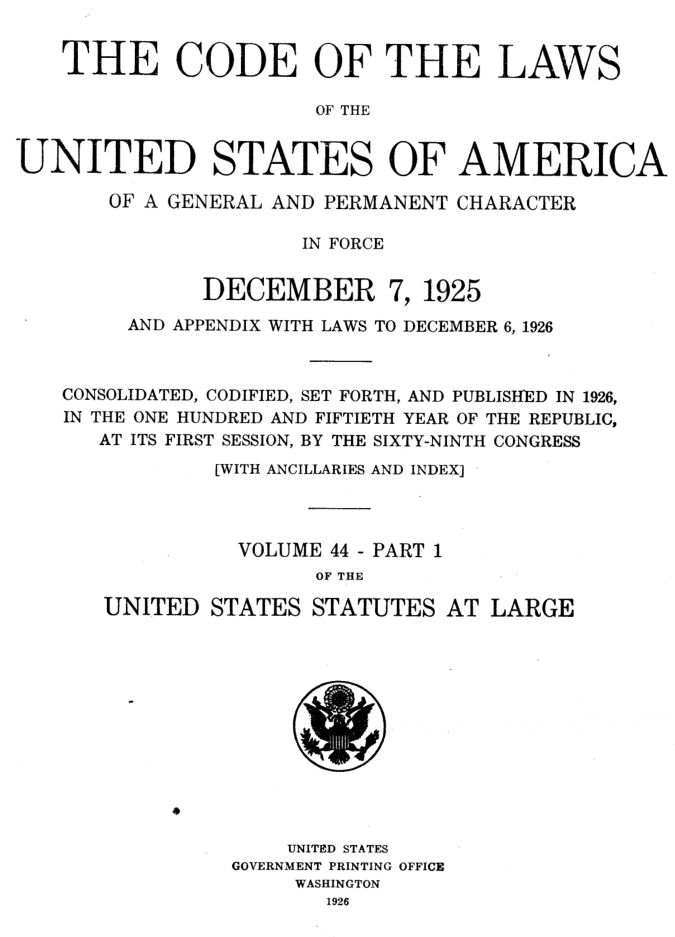
The title page of the US Code in the Statutes at Large, 1926.
In 1845, the way the United States of America handled laws after their passage changed. Instead of relying solely on newspapers the State Department was directed to hire a private company to print the laws for official distribution. And the books that were published containing these laws were named the Statutes at Large. Previously, the slip laws were organized as session laws with each law giving a reference according to the session of Congress in which it was passed. A "session" of Congress is simply one continuous period of lawmaking within a two-year Congress. Congress, after all, meets in annual sessions, so a single numbered Congress--say, the 1st Congress, which ran from 1789 to 1791--typically consists of two or three sessions. This would usually mean a "1st session," a "2nd session," and sometimes a short additional "3rd session" before that Congress's term expired and a new one was elected. For example, the 1st Congress's 1st session ran from March 4, 1789, to September 29, 1789. And it was that first session during which the Records Act along with the Judiciary Act of 1789 were both passed.
A "session law" was simply a law identified by where it fell in that session's chronological sequence, rather than by any subject-matter organization. So instead of looking a law up by topic — the way you'd search for "nursing home law" in the modern U.S. Code — you would look it up by knowing it was, say, the fourteenth act passed during the 1st Congress's 1st session, or by its date of passage within that session. This is exactly why the earliest reference style you'll find was something like "FIRST CONGRESS. Sess. I. Ch. 14. 1789." In 1845, this referencing was changed to the Statute at Large referencing that is still very much valid today but you'll probably rarely see. And even that system evolved. If you look up laws with within the first statutes at large volume, you'll see laws from five different Congresses. However, the current model has it where each statute at large volume covers basically a one-year period. For instance, volume 110 of the Statutes at Large covers the laws passed in 1996. So that's the history of the law and where you can find it today, which is in the Statutes at Large. So let's get back to the United States Code and what it was meant to be and what it has unfortunately been used as.
Initially, the law stated that each law be printed in three newspapers. Since it didn't specify three newspapers by state, Thomas Jefferson initially only had the laws printed in three newspapers total, for the entire country. The law was eventually changed to clarify that it should be three newspaper for each state.
For years, there were those who said the law should be made easily accessible. And they were right in sentiment. In those days, getting access to the law was a challenge since you physically had to have a printed version in front of you to review it. Plus, there was the aspect that some laws were no longer valid because of later repeal or amendment. For instance, you could be looking at a law in volume 4 of the Statutes at Large and think it still valid. And the only way to know it was repealed would mean having to find it referenced in volume 20 of the Statutes at Large. The idea of trying to resolve this complication had been around even before 1926. In fact, the Revised Statutes were pushed forward in the 1870s as an early attempt at not just having an easy reference but also even attempting to update all laws to that point by passing the Revised Statutes. The idea was to make that time period the new starting point moving forward. But it failed miserably. Every effort at "revising" the law was met with errors and oversights. Congress devoted massive amounts of energy and funds to try and make it work. But they ultimately gave up on it in the 1890s. The revived effort in 1926 made it clear that it was not replacing the law but providing an organization of it for easier reference. While it has lived a lot longer than the revised statutes effort of the late 1800s, it's failing just like that earlier effort did. But now it's even worse because it has become almost the automatic reference by not just lawyers but even Federal prosecutors when they file cases that threaten to take away somebody's freedom or property.
And it's not a trivial matter. Many might think that if the USC is just referencing the statutes at large then it's a simple restatement. But it's not so simple and the very organization of the US Code itself is built around judgment calls. The USC is organized in titles based on subject. For instance title 38 is veterans benefits. You start off assuming an aspect of law fits neatly into one category but may be leaving out nuanced language in the actual individual public law it was passed as. And sometimes restrictions on one so-called benefit program gets inserted into a title that might have a number of other "benefit" programs that were actually passed as standalone bills with no restrictions identified. So by that measure, you are creating something that didn't exist before in law and in essence creating a new law instead of simply organizing it. But that is Constitutionally impossible but unfortunately happens when people only rely on the United States Code. And how do we know it's happening? Because the Supreme Court actually found the US Code creating law where it couldn't in one high profile case.
In United States National Bank of Oregon v. Independent Insurance Agents of America (1993), a 1916 law letting small-town national banks sell insurance had been correctly listed in the U.S. Code for decades, but the 1952 edition mistakenly omitted it, wrongly noting that Congress had repealed it in 1918. When a 1986 regulatory ruling relying on the provision was challenged in court, the Supreme Court went back to the actual Statutes at Large rather than trusting the Code's note, and found the 1918 law had never touched the provision at all. The Court held the banking law had been valid and in force the entire time, confirming that when the Code and the Statutes at Large conflict, the Statutes at Large controls. This case has huge stakes for both sides because it was literally worth a fortune depending on who won. You had lawyers who took their time to actually examine the US Code critically and found the flaw. And then they had to fight through an extended legal battle just to get the correction made. Now imagine how many other errors are out there that we'll never find because the parties don't have the money and time to pick it apart?
In one of the multiple attempts of the US Code's passage, the Senate found it contained over 600 errors and rejected it. It eventually was passed in 1926 but only on the condition that it would not take place of the actual law.
Instead of a finding aid or an easy reference, the US Code has developed into the same confusing mess that the Revised Statutes did the century before its creation. In fact, it's even worse because now Congress is referencing US Code citations instead of previous statutes at large citations. You'll see a law originally passed as a simple statute at large reference and then later laws passed referencing an amendment to a USC citation. It's a confusing mess. And unfortunately, most lawyers and judges call that mess law.