You ever sit and watch a movie and about twenty minutes in you start thinking that the movie seems a bit off? There's something wrong with it but you're not sure. If you're watching a movie that was shot fully on digital cameras, then that's probably why. And the reason why you've noticed that difference isn't due to some personal aesthetic choice. Instead, it's due to the simple fact that digital cameras only capture a certain part of the color the camera sensor is recording. In other words, digital cameras recreate some colors and shadows while basically making up the rest. Seriously, it's science.
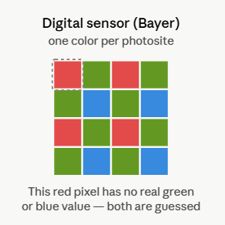
How a digital sensor works.
How a Digital Camera Works
Picture a digital sensor as a huge checkerboard of tiny cells. Each cell physically has one colored filter glued on top of it — red, green, or blue — and it can only see that color. A cell under a red filter is blind to green and blue light. Those wavelengths literally get blocked before they ever reach it. So if you zoom into a single cell on that checkerboard and ask "what color is this point?", the honest answer is "I only know the red value — the camera's software had to guess the green and blue by looking at what the neighboring cells recorded." That guessing is happening at roughly two out of every three pixels in the entire image before you ever see the photo.
How a Film Camera Works
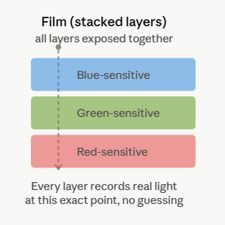
How film works.
Color film is built more like a stack of three transparent layers glued on top of each other — think three thin sheets of colored cellophane stacked directly on top of one another, each one sensitive to a different color of light. When light hits any single point on the film, it doesn't hit just one layer. It passes straight through all three, and each layer records its own true reaction to that same point. There's no guessing involved, because nothing is spatially separated. The red, green, and blue information for a given spot are all sitting right on top of each other, not spread out across neighboring cells that have to be interpolated.
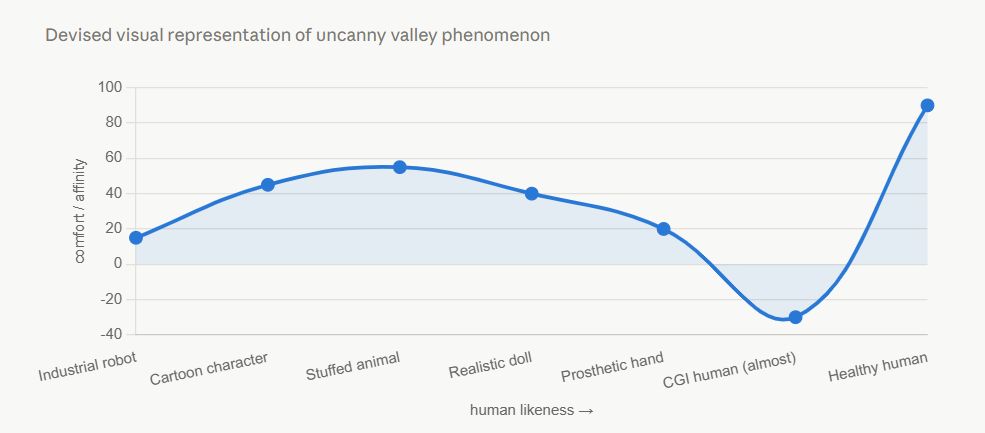
A depiction of the uncanny valley.
With Digital, You Have a Less True Picture
So when you understand that digital sensors literally take in less data directly from it's environment than film does, you see why there is a natural preference for film. In some ways, when you watch a digitally shot video you are experiencing something called "the uncanny valley." The uncanny valley is a term that originated in the robotics field but has been applied more widely since. It describes a point where something artficial, like a robot or cartoon, becomes close to seeming fully human but not quite. And when you get close to the real thing but slightly off, you feel a sense of disturbance. In some ways, things obviously artificial like teddy bears or black and white TV shows are better accepted than something nearly perfect. With most movies being shot with digital sensors, there's not much you can do to change the film industry. But at least you'll have an idea why the movie feels a bit off the next time you watch.
Digital cameras now capture over 90% of major studio films. This number was under 20% in 2012. Film survives mainly as a deliberate artistic choice by directors like Christopher Nolan and Quentin Tarantino, rather than the industry default it once was.