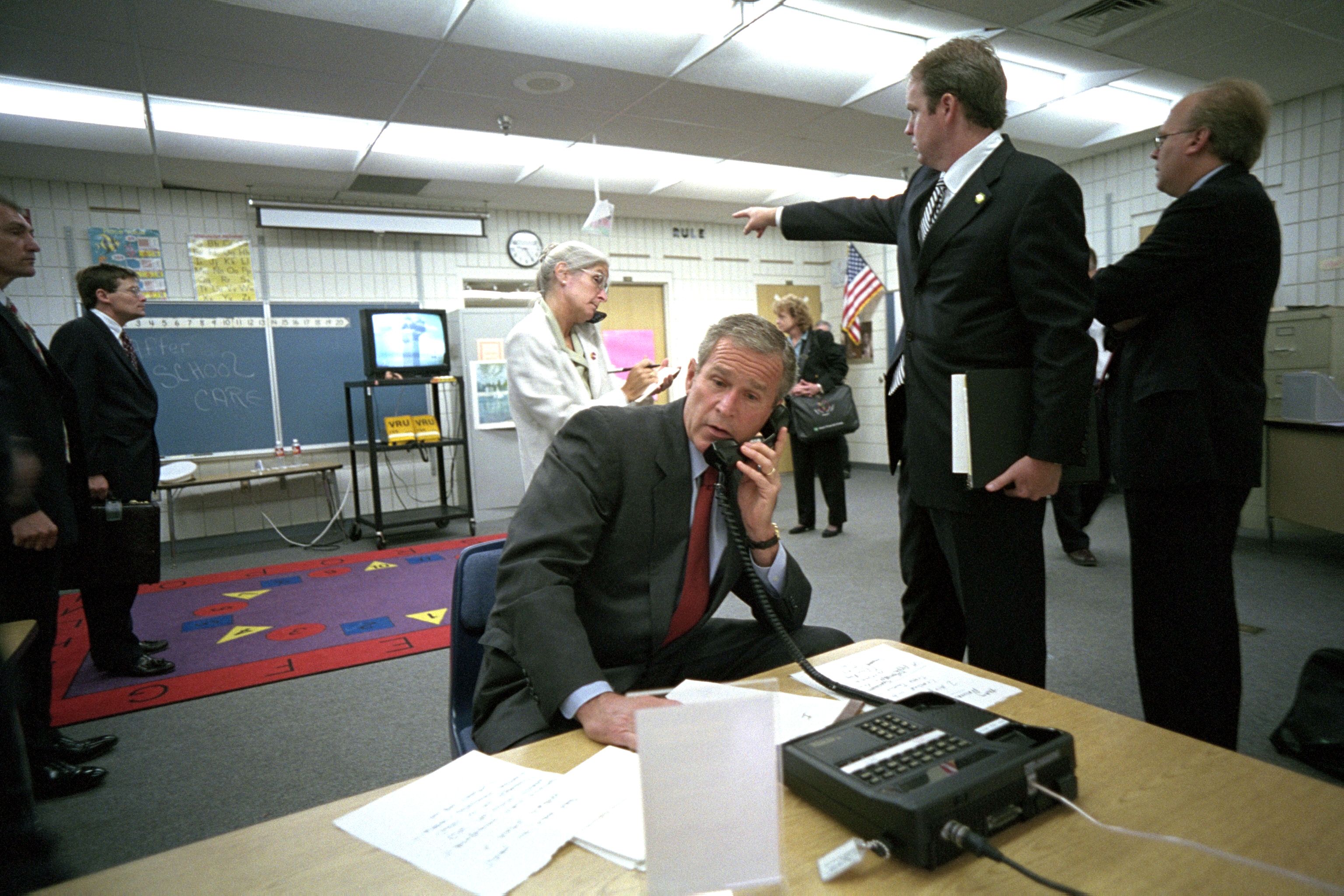
Bush on the phone on 9/11. The FCC under Bush exempted internet calling service from universal service obligations.
Across the United States, the copper telephone network that has carried voices into American homes for over a century is being dismantled. AT&T has been granted federal approval to decommission copper service across roughly 500 wire centers, with a stated goal of retiring the bulk of its copper footprint by 2029. The last serious holdout is California, where a state law requires a "Carrier of Last Resort" to provide basic phone service to anyone who requests it. AT&T is suing to override that law, arguing federal approval to retire copper should preempt the state's protections. The Federal Communications Commission, under its March 2026 Network Modernization Order, has already cleared much of the regulatory path nationally. What's left is a legal fight over whether one state can still insist that a phone company answer when called upon.
The practical loss is easy to overlook until it's gone. A copper landline is powered independently by the phone company's own central office. The power it uses has nothing to do with the electricity in your home, by a cell tower, or by your internet connection. That's why, on September 11, 2001, when cellular networks in New York collapsed under call volume, landlines largely kept working. Once copper is retired, that redundancy disappears. What replaces it is either VoIP over fiber or a cellular box in your home. And they very much depend on the power grid staying up. And for those switching to wireless replacements, phone service would be at the mercy of the functioning of a shared cell network that can become congested at the exact moments people most need it. The backup battery some providers offer typically lasts hours, not the indefinite stretch copper's own power supply provided.
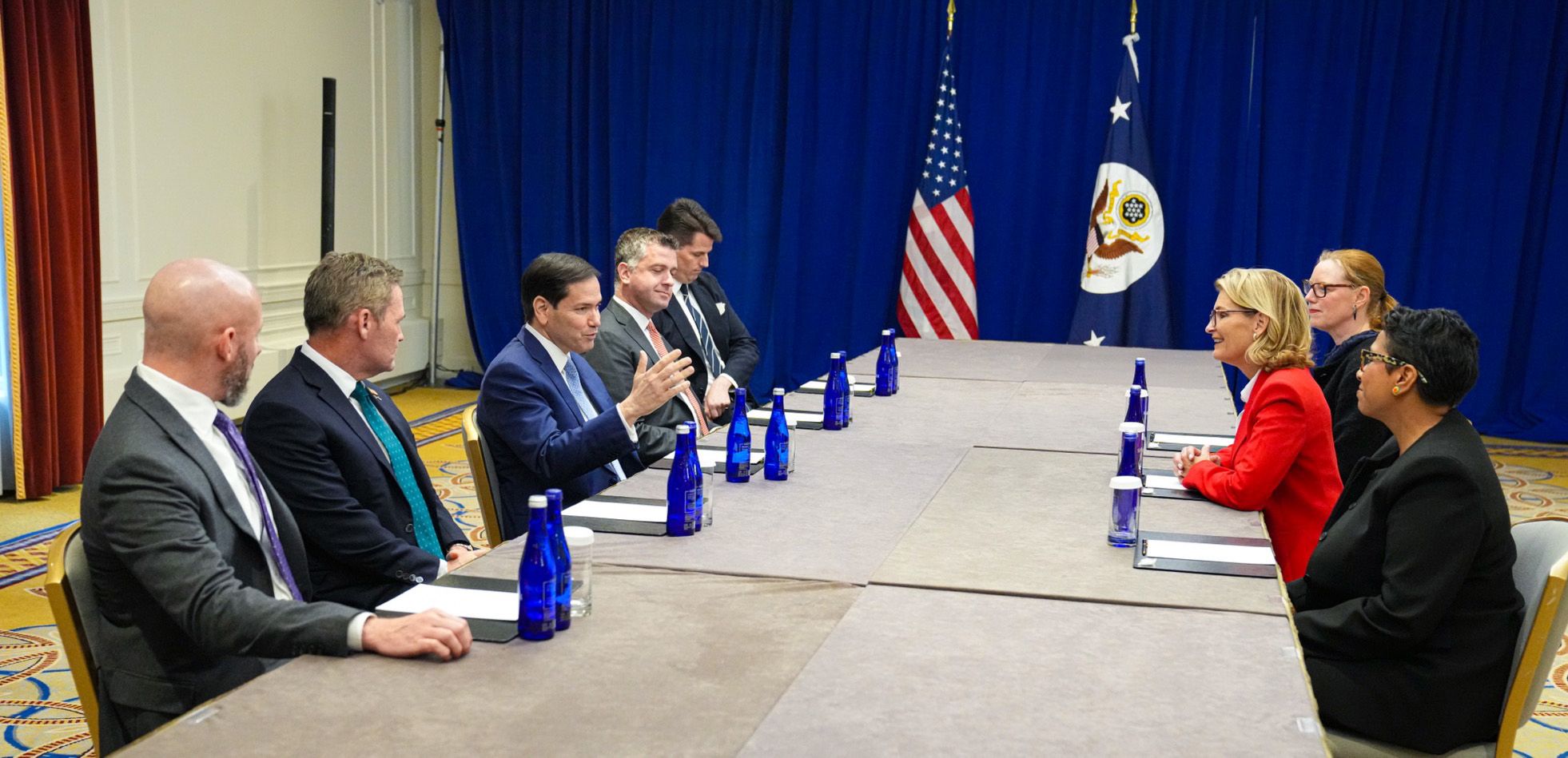
Secretary of State Rubio meeting with International Telecommunications Union Secretary General, 2025.
None of this could happen under the old rules. Traditional phone service was--and still is where it still exists--regulated as a "common carrier" under Title II of the Communications Act. This is a legal status that came with real obligations: serve everyone who asks, don't discriminate, and keep serving even unprofitable customers. VoIP escaped that category. In 2004, entrepreneur Jeff Pulver petitioned the FCC to rule that his early internet-calling service wasn't a "telecommunications service" at all, but rather an unregulated "information service." The FCC agreed. That single classification, that became known as the Pulver Order, became the template for how VoIP, and eventually the entire IP-based communications industry would be treated. It was the basis for the lighter regulations and exemption from common-carrier duty to serve that copper's replacement receives.
This same fight over who controls the pipes of communication has played out on the world stage too. At the UN's International Telecommunication Union, Russia and China have repeatedly pushed to shift internet governance away from the multistakeholder model where engineers, companies, and civil society have a seat at the table. And instead, toward a purely intergovernmental system, where only national governments vote. It surfaced openly at the 2012 World Conference on International Telecommunications in Dubai, where Google warned that "only governments have a voice at the ITU," and again in 2019 when Huawei proposed a "New IP" architecture built for centralized, top-down control. It surfaced most starkly in 2022, when Russia ran a candidate for ITU Secretary-General on an explicit platform of moving internet governance into state hands.
The FCC used to cap how much carriers could raise copper line rates each year. That cap is gone with some copper lines now being billed over $2,700 a month.
Whether it's the US phone companies fighting to demolish copper landlines and the "commmon carrier" obligations that come with them or Russia and China pushing for more top-down governance and control for Internet communications, the impact is the same. Once a network is no longer bound by obligations to deliver, whoever operates it gains discretion over who stays connected. In America, that discretion now sits with private companies. A phone or internet provider classified as an "information service" has no legal duty to serve an unprofitable rural county, and can suspend an account for violating a terms-of-service clause on spam, abuse, or any other pretext it defines for itself. Nobody has to answer. The dial tone that once came with a legal promise to pick up has been replaced by a service that comes with no promise at all. And the infrastructure making that shift possible is being unplugged, one wire center at a time.