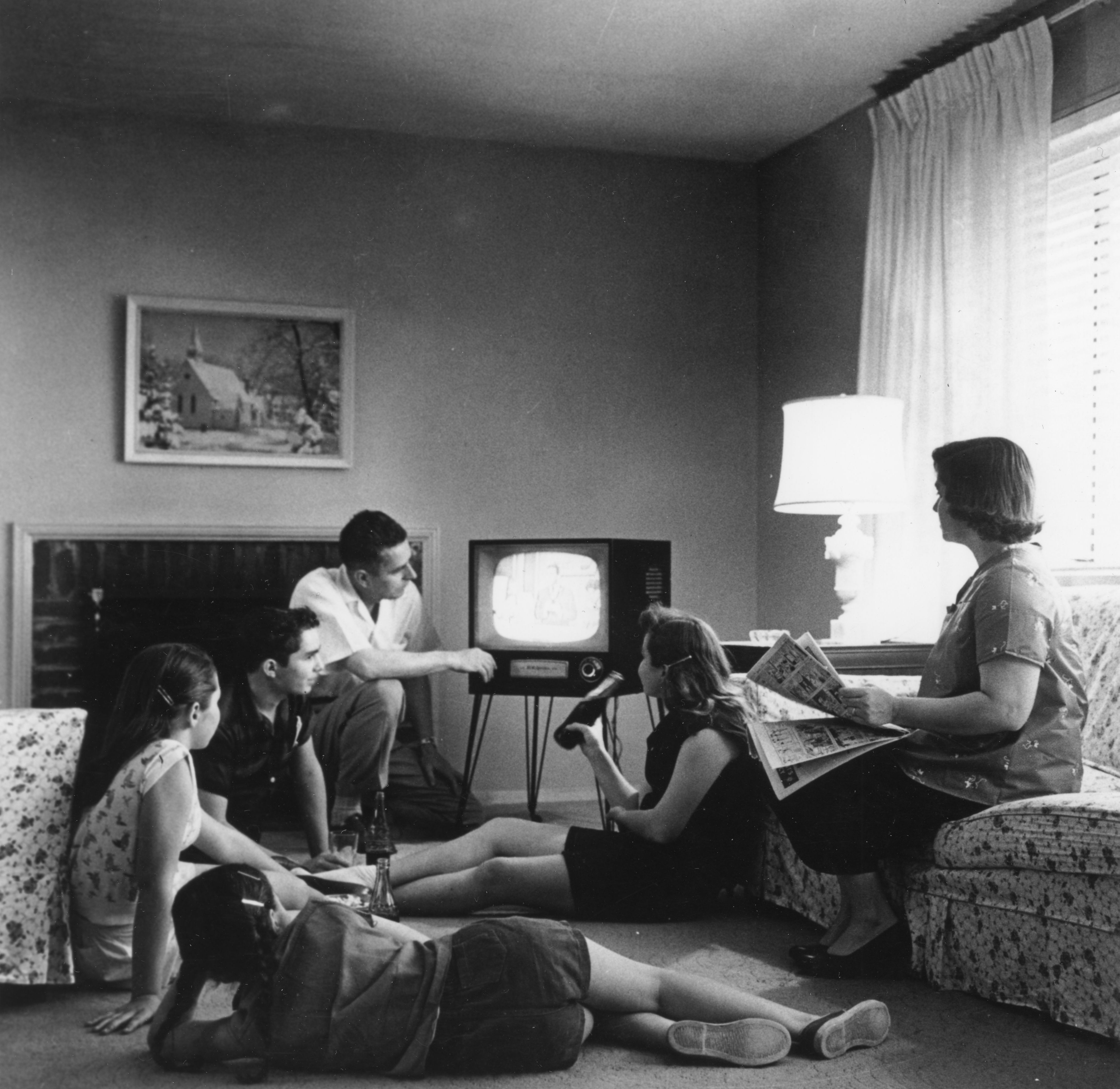
A family watching an analog television in 1958.
Today, many might not realize there was a different why to watch television. And I'm not talking about cable. I'm talking about broadcast. Currently, you need a digital tunner which every television produced after 2007 comes equipped with. But before the transition from analog broadcast to digital reception, you had to have an antenna to receive the analog signal. The roll out of digital broadcast in 2009 was touted as freeing up frequencies for public safety and was promised to get you more channels with a clearer reception. The switch did get rid of static--for some. But others, they got worse than static, they got nothing.
Before we go into the details, we first need to understand the difference between the analog television broadcast we had previously and the digital broadcasts we have now. Analog broadcasts worked by encoding picture and sound as a continuously varying radio wave — the signal itself mimicked the shape of the light and sound it was carrying. It's similar to the way a vinyl record groove physically mirrors the sound wave cut into it. A television receiving that signal simply reconstructed the picture directly from the wave's shape, line by line, 30 times a second. This had a real consequence for picture quality because the signal was continuous, it degraded gradually as it weakened. A viewer far from the transmitter, or behind a hill, would see a grainy, snowy, or "ghosted" picture rather than losing the channel outright. This was the classic staticky TV image most people of a certain age remember.
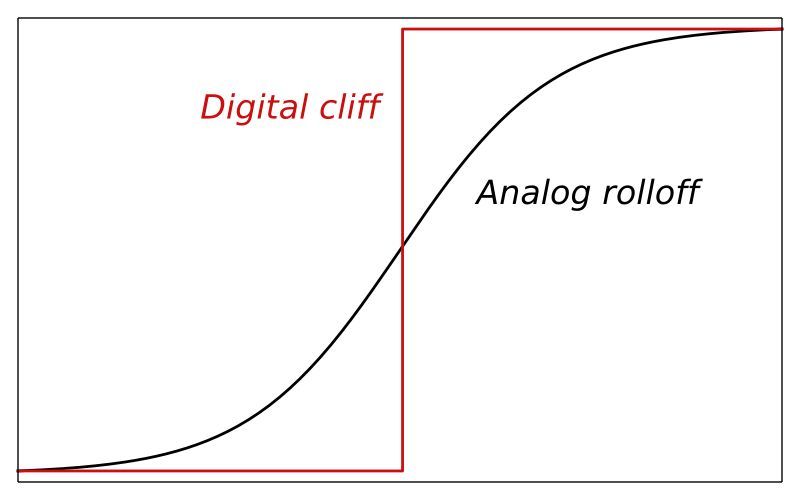
Depiction of the digital cliff effect.
Digital broadcasts work on an entirely different principle. Rather than transmitting a continuous wave that mirrors the picture, the broadcaster converts the video and audio into strings of binary data — 1s and 0s — and compresses that data. They then transmit it in packets, much like a computer file being sent over an internet network. The receiving television's tuner has to capture that signal and then actively decode it. This involves demodulating it, correcting errors, decompressing the video, and reassembling everything into a picture in perfect sync with the sound. Because the information is discrete data rather than a continuous wave, a digital signal doesn't degrade gracefully the way an analog one does. As a result, either the tuner receives enough clean data to fully reconstruct the picture, or it doesn't. This produces the so-called "digital cliff" effect where the picture is either sharp and error-free or it fails to display at all.
There's science behind it. But I never really watched broadcast television that much since the 1990s--that's when my family started subscribing to cable. So the practical reality of the switch was unknown to me. I always assumed that the transition to digital meant a transition to something better. After all, the United States Government spent millions in tax payer dollars for advertising campaigns that promised it would be better. Then, years later I was talking with my Uncle Dale. He lives in a rural area and has always relied on broadcast television--you know, the local affiliates of the big network television channels like ABC and CBS. And don't forget Big Bird on Sesame Street and the rest of the Public Broadcasting Lineup. Of course, I doubt my uncle watches Sesame Street. Regardless, he told me how ever since the transition he completely lost at least 2 local channels. And it's still the case over a decade later. They just disappeared for him. And one has their station just 10 miles or so from where he lives. It was that conversation that made me curious.
Verizon spent years warning regulators that carriers faced a looming capacity crisis without more spectrum — then, by 2015, effectively admitted it was sitting on spectrum it wasn't even using, while data showed AT&T and Verizon together controlled roughly 70% of all low-band spectrum licenses nationally.
But the most interesting thing that doesn't seem to be asked is whether the switch needed to happen at all. And I don't mean simply not offering digital broadcast. Instead, what I'm wondering is why did we need a mandatory switch when the original plan dating back to the 1996 Telecommunications Act was to have voluntary adoption. From what I could find, it seems the two biggest reasons for what Congress mandated was Verizon and AT&T. As the old saying goes when you're tracing power--follow the money. And the money flowed from both companies to lobby for the transition and then to buy the spectrum once it was auctioned. That last part is the most interesting since many pointed to the amount of money the spectrum auction brought in for the government. For instance, AT&T paid a little under $7 billion for the public airwaves it purchased following them being repurposed from analog television. But the thing that wasn't in the headlines is that what AT&T bought was considered an intangible asset that can be amoritized over 15 years. This means that 1/15 of the cost of that purchase can be deducted from their tax bill every year for fifteen years. So that money they paid up front is something the government isn't keeping. They're giving a portion back to AT&T every year. That's something to think about the next time you're trying to watch broadcast and you can't get your local news or Sesame Street.