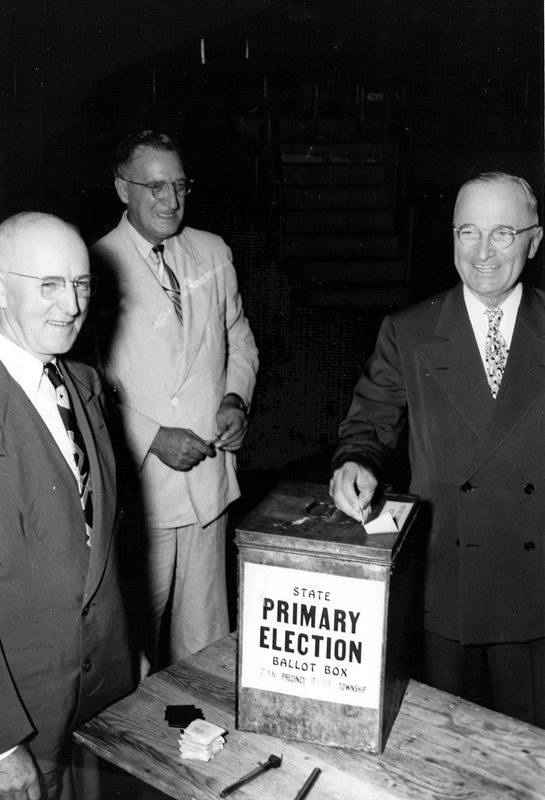
Harry Truman voting in a primary.
Every state in the United States devotes public funds in some fashion for organizing activities of two private organizations. In Mississippi, it's the counties that fund it. For others, it's at a district or city level. Sometimes the funds come from business formation fees. Other times, it's taken out of general revenue. But regardless of the entity and the particular tax or fee involved, you're paying for it. And what are these private organizations that get such public benefit you might ask? The answer--the Republican and Democratic parties.
The cost of the ballots and the printing are covered. The voter education advertisements are covered. And even the salaries for the poll workers are sometimes covered depending on the state. And it's all so the most active and elite members of two private organizations can choose who they'll have as their standard bearer in whatever particular office is at question. And when I mean elite, the numbers don't lie. Broadly speaking, the general elections in November usually see over 50% of the state's voting population turn out with it sometimes going as high as the low 60s. But when you look at the primaries (counting for both parties), you'll be lucky to see 23% of voters show up.
And what does all this expense get you? The result is that the vast majority of voters get denied choices in the general election. After all, the winner in each party's race goes forward while the other candidates don't. People often ask why the choices are so terrible on the election day people actually go to and that are truly for public office. Well, my answer is its partly due to the primary system. And a good example of that loss of choice is what happened in Maine's senate primaries in the summer of 2026.
Before states started printing ballots in the late 1800s, there usually were no other restrictions to run for Federal Office in the state other than what is stated in the Constitution. For Congress, the Constitution only requires that you're 25 years old or older, have been a citizen of the United States for 7 years, and an inhabitant of the state you seek to represent.
Although Maine has state legislative elections and other offices also on primary day, it still results in an election day that sees only a fraction of the turnout that shows up in the November elections. For this article, the 2026 Republican and Democratic primaries for the US Senate Election is an apt case study to show what primaries actually cost us. On the Republican side, incumbent Susan Collins ran as the only candidate in the Republican primary to make the ballot. She did have challengers but they didn't qualify for whatever reason to make it to the point of actually having their names as options for voters. This meant that the Republican voters only had one choice, which means they really had no choice.
Louisiana has something many call a "jungle primary." But it's not really a primary. The state holds one election in November with every candidate on the same ballot, party labels shown, open to all voters. Over 50% wins outright. Otherwise the top two, regardless of party, meet in a December runoff.
On the Democratic side, there was a much livelier race with ultimately four candidates being on the ballot. Marine veteran and oyster farmer Graham Platner won with a large majority. However, he faced various reports of sexual improprieties to include a widely publicized accusation of sexual harrassment. Although he denied the accusations, he announced his decision to withdraw from the race on July 9th. The state's Democratic party then faced a deadline of just weeks (July 27th) to choose a replacement candidate. So on one side you had an incumbent basically go through an anointing process instead of an election despite other Republican candidates wanting to be on the ballot against her (and presumably voters wanting to vote for those other candidates). And on the other side, yet another selection of only one candidate despite at least a total of three others wanting to run for the job.
That's the primary system in action--a small group of private organization insiders getting the ability to restrict the choices for the rest of the state. And it's done with your public funds.