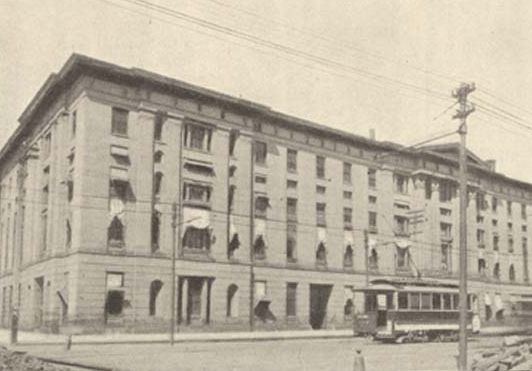
A federal building in New Orleans in 1901, which often served as a venue for United States Circuit Court proceedings.
Today's federal courts of appeals are among the most powerful institutions in American life. Sitting in thirteen circuits that blanket the nation, these courts issue rulings on constitutional rights, federal criminal law, and the reach of executive power. For the vast majority of individuals who set foot in them, a decision from one of these courts is the final word since the Supreme Court takes fewer than one hundred cases a year. Their caseloads have exploded since the 1960s, rising from roughly six thousand appeals a year to more than sixty thousand by the mid-2020s. Yet, most Americans would be surprised to learn that these courts, as they exist today, have only been around since 1948. The original federal review courts were for far more than just appeals. And in some ways, the original courts as they were first structured provided decisions that were more consistent. And more importantly, more rooted in law than the appeals courts that exist today.
The original circuit courts, established by the Judiciary Act of 1789 were unlike anything in the modern federal system. They had no judges of their own. Instead, each circuit court was constituted on a regular basis from two Supreme Court justices, who were required to travel to each district within their assigned circuit twice a year. And the local district court judge would sit with them as they handled not just appeals, but also full trials with sitting juries. In fact, appeals were the smallest portion of its workload. And it's not necessarily because of the jury trials that it conducted. It also comes down to what appeals actually were--and still are. But to understand this fully, we need to define what an appeal really means and what the other review actions are and why they're different.
Even Alexander Hamilton, one of the strongest advocates for powerful federal courts, pointed out that equity should be confined and used only in special circumstances. And even then, used only to relieve punishment instead of to inflict it. Currently, equity is often used by the courts to assert they have the power to take property and even freedom without trial. To most Americans, this would be quite unsettling since it's so different from the foundational principles of American law.
In what would surprise most Americans today, an appeal is not rooted in law. Instead, it's an action in equity. The distinction is more than academic. And often, it could mean the difference between freedom and jail. For actions at law, there was no single method of review. Instead, there were multiple options that ensured a mistake or injustice that occurred at the lower level could be corrected and done so without a judge having the discretion to say no. They were--and still are--called writs. The writ of error reviews the record for legal errors appearing on its face after final judgment. The writ of certiorari brought up a record for examination of jurisdictional defects and procedural irregularities. The writ of mandamus compelled a lower court or officer to perform a specific legal duty they were refusing to perform. The writ of prohibition stopped a court from proceeding in a matter beyond its jurisdiction. The writ of habeas corpus challenged the legality of detainment or imprisonment by examining whether the lower court had acted within its authority. The writ of coram nobis brought an error of fact before the same court that rendered judgment for matters that could not have been raised at trial. And when a trial had been so fundamentally flawed that no valid verdict could be said to have been rendered at all, the writ of venire facias de novo sent the case back to a new jury. The most important thing to note was that the remedy for a broken jury trial was another jury trial. At law, the decision belonged to juries and not judges.
The appeal, on the other hand, belonged to a different tradition. It originated in the English Court of Chancery where the chancellor reviewed a case with practically no bounds on what he could decide and how he could decide it. Despite the dressing put on equity today, its origins come from religious doctrine in the English middle ages. The early chancellors were almost always senior churchmen like bishops, cardinals, or archbishops. And they ruled on medieval Church theology instead of common law principles. The very concept of conscience that justified the chancellor's jurisdiction was built from Catholic tradition, which involved a system of confession and absolution through priests. The chancellor was literally called the Keeper of the King's Conscience, and the conscience he kept was understood in theological terms. Under the Thomistic natural law tradition, justice was not in written rules but in the moral reasoning of a learned man applying divine principle to individual circumstance. The canon law concept of the denunciatio evangelica was the ecclesiastical practice of calling a wrongdoer to account before a church authority on grounds of conscience rather than strict law. And it's this that is a foundation of equity. When a medieval petitioner came before the chancellor and asked not for his legal rights but for relief "for the love of God and in the way of Charity," he was invoking a theological rather than a legal framework. It might sound fine when one looks to equity for relief from harsh laws. But it's another thing entirely when equity is used to avoid the law even if the law would protect you otherwise.
Relieve the judges from the rigour of text law, and permit them, with pretorian discretion, to wander into it's equity, and the whole legal system becomes incertain. This has been it's fate in every country where the fixed, and the discretionary law have been committed into the same hands. --Thomas Jefferson
And it's the confinement of equity for relief instead of being used for total discretion that bounded its use to just a small portion of cases in the early US court system. But this isn't the only thing that distinguishes the early circuit courts from the "appeals" courts of today. The difference also lies in what the federal district courts actually did. And more importantly, what they didn't do. Originally, district courts were limited mostly to admiralty and maritime cases or procedural actions like registering copyrights. If you look at the journals of the district courts for the first fifty years or so of America's existence, you'll notice how thin they are. That's because the real action was in the United States Circuit Courts and they had multiple checks to make sure that the decisions they reached got it right. And I'm not just alluding to the jury of twelve fellow citizens who had the final say. You also had two judges that were presiding, which meant you had two law experts who had to agree before they took any procedural action. And if they didn't agree, it would go to the Supreme Court for their determination in the form of a certificate of division. This system was filled with friction. And that was the point since the Circuit Courts were dealing with matters of personal property, the potential taking of one's freedom, or even one's life depending on the nature of the crime. But that court didn't last. And it broke down in multiple stages before it was completely abolished and overtaken with a court that now is determined by one man with nearly total discretion. And often, that discretion and power comes with no one checking from the outside.


The first real damage to the original Circuit Court came after the Civil War. In 1867, Congress allowed district judges to hear and decide appeals that dealt with decisions he made as a district judge. As mentioned earlier, district judges had always been part of the Circuit Court system since they would sit with the Supreme Court justices as they presided over a Circuit Court case. But there was always a hard line the district judge could not cross, and that dealt with decisions relating to his actions as a district court judge. In other words, you can't make a judgment and then preside over an appeal of that judgment. But 1867 changed that and made it possible. Of course, Congress qualified it by stating this could only be done with consent of both parties in a case. But as we see now with lawyers handling most cases instead of the clients themselves, most people aren't even told what choices they have much less that they even have any. Scholars have long written about how "consent" in legal proceedings is often so inherently coerced that to call it a "choice" is simply untrue. And with that change, the Circuit Courts turned from a system of multiple checks and balances to mostly one man going back to check his own work. And naturally, that man more often than not found he was right and affirmed his earlier decision. Furthermore, the extending of the power of sole judgment for appeals created a natural incentive for judges to find more reasons to claim cases dealt with equity instead of law. Although the official end of the Circuit Court didn't happen until the early 1900s, it's at this moment in 1867 where its protections for individual citizens truly ended. After that, it was just a question of how much worse it would get.
In 1891, Congress created a new court, the United States Circuit Court of Appeals. This new court had dedicated judges and focused fully on appeals, which as we pointed out earlier involve reviews in equity. In 1911, Congress abolished the original United States Circuit Courts and gave district courts authority over jury trials. Through a change in federal court rules in 1938, equity and law were merged. And then in 1948, the United States Circuit Courts of Appeals was renamed simply the United States Courts of Appeals. Technically, America still has at law forms of review that take discretion out of the hands of judges and gives individuals the ironclad protection of law. But by looking at the name of America's new "middle courts," you wouldn't know it. And in most situations, the only thing people know how to do is to appeal.