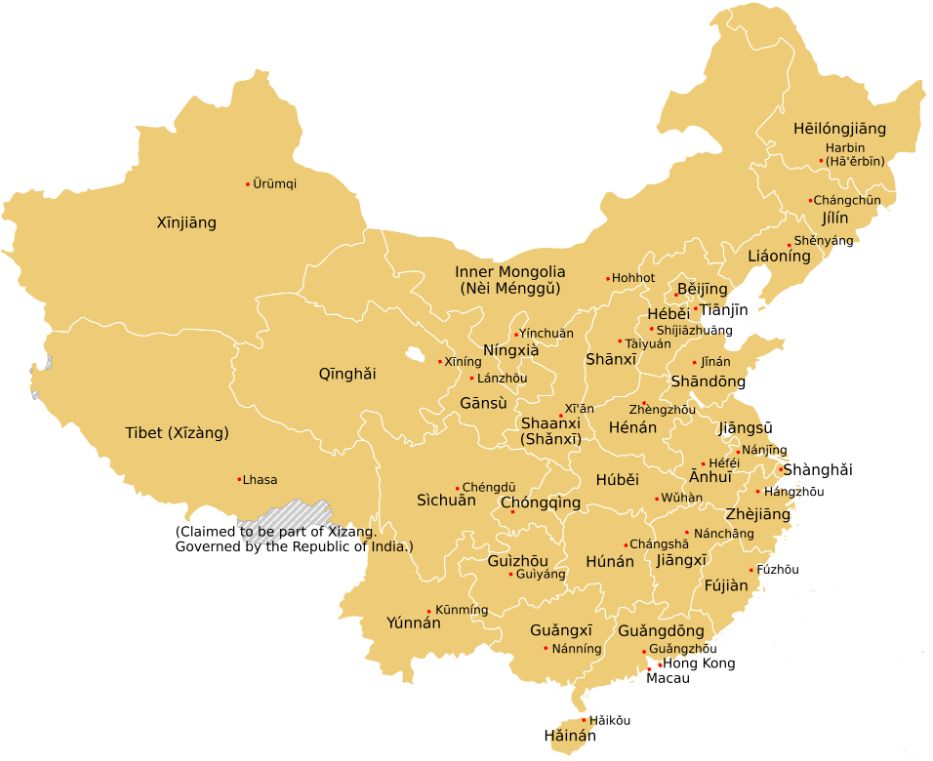
A map of China.
Antibiotics are among the most important discoveries in the history of medicine. Before their arrival, a simple scratch could kill you. Bacterial infections that are treated with a three-day course of pills today once wiped out entire armies and devastated whole populations. The story begins in 1928, when Scottish bacteriologist Alexander Fleming noticed that a mold called Penicillium notatum was dissolving the bacteria around it in his laboratory dish. That accidental observation eventually became penicillin, the drug that would save millions of lives during World War II and usher in the modern era of medicine. From that initial discovery, many more followed through the 1940s and 1950s. This line of advancement involved medications like streptomycin, tetracycline, erythromycin, and amoxicillin. These treat everything from strep throat and ear infections to tuberculosis and pneumonia. Antibiotics don't just save individual lives, they make modern surgery, chemotherapy, and organ transplants possible. Without them, the bacterial infections those procedures would produce would be deadly. They are, in one of the most fundamental ways, the foundation of modern medicine.
And for most of the twentieth century, America made them. By the 1940s, the United States was producing penicillin at industrial scale with much of it coming from a Pfizer facility in Brooklyn, New York. And the country didn't just supply itself, it supplied the world. At its peak, the Bristol-Myers Squibb plant in East Syracuse, New York, alone produced up to 70% of the world's penicillin. In 1988, the United States had at least 29 penicillin and antibiotic manufacturing facilities operating across the country. American companies like Eli Lilly, Pfizer, Squibb, and Bristol-Myers were global leaders. And they were not just selling finished pills, but also producing the active pharmaceutical ingredients, which were the chemical compounds that made the antibiotics work. The US was an exporter of these critical medicines.
The term "antibiotic" was invented by Selman Waksman, the Rutgers University scientist who would go on to discover streptomycin. He coined "antibiotic" from the Greek meaning "against life," referring to naturally occurring substances that kill other microorganisms. Waksman won the Nobel Prize in 1952.
Then China arrived. In the 1980s and 1990s, Beijing began pouring state subsidies into pharmaceutical and chemical manufacturing. And the goal was clear, they aimed to become the leader in the global production of antibiotic ingredients. Chinese state-backed companies invested heavily in penicillin fermentation technology and then priced their work no Western producer could match. Since 1992, import prices for antibiotics have fallen by more than 80%. American factories, forced to compete against a foreign government rather than a private competitor, closed one by one. The most iconic American manufacturing facility fell on August 6, 2004, when Bristol-Myers Squibb announced it was shutting down all antibiotic production at the East Syracuse plant. They took a $100 million write-off by doing so. When Bristol-Myers Squibb shut the doors on America's last penicillin plant, the US tax code handed them back $38 million for doing so, which made it more lucrative to abandon the factory than to save it. Today there are only seven manufacturing sites in the entire world capable of producing 6-Aminopenicillanic Acid, the vital precursor to semisynthetic penicillin. Five of them are in China.
What this arrangement creates, in peacetime, are significant risks. Supply chain vulnerability is the biggest concern. A single Indian firm, Aurobindo, supplies roughly a third of all finished-dose antibiotic imports to the United States. Four Chinese suppliers account for 54% of all the ingredients that India needs to make those drugs. A fire at one facility or perhaps a flood could cascade into a global shortage. In 2008, contaminated heparin manufactured in China killed dozens of American patients and triggered a massive FDA recall. Drug shortages of common antibiotics have become a recurring theme of American healthcare. But the risks compound during a time of war. A 2023 Pentagon study found that 27% of military drug purchases depend on China. The Department of Defense (DoD) has explicitly warned that this creates a strategic chokepoint. After all, if an adversary nation controls inputs to the medicine that keeps American soldiers alive then it puts our security at risk. Incidents like this have already happened. During World War II, Japan's control of Southeast Asian rubber supplies hampered Allied military operations until synthetic alternatives could be developed. America cannot afford a medical equivalent of the rubber crisis.
After the 2001 anthrax letter attacks, the US government spent hundreds of millions of dollars stockpiling doxycycline and ciprofloxacin, which were the recommended treatments for anthrax exposure. The chemical starting materials for both drugs come predominantly from China. So the emergency stockpile built to protect Americans from bioterrorism was dependent on supplies from a strategic competitor.
Those who dismiss this concern as alarmist are not reckoning with how carefully China has thought about influence and power. In 1999, two colonels in the People's Liberation Army published a strategic doctrine called Unrestricted Warfare. Its central argument was that future conflict between great powers would not be limited to military force. Instead, it would be waged across every domain simultaneously, to include economic, financial, cyber, psychological, and logistical. The ideal scenario would be to defeat an enemy without firing a single shot. The height of skill, echoing Sun Tzu, is to win before the battle begins. Beijing designated pharmaceuticals a "high-value-added industry" in 2008 and began systematically subsidizing Chinese manufacturers to undercut and eliminate Western competitors. When India attempted to build domestic antibiotic ingredient production to reduce its own dependence on China, Chinese producers flooded the market with below-cost exports specifically to destroy those budding competitors. China has already demonstrated willingness to use this leverage. China imposed export controls on pharmaceutical-adjacent chemicals on Japan after Japan's prime minister made public remarks about the Taiwan Strait. And during the COVID-19 crisis, China's state media outlet Xinhua openly warned that Beijing could "announce strategic control over medical products and ban exports to the United States." And then predicted that America would then "fall into the hell of a new coronavirus pneumonia epidemic" should they do that.

There are some that say the import problem is not as bad as it seems. The American Action Forum, for instance, argues that China supplies only 9% of total antibiotic imports to the US. The Atlantic Council has noted that over the past decade, China has averaged about 17% of US active pharmaceutical ingredient imports. These figures are misleading. And those that do such parsing appear to go out of their way to avoid stating what is plainly the case. The 9% figure counts only the final leg of the supply chain, which are finished pills arriving directly from China. It ignores the enormous amount of ingredients from China that flow through India and Europe before arriving in the US. It's almost like money laundering except with life saving medications instead. A Johns Hopkins study found that China directly supplies more than 60% of the active pharmaceutical ingredients (API) used to make antibiotics in the United States. India, officially the top supplier of finished antibiotics, relies on China for roughly 70% of its own API imports.
The debate about what to do tends to tiptoe around the powerful interests that benefit from this current arrangement. The pharmaceutical industry make massive profits from cheap Chinese inputs. Some say stockpiling helps. Others point to diversifying to other low-cost countries like India. But both of these supposed solutions simply modulate the dependency instead of removing it. The only real answer is the obvious one. We need to reopen American manufacturing and restrict the imports that made domestic production close in the first place. California pointed toward this model in 2022 when it contracted directly with a generic drug manufacturer to produce its own low-cost versions of critical medications. That experiment was small, but the logic was sound. The US built the world's antibiotic supply from scratch in the 1940s because the government decided it was a national priority and acted accordingly. Getting it back will be expensive, slow, and politically difficult. But the alternative, as any strategist following the doctrine of Unrestricted Warfare could tell you, would be putting America at risk of losing a war before even the first shot is fired.