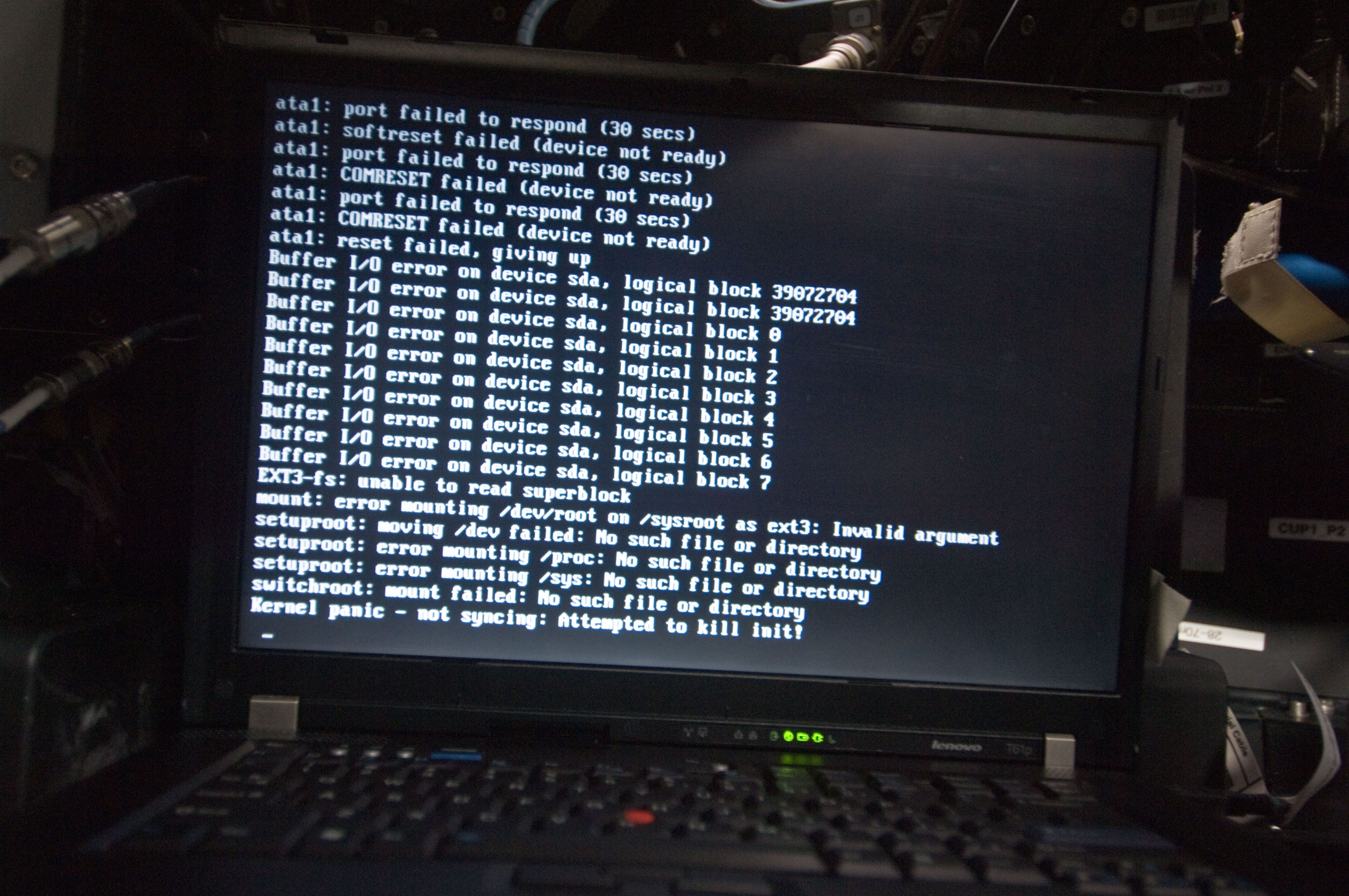
A computer with an error message.
In August 2026, a story hit the online news website. It was about a Public Broadcasting System (PBS) station in St. Louis, Missouri, KETC Channel 9, filing for a temporary restraining order and damages against a digital storage company. The PBS station accused the company of withholding the station's archival material and television programs dating back to the station's founding in 1954. The station used the company, Open Source Storage, to house over 50 terabytes of audio and video footage. But suddenly, the station lost access to their data when the cloud storage vendor went out of business. And it wasn't just data. But rather parts of history such as archival footage of East St. Louis, coverage of the COVID-19 pandemic, and footage of the Great Flood of 1993. Quite simply, the television station described it as "unique and irreplaceable." And the scary thing is, most of American businesses and institutions rely on others for hosting their data. Even the federal government has more and more of what is sensitive data stored purely on private, proprietary systems. And often with no physical backups.
The oldest known photograph still in existence was taken in 1826. It's a blurry image of rooftops in France taken by Joseph Nicéphore Niépce on a pewter plate. It's still viewable 200 years later. And no cloud subscription is required to see it.
To understand how we got here, we have to go back to the 1990s when the internet evolved into a mature industry and became near equals with the private computer business. Once the capabilities to move massive amounts of data from one system to another reached an affordable price points, businesses and governments alike began moving their records into digital spaces. Around the turn of the century, server capabilities advanced to the point where it seemed sensible to store files in digital folders instead of gigantic metal cabinets. Information age companies were making attractive pitches that focused on costs. If you go paperless, you save money by saving space. You can get rid of warehouses and store the same amount of information on systems within a single room. The concept of the paperless office wasn't new. In the early 1970s, Xerox's Palo Alto Research Center envisioned terminals replacing typewriters and paper files with shared screens and storage. Articles in magazines like Businessweek were forecasting most offices would be managing all of their records electronically by 1990. The federal government became an early and aggressive convert. The National Archives and Records Administration had been involved with electronic records since 1965, and the first transfer of electronic records from U.S. Federal agencies came in 1969. By the early 2000s, the push took a different turn however. Throughout the preceding decades, the transfer always involved duplication. Institutions took physical documents and turned them into digital scans that were stored on computers. The physical originals and the digitals both existed. But at some point around the late 1990s, the move started to be about replacement instead of redundancy. From the big data firms, you heard nothing but talk about saving space and the increase efficiency and cost saving it provided. But you didn't hear very much about what that savings cost in terms of risks.
GeoCities was once the third most visited website on the internet. It ranked behind only AOL and Yahoo itself and peaked at 19 million unique visitors in December 1998. All of it was gone within barely a decade.
What was never reckoned with was what happens when the digital systems fail. The PBS case is not an isolated incident. In 2019, the world discovered that MySpace lost millions of songs from artists during a server migration. Another example is what happened to millions of webpages created on platform most average people used in the early years of the interent. GeoCities was a free website hosting platform launched in 1994 that let everyday people build and publish their own personal web pages. After a leadership change at Yahoo, the company closed GeoCities completely and destroyed tens of millions of pages going back to the early commercial internet. GeoCities contained primary sources, personal accounts of world events written in real time, and documentation of subcultures that had never been recorded anywhere else. Another warning for relying solely on digital storage comes from local government. In March 2018, hackers deployed ransomware against the City of Atlanta, bringing the city's entire IT infrastructure to a halt. The city had fully transitioned to digital storage with little offline backups. The result of the cyberattack was the loss of years of police dashcam footage along with court records, and legal filings. Without physical backups, once the digital files were gone that information was gone forever.
So what exactly is physical media? The best way to explain it is to look at specific examples. When light hits the film inside a camera, it chemically changes tiny particles on the film's surface. Those changed particles become the image. This is kind of like how sunlight can bleach or darken certain materials just by touching them. The developer fluid then makes that invisible change visible and locks it in permanently. The light that entered the lens was captured by atoms. And the record of that capture persists as long as the physical medium survives. A vinyl record is another physical reaction. The grooves pressed into the disc that allow the record to replay music are direct physical impressions of the sound waves that created them. Run a needle through those grooves and you reproduce the original vibrations. For VHS and cassette tapes, the physical changes are done through magnetism. Magnetic tape, whether reel-to-reel or VHS, works by a process in which the magnetic particles on the tape are physically rearranged by the magnetic field generated by the original audio or video signal. The tape itself is physically altered by the source that created it. A VHS tape of a 1987 local news broadcast is, at the molecular level, a record made partly of the original broadcast signal itself. When that tape is destroyed and no digital copy exists, that signal is gone.
A vinyl record pressed in the 1950s will still play today on any turntable. There's no software update required. The grooves pressed into a disc by Ella Fitzgerald's voice in 1956 is still physically there, unchanged and simply waiting for a needle to be made into music again.
When you digitize all of that and surrender it to the cloud, you're increasing your risk at two levels. First, you're putting your data in a system where the only way it can be accessed is through remote access. If you can only access your information through someone else's system remotely, then it's also possible for others to do it too. Second, you've also put your trust in somebody else. That other entity might have every intention of fulfilling their obligations. But if there is a cyberattack or a business failure, then whatever happens with that entity's assets are often even out of their control. And far too often, this results in you losing access to what is your data. By the mid 2020s, the barrier to entry for conducting cyberattacks has become considerably easier. AI platforms are increasingly utilized to break encryption and design new methods of accessing and destroying digitized information. Of course, there are risks with physical data too. Floods and fires can destroy paper records, for instance. We've gone too far into digital for me or anyone else to say that digitization isn't a way to operate. But if we are serious about safeguarding our information and knowledge for the future, it can't be the only way.