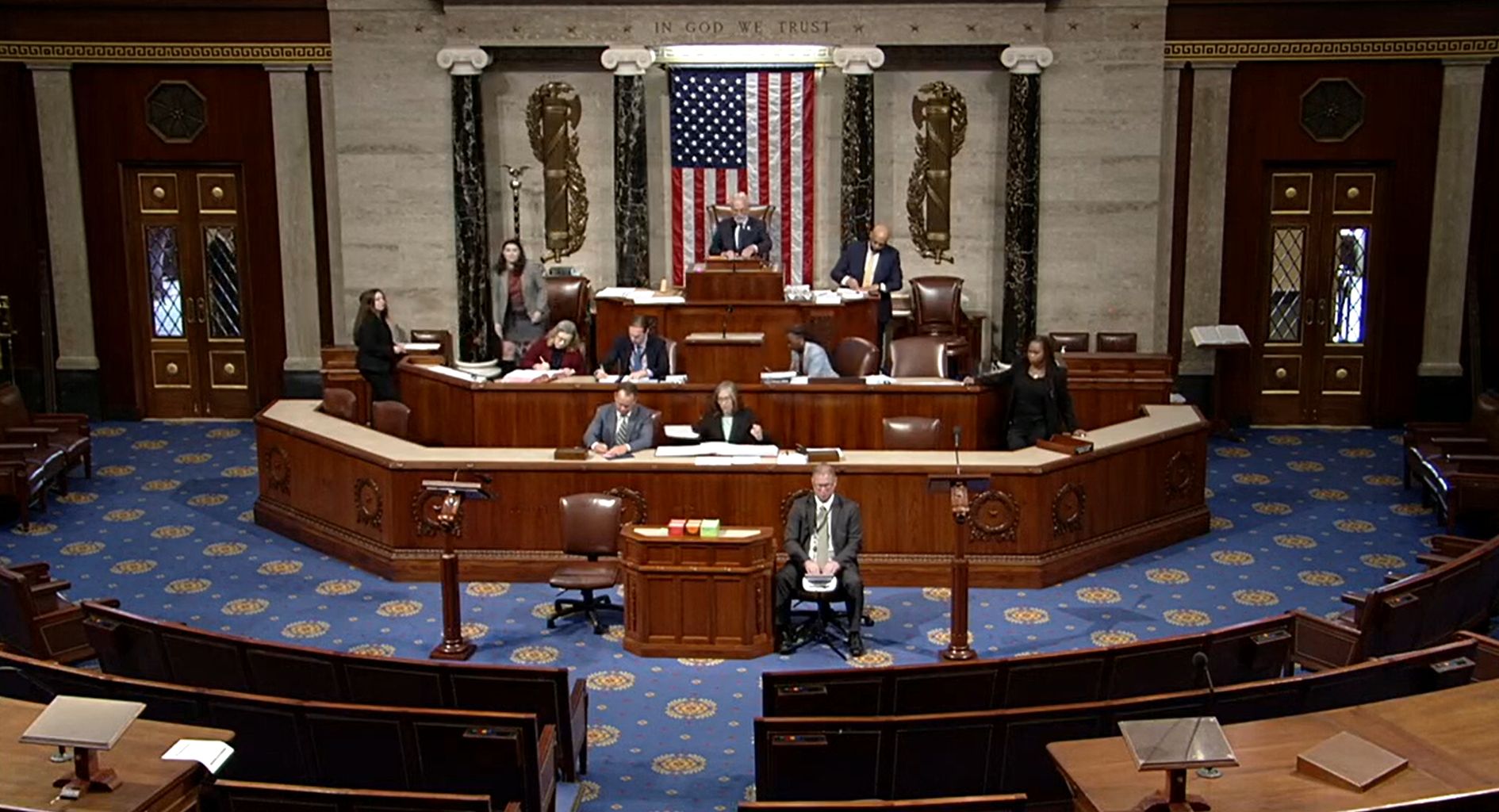
A mostly empty United States House of Representatives chamber when that chamber's version of the bill to end the penny was "passed."
It happened on a Friday night in August 2026, and most Americans had no idea. The U.S. Senate passed the Common Cents Act, legislation that would officially end the production of the penny. And it did so without a single senator casting a recorded vote. No roll call. No debate. No quorum of members gathered to deliberate the merits of the bill. The Senate passed the bill with an amendment by unanimous consent on August 7, 2026 at 10:55pm. When you look at the video of the session, the Senate chamber was mostly empty. The House of Representatives acted on the bill earlier. On July 14, 2026, that chamber voted on the bill by a suspension of the rules that allowed voice vote by those present. This maneuver happened earlier in the day than late evening but it, like the Senate that acted later, was mostly empty. The one-cent coin, commonly known as the penny was America's first official coin. It ensures that people making transactions are able to value and pay the exact cost of something instead of having to round to a number that isn't true. By August 2026, both chambers pushed legislation impacting every cash transaction in America without a single member going on the record with a yes or no. And without most Congressmembers even being in the room when it happened.
The mechanism that made this possible is called unanimous consent. Although it sounds like something requiring everyone's enthusiastic agreement, it has become a way for a small group in Congress to pick and choose who is voting. After all, it's a bit of a challenge to vote against something if you're not there to do it. But it didn't start out this way. In fact, it was meant to only be used with one vote. The first formal unanimous consent agreement in the Senate is traced to April 1846, when Senator William Allen of Ohio argued that a vote on the Oregon question was inevitable and to go ahead and end debate and simply agree on the exact day the Senate would proceed to vote. Kentucky's James Morehead accepted, "provided it was not to be regarded as establishing a precedent." But obviously it did set a precedent since I wouldn't be writing this article otherwise. But what it started out to be and actually was for most of its existence was constrained. It was used to waive Senate rules and expedite floor action on measures to constrain debate or amendments. But it was never meant to be used for the actual passage of bills themselves. A type of consent agreement had been used in the U.S. House and Senate since their first meetings in 1789, but these were for routine things like bypassing quorum calls and managing minor procedural questions.
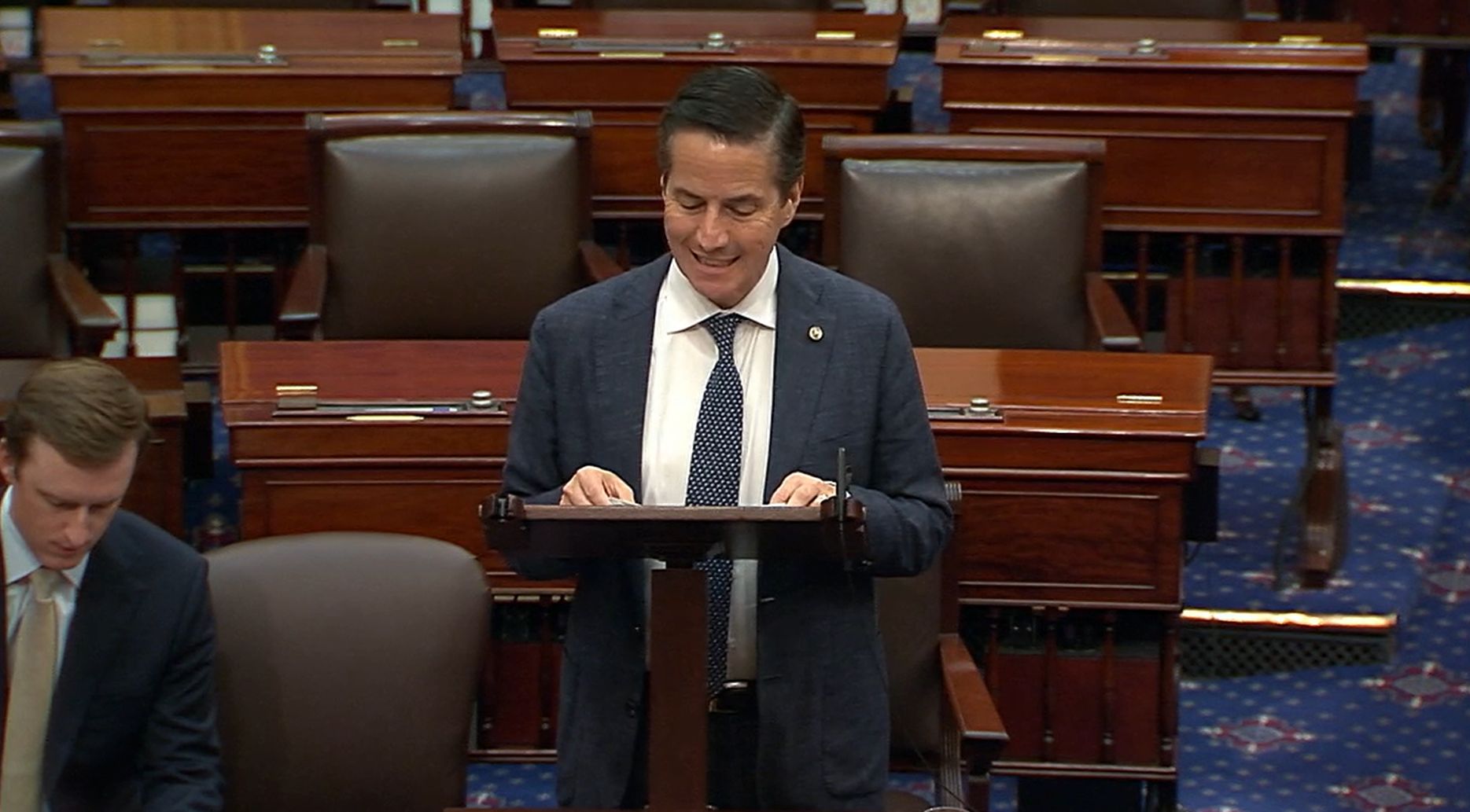
A picture of a mostly empty United States Senate on August 7, 2026 at 10:55pm, when the bill to end the penny and give the Treasury Secretary the power to end the other US coins too was passed.
The 20th century saw a move of unanimous consent as more of a measure of control than bypassing formalities on genuinely universally accepted small, procedural matters. In January 1914, the Senate adopted a new rule stating that unanimous consent agreements "shall operate as the order of the Senate" and can only be altered by another unanimous consent agreement. That created a way to lock in issues by manipulating when unanimous consent votes were had. For instance, you might have a particular policy you want permanently attached to a bill but know there are those who are fiercely opposed to it. You can wait to introduce unanimous consent when you know only the supporters are in the chamber. And if successful, then even when the opponents are back in their desks they would need their own unanimous consent to remove it. That's hard to do--especially if those that got it added ensure at least one of their cohort is around to object. By the 1950s, Lyndon Johnson became Senate Majority Leader and he began pushing its use further. Johnson, widely seen today as "master of the Senate" thanks largely to author Robert Caro's multi-volume biography on him, revamped unanimous consent agreements to control basically the entire legislative process. What Johnson built, his successors inherited and built on. Today, a bill is "hotlined" at the discretion of the Majority Leader in consultation with the Minority Leader. The leader's office contacts each Senate office with a message on a special alert line providing information on what bill the leader is seeking to pass through unanimous consent. In practice, instead of requiring explicit unanimous consent, the hotline process only requires a lack of dissent. The result is a system in which silence is treated as consent, and where the absence of an objection is considered equivalent to a vote.
But this isn't a vote--no matter how much House and Senate leaders say it is. Unanimous consent represents the absence of objection. In contrast, a unanimous vote occurs when a formal tally is taken and every senator present casts an active "yea." Consent, for the bulk of its history, is primarily used as a tool for procedural matters. A vote, on the other hand, is a formal recording of individual positions on the record. The distinction matters since a vote where a citizen can see how their representative or senator voted on the issues informs their own vote for whether or not they want to keep them around. A senator who is traveling, sick, or simply not paying attention that evening does not vote "yes." Surprisingly, it's sometimes left to staff to decide to object or not. Senator Tom Coburn of Oklahoma became one of the most vocal opponents of the hotline system. He pointed out the absurdity of using the absence of objections from unelected staff to claim legislation had passed. In other words, when these hotline votes happen the members that aren't in the building are denied their say. And by extension, the people they represent are denied their representation.
When the Senate passed its version of the Common Cents Act on August 7, 2026 at nearly 11pm; it did so with an amendment that gives the Treasury Secretary a power he didn't have previously--the power to discontinue all the current coins. It technically still can be stopped since the House would need to vote on it. Or, I guess they could end up just doing another unanimous consent instead.
And increasingly, the bills that are passed this way are controversial and widely unpopular. The warrantless surveillance authority known as FISA Section 702 has been repeatedly extended through similar procedural shortcuts. The Senate passed a 45-day reauthorization of Section 702 of the Foreign Intelligence Surveillance Act by unanimous consent. The Gang Abatement and Prevention Act, which allows juveniles to receive life sentences without the possibility of parole, passed the Senate by unanimous consent. And just on the night the Common Cents Act cleared the Senate, multiple other bills were also dispatched by unanimous consent in the same session. This included a bill raising the amount of money needing to be involved in a case for a federal court to hear it.
The Founders designed Congress to be a slow, deliberate, friction-filled institution precisely because they feared the consequences of hasty lawmaking. When the Senate passes legislation affecting American currency, surveillance authority, and criminal sentencing; the logical expectation by Americans is that their representatives and senators will go on the record and cast a vote on their behalf. In reality, unanimous consent by an empty chamber is "passing" many of America's laws instead.