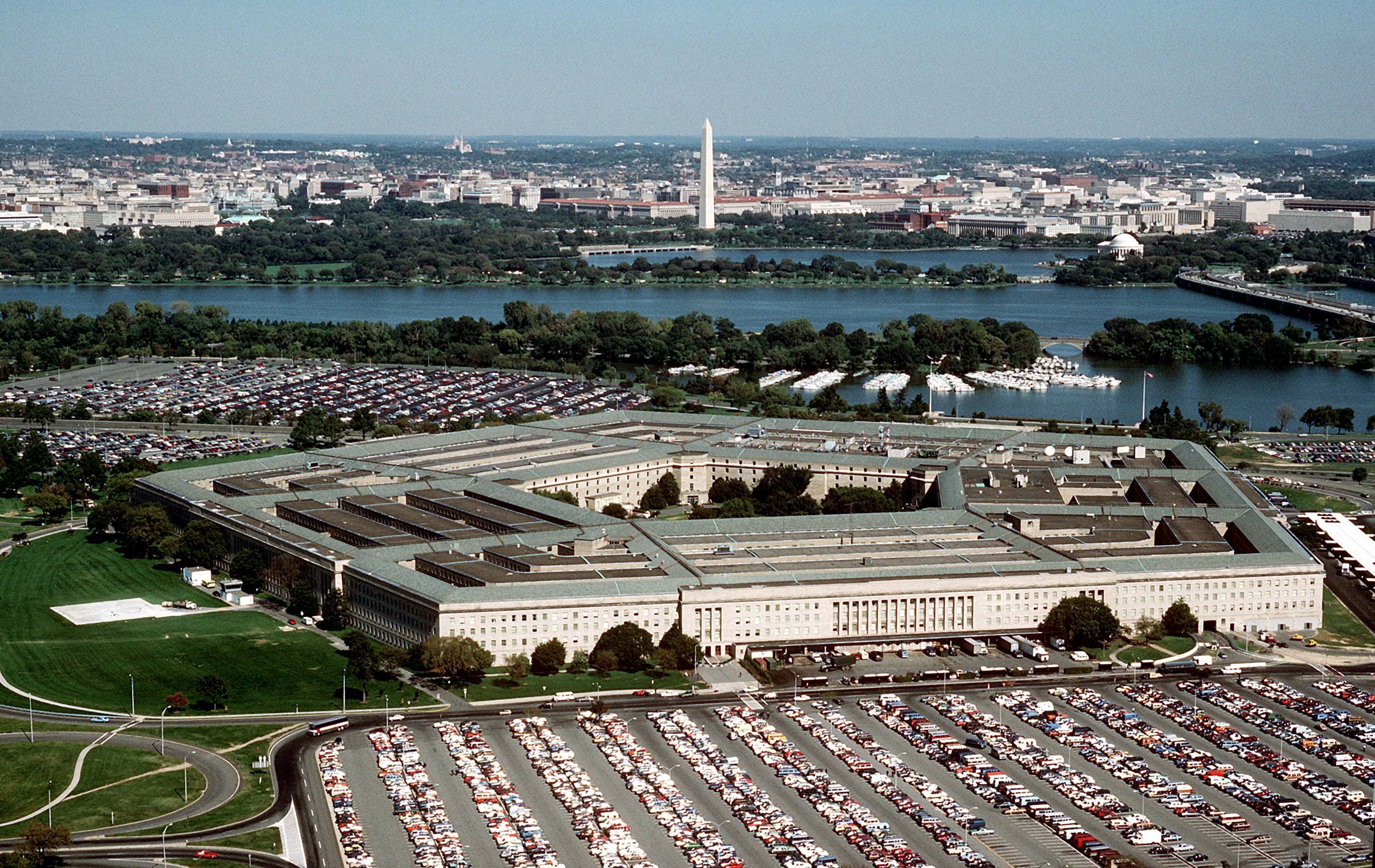
The headquarters of the Department of Defense, the Pentagon.
Every working day, the United States government creates approximately 400,000 new secrets. That figure comes from the Moynihan Commission on Government Secrecy, which was authorized by Congress and issued its final report in 1997. In all likelihood, the number is much higher now. The government had, by 1994, accumulated over 1.5 billion pages of classified material that was at least 25 years old. It was so voluminous that no one had reviewed most of it to determine whether it still needed protecting. The system is so vast and so compartmentalized that analysts with the highest clearances regularly discover that critical information held by a neighboring agency was never shared with them. Intelligence failures don't always happen because secrets fell into the wrong hands. Sometimes they happen because the right hands never got them. And because classification has never been defined by statute, there is no reliable measure of what is actually secret or why. The determination has always been whatever the person with the stamp decides to as classified. This produces a paradox. The United States has a government so consumed by secrecy that senior officials, up to and including nearly every president since Harry Truman, have operated in genuine ignorance of significant programs conducted in their name. Compartmentalization designed to protect secrets from enemies has also, far too often, protected those secrets from oversight, accountability, and even the elected officials responsible for them. And if the Department of Defense has its way, it will get considerably worse. But to understand where America may be headed, we first need to understand how we got here.
The law passed in 1917 to stop German saboteurs has been used almost exclusively against American citizens to include whistleblowers, journalists' sources, and political activists. Foreign spies caught on American soil are typically charged under separate statutes. The law designed to protect secrets from enemies became seemingly a tool for silencing domestic critics instead.
The story of American government secrecy is shorter and stranger than most people assume. George Washington did write "Secret" on communiqués in the field, but this was informal field practice. For the most part, there was no system like we have today. Throughout most of the nineteenth century, secrecy in government was handled ad hoc, by tradition and discretion rather than by law or executive order. The real architecture of modern secrecy was built in eleven weeks in the spring of 1917. On April 2, President Woodrow Wilson asked Congress for a declaration of war against Germany. That same evening, espionage legislation was introduced in both chambers. Wilson wanted sweeping authority, to include press censorship and the power to define what information was "related to the national defense." Congress pushed back and stripped the press censorship provisions as well as removing the sections that would have defined the classification process itself. The Espionage Act that passed on June 15, 1917 made it illegal to share information "related to national defense." But it did so without defining what that meant or establishing who was authorized to know it. The penalties were thus unconnected to any formal classification process. The Army did develop a rough system during World War I that included "For Official Use Only," "Confidential," and "Secret," but it was internal to the military and had no government-wide application. The actual classification system as Americans now understand it traces to March 1940, when Franklin Roosevelt issued Executive Order 8381 establishing authority for civilian personnel to classify military information. In September 1951, Harry Truman issued the first executive order extending a classification system across both military and civilian agencies simultaneously. The bulk of classifications stemmed from the subsequent Cold War and all that accompanied it: the nuclear arms race, the intelligence explosion, and the ideological struggle with the Soviet Union. All of those things generated a massive volume of sensitive information and the bureaucratic infrastructure to protect it. Critically, this entire structure rested on executive orders, not statute. Congress never defined what could be classified, what couldn't, or on what authority. It still hasn't. Secrets remain, in the Moynihan Commission's formulation, "whatever anyone with a stamp decides to stamp secret."
The government classifies the number of pages it declassifies. The Information Security Oversight Office, which is the body that tracks classification activity, has reported that some agencies treat their own declassification statistics as sensitive information. The system designed to manage secrets generates secrets about how many secrets it manages.
The consequences of that unchecked authority accumulated steadily for decades and then erupted. The Pentagon Papers revealed in 1971 that four administrations had systematically lied to Congress and the public about Vietnam. Watergate demonstrated that classification and executive privilege could shield criminal conduct at the highest levels. The Church Committee hearings in 1975 exposed COINTELPRO, the FBI's covert program to infiltrate, discredit, and destroy civil rights organizations. The hearings also went into CIA assassination plots and domestic surveillance programs that had operated for years without oversight. Congress responded with a series of institutional effort to prevent these things from happening again. The Freedom of Information Act was passed in 1966, and then amended in 1974 to give it more strength. The Privacy Act of 1974 established protections for personal government records. The Government in the Sunshine Act of 1976 forced agency meetings into the open. For a brief period, sunlight was official policy. For those wanting to understand the full scope of FOIA's rise and fall, refer to my article, "What Happened to the Freedom of Information Act?" But for this article, the focus is on classified information itself and how the problem is at risk at getting much worse.
And it turns out, many of the things classified as national security matters really aren't that. Too often, classification is used to hide errors or even outright lawbreaking. A 1953 case called United States v. Reynolds shows this clearly. It revolved around a plane crash. Three civilian contractors died when a B-29 bomber crashed in Waycross, Georgia in 1948. Their widows sued the government. The Air Force refused to release the accident report, claiming it contained military secrets whose disclosure would endanger national security. The Supreme Court upheld the claim, creating the formal state secrets privilege. When the documents were finally declassified in 2000, there were no military secrets in them. There was, however, evidence of Air Force negligence. Reynolds has been invoked to give the executive branch the legal authority to withhold evidence from courts routinely, resulting in many who have their cases dismissed. The Moynihan Commission's conclusion in 1997 examined this and other issues related to the secrecy problem. After exhaustive study, it found that the classification system "inevitably degrades" without a statutory framework. And that secrecy without legal definition becomes an instrument of institutional self-protection rather than genuine national security. The Commission recommended a statute. But Congress never acted on it. Its report gathered dust while the system it diagnosed continued to expand. After two separate eras in which Congress, bipartisan commissions, and virtually every serious observer concluded the government was classifying too much, the Pentagon now proposes changes that will make it considerably worse.

In late June 2026, the Department of Defense quietly submitted a legislative proposal buried in a budget package, asking Congress to create a new Freedom of Information Act (FOIA) exemption. It would allow the secretary of defense to exempt "Controlled Unclassified Information" (CUI) from disclosure under FOIA whenever he determines that harm from disclosure outweighs the public interest. CUI is not a classification level. It is an administrative handling marker for unclassified information, established by President Obama's Executive Order 13556 in 2010 to replace over 100 inconsistent agency-specific markings like "For Official Use Only." The National Archives has repeatedly stated that CUI designation has no bearing on FOIA. In other words, being marked CUI does not mean a document can be withheld. But that stance is what the Pentagon's proposal would change. Virtually every computer system on the Department of Defense's unclassified network now carries a CUI banner. The Pentagon inspector general confirmed in early 2026 that the prevailing culture at the department is simply "when in doubt, mark it CUI." This is a practice so widespread that virtually all of the DOD's 2.8 million documents could potentially fall under the proposed exemption. The proposal would also give the secretary of defense unilateral authority to designate additional information as CUI beyond the existing registry. And then exempt whatever he has designated. Worse, the proposal would preempt state open-records laws, explicitly banning state and local governments from releasing shared CUI documents even if their own law permits it.
But the argument goes beyond merely open government. Experienced national security professionals have argued for decades that overclassification is itself a security failure--and a risk. When everything is treated as secret, real secrets get lost in the noise. The Reynolds case demonstrated where this leads. When secrecy becomes reflexive rather than principled, it protects embarrassment and negligence rather than genuinely sensitive information. And increasingly courts simply refuse to even try to distinguish one from the other. Far too often, they just dismiss a case and call it a matter of national security. A secretary of defense who can designate anything CUI and then exempt it from the only transparency law that reaches unclassified records would have more unilateral secrecy authority than any executive official in American history. If everything is secret, then nothing is. And no one, inside or outside the government, can tell the difference.