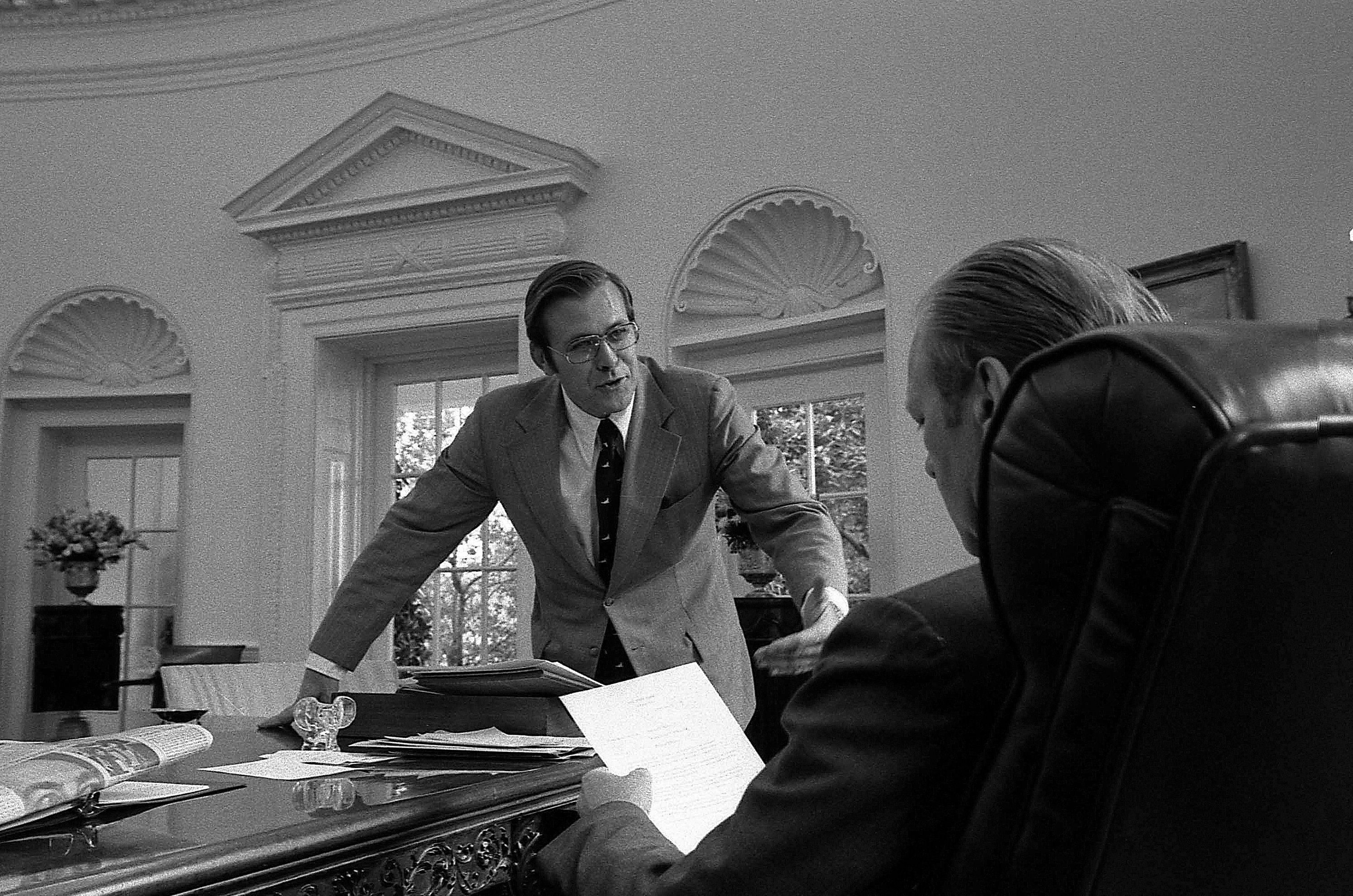
Chief of Staff Donald Rumsfeld with President Gerald Ford in 1974.
The Freedom of Information Act, signed into law on July 4, 1966, established what its architects called a "clear right" for the public and press to inspect federal executive records. The premise was simple, and to some, also radical: in a democracy, the governed have a right to know what their government is doing. For a brief period, it worked. Journalists and researchers used the Freedom of Information Act (FOIA) to drag into the open some of the most significant abuses of power in American history. Central Intelligence Agency (CIA) director Richard Helms ordered the files of what truly can be described as "mind control" experiments conducted on unknowing citizens with sometimes deadly effects--known as MKULTRA--destroyed in 1973. If not for a FOIA demand that was actually honored, the program most likely would have been buried forever. Over 20,000 documents accidentally stored in a financial records building survived and only made public by journalist John Marks' FOIA submission. In those documents, it became known that the CIA had been conducting drug experiments on unwitting American and Canadian citizens for decades, and doing it to people in hospitals, prisons, mental institutions, and even American military personnel without their knowledge. Subjects died.
FOIA also exposed something with a seemingly benign name of Counter Intelligence Program (COINTELPRO), in which the FBI covertly and illegally surveilled, infiltrated, and destroyed various entities ranging from civil rights organizations to antiwar groups and even simple college associations. One of the targeted groups included Martin Luther King Jr.'s Southern Christian Leadership Conference (SCLC). The FBI used wiretaps, forged letters, and manufactured blackmail material to go after the targeted groups and their members. The Gulf of Tonkin documents, obtained through years of declassification requests, revealed that the second North Vietnamese attack that triggered America's full military escalation into Vietnam very likely never happened. Decades later, the American Civil Liberties Union (ACLU) filed a FOIA request in 2003 and spent years in litigation to obtain more than 100,000 pages showing that torture policies at CIA black sites and military detention facilities were developed at the highest levels of the Bush administration instead of being simply the act of rogue actors as was the initial talking points. The Federal Reserve's secret $7 trillion in bank lending during the 2008 financial crisis only came to light after Bloomberg News spent years fighting for the records. But just because the public eventually got these documents doesn't mean it was easy.
The National Security Archive has FOIA requests that have been pending for over two decades. The 20-day statutory deadline is so routinely ignored that some requests filed in the early 2000s are still technically "pending," meaning the agency has simply never responded and faces no meaningful consequence for the violations.
Every one of those revelations required extraordinary resources that ordinary citizens simply don't have. John Marks spent years filing requests and appealing denials before the surviving MKULTRA documents surfaced. The ACLU's torture FOIA required a full legal staff, five years of litigation, and hundreds of individual court fights over redactions. Bloomberg's Federal Reserve case was a multi-year legal battle that went to the Second Circuit Court of Appeals. Journalists who used FOIA routinely describe only receiving responses years after deadlines. And even then, the documents are so heavily redacted that they were little more than a depiction of scattered words surrounded by lines of blacked out boxes. And most agencies simply ignored requests until a lawsuit forced a response. The National Security Archive, a non-governmental research institute located at The George Washington University in Washington, DC, has used FOIA to declassify millions of pages of government records. But it has operated as an institution composed of lawyers, researchers, and decades of institutional knowledge about which offices hold which records and how to appeal which denials. Individual citizens with less expertise and fewer resources filed requests and heard nothing. The law says the agencies have twenty days to respond. Agencies routinely go beyond that. But for a period of time, the tool worked in a way--even if most citizens couldn't afford to use it.
The story of how FOIA came to exist is itself a study in institutional resistance. Representative John Moss of California spent twelve years, from 1954 to 1966, fighting a Congress that didn't want his bill, an executive branch that actively opposed it, and his own party's president. When the bill finally reached Lyndon Johnson's desk, LBJ had to be dragged, in the words of his own press secretary, "kicking and screaming to the signing ceremony." Johnson hated the idea of journalists rummaging in government closets. Every single federal agency that testified during hearings opposed the bill. And yet the legislation passed the House 307 to 0, in no small part because of a young Republican congressman from Illinois named Donald Rumsfeld. Rumsfeld co-sponsored the bill, rallied Republican support, and afterward wrote Johnson personally to express his sincere appreciation for signing it. The 1966 law, however, was largely toothless. It had no enforceable deadlines, no penalties for noncompliance, and no meaningful judicial review. Agencies could stonewall indefinitely and nothing happened. It took Watergate and the Pentagon Papers to change that. In 1974, Congress passed sweeping amendments giving the law real power with deadlines, fee waivers for journalists, sanctions for wrongful withholding, and the right for courts to review whether documents were actually properly classified. The vote was 371 to 31. Gerald Ford vetoed it. And Donald Rumsfeld, now part of the executive branch as Ford's chief of staff, positioned himself opposing government transparency--even though he co-sponsored the original law eight years earlier. Rumsfeld worked alongside a young Antonin Scalia, later to become a Justice on the Supreme Court, to build the case for the veto. Congress overrode it the stronger additions to the law.


What followed was a slow, decades-long effort by federal agencies to rebuild the walls the 1974 amendments had knocked down. The most significant revelations made possible by FOIA — the COINTELPRO files, the MKULTRA documents, the Gulf of Tonkin papers — came primarily in the years immediately after 1974, when the law had its sharpest teeth and agencies hadn't yet learned to use exemptions as systematically as they would later. Ronald Reagan issued Executive Order 12356 in 1982, dramatically expanding what government officials could classify and making it far easier to withhold records without invoking a formal exemption. The Reagan years saw a sharp increase in classification and a corresponding decline in what FOIA actually produced. The Clinton era brought a partial reversal. Attorney General Janet Reno issued guidance in 1993 directing agencies to release information unless disclosure would cause "foreseeable harm." This was a standard that made the default presumption in favor of openness rather than secrecy. Fully granted FOIA requests climbed toward 38 percent. For a few years, the law came closest to functioning as Moss had intended. But then something happened that changed everything. Donald Rumsfeld came back — and this time he came with a war.
Six weeks after the September 11 attacks, with Rumsfeld now serving as Secretary of Defense in the most secretive administration in modern American history, Attorney General John Ashcroft issued a memo reversing the Reno guidance entirely. Where Reno had directed agencies to release unless disclosure would cause foreseeable harm, Ashcroft directed agencies to withhold whenever there was a "sound legal basis" for doing so. This was backed by Department of Justice that promised to defend every denial in court. Rumsfeld, who had written a thank-you note to LBJ for signing FOIA in 1966 and would later reference his co-sponsorship with pride in his memoirs, had actually participated in gutting the law twice.
Agencies have developed internal guidance on how to apply FOIA exemptions that is itself withheld from the public under those same exemptions. You can FOIA the rules for FOIA and often get them redacted.
In that same post-9/11 period, the government quietly began combining FOIA and the Privacy Act. Those two laws had fundamentally opposite purposes and were fully separate. Yet, the federal government comingled them into a single online portal for joint processing. What this did was combine identity verification requirements of the Privacy Act with the exemptions the government relied on for denials creating higher denials and stricter processes than either law produced alone. FOIA's presumption is openness. While the Privacy Act's is protection as well as openness. But because Privacy Act requests are centered around someone getting records about themselves, it requires identify verification. When agencies merged the two, they imported the Privacy Act's identity verification requirements into a FOIA process that had never required identification. The FBI's eFOIPA portal initially required a government-issued ID just to submit a request. This requirement, by the way, has no legal basis whatsoever.
The merger also created processing ambiguity that agencies exploit routinely. By treating a FOIA request as a Privacy Act matter instead, they make the statutory twenty-day response deadline disappear entirely. Recently, the Freedom of the Press Foundation sued the Justice Department after it estimated it would take more than 600 days to process a single time-sensitive document. The Reporters Committee for Freedom of the Press submitted FOIA requests in May 2025 for DOJ records about revisions to its news media policies--these are records about how the government treats journalists. In response, they received nothing, prompting a lawsuit alleging the agency had simply violated the law. A district court judge, noting that the CDC had shut its own FOIA office under DOGE workforce reductions and was now citing the resulting delays as justification for further delay, scolded the government. The twenty-day statutory deadline violations is the clearest evidence that the law is no longer being followed since agencies across the government routinely ignore it. The average simple request now takes nearly 50 days. However, most of the meaningful requests end up taking years. And even after that, not much information is released. Congress holds occasional hearings expressing frustration. Judges issue contempt warnings. And the government's lawyers show up in court to say they're sorry and point to things like personnel turnover or some other excuse. The Federal Government is violating the Freedom of Information Act nearly every day. And the citizens the law was supposed serve have to resort to thousands of dollars in court costs just to get something. The government clearly believes in the freedom of information. It's just that they believe the flow only goes one way and not out to the people.