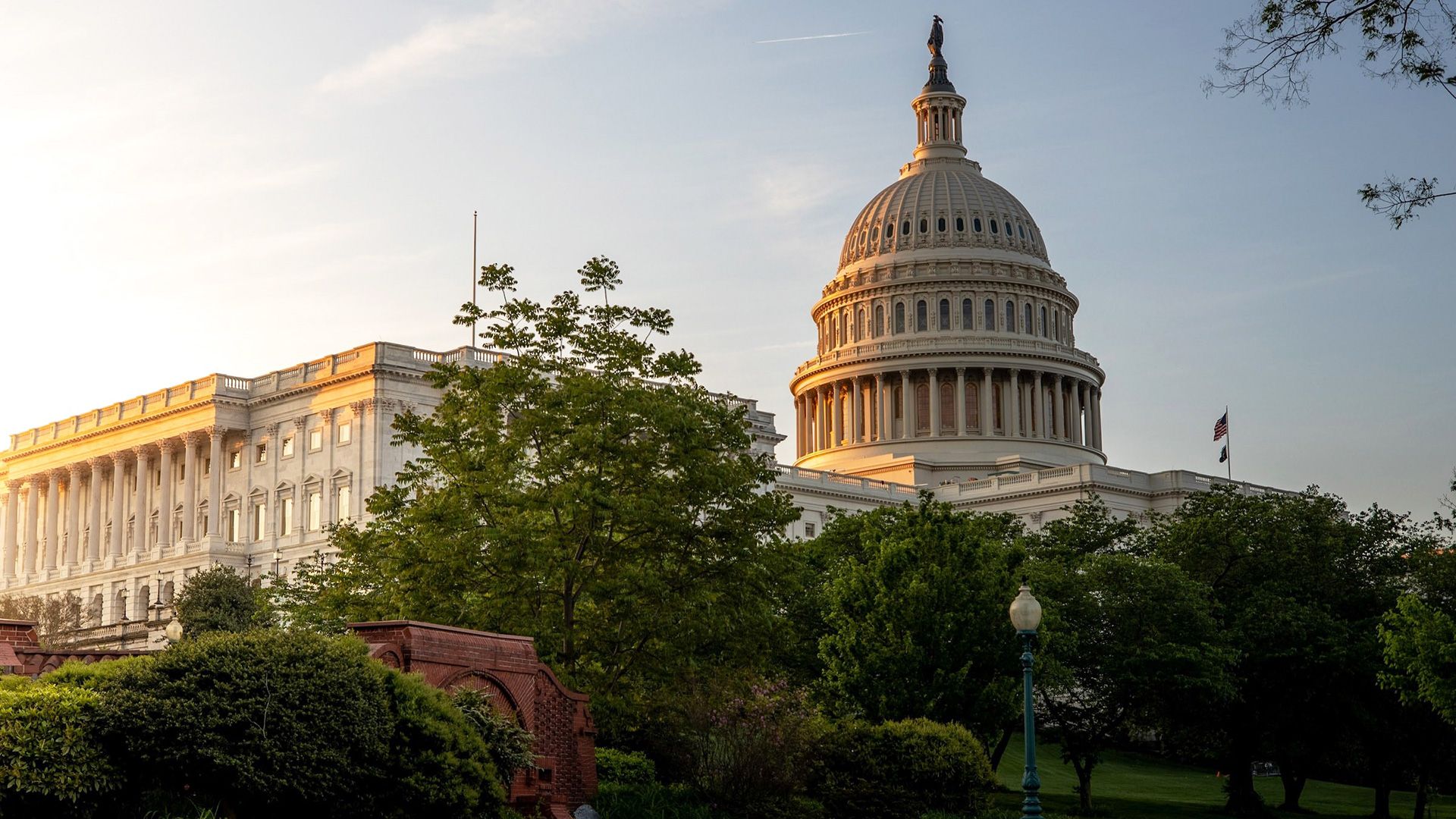
United States Captol Building, 2023.
In late December 2014, Congresss passed a $1.1 trillion spending bill to keep the government open. Buried in its 1,600 pages were two provisions almost nobody outside Washington wanted. One repealed a section of the safeguards passed to prevent another 2008 financial meltdown from happening again. The bulk text of the legislation had been drafted by Citigroup years earlier. The Government Accountability Office pointed out the effect: it allowed a small number of banks to keep more than $10 trillion in high-risk assets insured by the Federal Government. This meant that whenever those assets fail, Americans' tax dollars will be used to bail out the banks yet again. Another, tucked near the end as an unread "rider", created new campaign accounts increasing the maximum amount an individual and other organizations could give to a national political party. That meant more special interests and corporations having the ability to put more toward partisan politics. No one publicly admitted to writing it. House Minority Leader Nancy Pelosi said she learned of it the day before the bill was released. Neither provision, as finally passed, could have survived a standalone vote. But neither had to. And those were just two examples. Congress piles on more and more every year.
The founding generation recognized the problem of mixing unrelated issues together in laws. They legislated against it. The Congresss of the Confederation adopted a rule in 1781 barring new propositions offered under color of amendment as substitutes for the question under debate. In plain terms, the only amendment that counted was one that actually dealt with the subject of the bill. And that viewpoint carried over into the United States under the Constitution. The House of Representatives adopted a germaneness rule in 1789. The principle rests on the notion that the House should consider one subject at a time. The bills were focused and clear. For instance, the Judiciary Act of 1789 which created the entire federal judiciary did so in less than 40 sections. But look at the bills being passed today and you'll find something very different. Routinely, both chambers of Congresss pull unrelated sections and aspects of law together in something called "omnibus legislation." Omnibus, in Latin means "for all." In Congresss today the word describes a bill assembled with dozens of separate laws. They're drafted by different committees for different purposes and loaded into a single bill for a vote. A modern omnibus is not a bill the founders or any Congresssmembers from most of America's existence would recognize. The 2014 package ran to roughly 1,600 pages. Others have run longer with numerous going into over 2,000 pages. These bills usually include appropriations for dozens of agencies bound together with tax provisions, land transfers, and riders. Riders, by the way, are labels that have come to describe non-germane (or unrelated) things being added to a bill. And they are almost always input without any clear attribution by who put them there. So if America's history and Congresssional rules say a bill can't have unrelated things placed in it, then why is it happening?
The Consolidated Appropriates Act passed in December 2020 is the largest bill ever passed. It folded 12 annual appropriations bills together with a COVID 19 relief package resulting in over 5,000 pages. The previous record holder was the 1986 tax reform bill, which was under 3,000 pages.
The first reason this became possible is that the germaneness rule was later allowed to have exceptions. This happened in many ways but one that helps illustrate the point is the rise of special rules. The ability to create special rules in the House of Representatives is held by the Committee on Rules. This committee governs how a particular measure will be considered on the floor. The Rules Committee has had this authority since the 1880s. A special rule sets the debate time, decides which amendments may be offered, and waives points of order. This means that the rules committee has control of what can go into a bill and what can't. The special rules are wielded by only a small group. In effect, it allows the leadership of the House of Representatives to have the power to add basically whatever they want to bills. This, of course, creates a huge problem for the individual Congresssmembers because they are often confronted with having to vote for something unrelated and often undesirable if they wanted to see something they did care about passed into law. The Senate has different ways of waiving rules. One way is through the unanimous consent agreement. It might sound like everyone has to be in agreement. But in reality, it means that if something was approved through unanimous consent it just lacked an objection among the senators that were there. Senate leadership often uses this distinction by waiting until certain members are gone to bring up a unanimous consent agreement to suspend the rules. The book Master of the Senate by Robert Caro provides numerous examples of how Lyndon Johnson used this and other mechanisms to combine very different things into single bills.
Another reason for the rise of omnibus legislation was the loosening of what it meant for two things to be related. Over the later part of the 19th century, points of order about whether amendments were related began to shift to wider and wider interpretations. For instance, a bill on railroads would allow inclusion of amendments about federal lands since the railroad bill also had aspects relating to lands for the railway. But this type of looseness also created a derivatives problem because when you include something with new elements within it then you keep moving the goal post on what is germane since you can keep finding more supposed germane aspects with each new introduction.

What makes the ombinus bill situation even worse is the addition of the time element into all of this. The final versions of the omnibus bills almost always arrive in the last days before a funding deadline. Or perhaps in the final few days before Congress goes into recess or before the November elections. Sometimes holiday pressures are used by scheduling votes right before Thanksgiving or Christmas. The pressue is to pass it or to face a government shutdown or be forced to stay in Washington while non-incumbent election challengers are on the ground campaigning to remove you. The 2014 package was released on a Tuesday night in December, five weeks after the midterms, and cleared the House two days later with the government hours from closing down. A member who objects to one provision out of several hundred is told that stripping it means reopening a negotiation that took months. And that failure to pass it means federal employees will miss paychecks over the holidays. The founders built a rule to force Congresss to face one question at a time. What Congresss faces now is often a deadline regarding a bill with thousands of pages filled with things that have no relation to each other. And to get the thing you want passed, you have to pass those other things too. That's not legislating. That's taking America's legislative branch hostage.