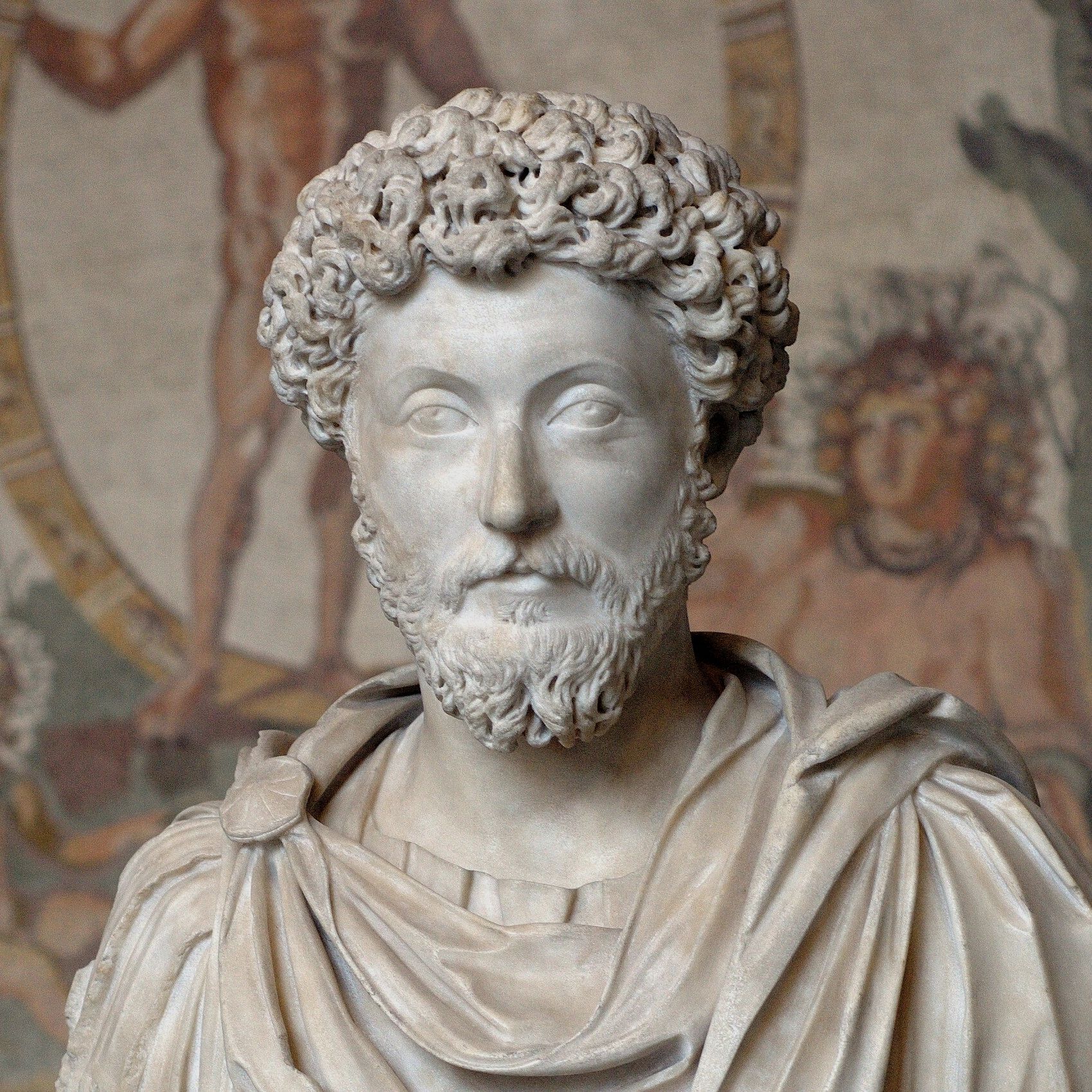
A bust of Roman Emperor Marcus Aurelius.
By the time Marcus Aurelius sat down each night to write in what we now call Meditations, he wasn't drafting philosophy for publication or posterity. He was Emperor of Rome, commanding legions on the Danube frontier, managing a plague that was gutting the empire's population, and--by his own private admission--still working daily to master his own mind. He grew up learning and practicing a branch of philosophical thought called Stoicism. It's a very practical type of philosophy in the sense that it teaches one that there are things that you control such as your thoughts, desires, and even aversions. And things you can not, such as your reputation, most external events, and especially others' opinions. And it was this school of thought that Marcus Aurelius began learning as a boy that drove his daily habit of journal writing.
When you read the book that came of his journaling, it seems the writings were more of a reminder to himself of what he must do to stay grounded and avoid the human frailities that lead to bad judgments and actions than a simple recounting of events. The very emotions that drive action and ambition can also be the very same that enable self-delusion and abuses of power. It takes an ever-watchful mind to see when emotions and limited perspectives have taken over internal governance rather than simply being a sensor indicating what is important and a fuel toward positive ambitions. And it was in book ten of his Meditations where two sentences explain how he was able to maintain the level of self-mastery as well as obviously productive outputs that lead most historians to treat Marcus Aurelius to be the closest anyone has ever come to Plato's philosopher king. Among the various things he wrote within his journal, he made the following observation:
"Accustom yourself in the case of whatever is done by any one, so far as possible to inquire yourself: To what end does this man do this? And begin with yourself and first examine yourself."
The first sentence is something nearly every leader or political actor knows by heart. If you aren't asking why someone is doing something or why someone is opposing something, then you aren't doing the simple political calculations needed to build alliances or propel collective action. It's the scrutiny of others and their intentions that help a leader develop a good picture of the environment he operates in. And we see this today in Congress where there are clear reasons why certain people fall certain ways on most individual issues. This type of motivational analysis helps explain why someone could support renewable energy but then oppose a wind turbine energy development near their hometown. Their own self-interest drives their positioning despite the project being something they would generally support. In fact, this type of analysis is a useful frame within practially any interaction with others. From business to religion, you have to ask yourself why the other person across from you is telling you to do something or urging you not to do something. So the first sentence that Aurelius wrote is something that could be considered common knowledge. It's the second sentence, however, that makes Aurelius' insight both uncommon and also more useful.
Marcus Aurelius's private notes were never meant to be read by others. No record exists of anyone mentioning them for roughly seven centuries after his death. It only became a book because a Byzantine bishop took an interest in it around 900 AD.
The thing that most people don't do is question themselves--at least not on a regular basis. It's far easier to run the motivational and logical audit outward than inward, because outward scrutiny costs nothing and confirms what you already suspect, while inward scrutiny risks finding something you'd rather not see. There's a name for the trap this guards against: psychologists call it the bias blind spot. The bias blind spot is the tendency to readily spot bias and self-interest in others while remaining confident that our own judgments are objective and clean. We assume that turning the same inquiring eye on ourselves will work the same way it does on others, that if we simply search our own motives we'll surface whatever self-interest or distortion is lurking there. But introspection doesn't expose bias this way—it exposes only what's already conscious, and the very self-delusions Aurelius warns against operate beneath that level by design. So "first examine yourself" isn't just a moral instruction to be humble; it's a practical acknowledgment that self-examination is a discipline and not something that can be done on a whim. It takes time and reflection to do this. And it must be done constantly. And it's here where Marcus Aurelius found the way to do it. And it's so simple but also so rarely done.

George W. Bush boarding Marine One, 2003. From state legislators to presidents, daily schedules leave little time for the self-reflection needed for self-correction.
His solution was the journaling itself. Whenever he sat down to write about his day and point out things he should work to keep in mind and guard against, he was operationilizing the part about starting with yourself. He was examining himself every night. And this naturally involved being critical and naming things very clearly, even when it wasn't flattering. In fact, after reading his Meditations numerous times over the years I've always come away thinking that he seemed to take a type of joy in discovering unflattering things about himself and correcting them. With this mind set, there was no ego for him to protect because he was only as good as his most recent action. Unfortunately, most people in positions of authority and power don't do this. And in some ways, the systems we've set up don't even give them the time to even try. When I worked in Washington, I got to see the types of schedules Congressmembers and members of the Executive Branch had. And even during their "off time," they're usually still doing something work-related like talking with the press or talking with constituents. When you have only action without reflection, you mostly end up with institutions that are short-sighted and reactive instead of strategic. There's a lot that two sentences from Marcus Aurelius can teach us all.
The Meditations is often repetitive. Aurelius returned to the same warnings and self-corrections again and again throughout the text, which suggests that even his hard-won self-awareness had to be renewed constantly.