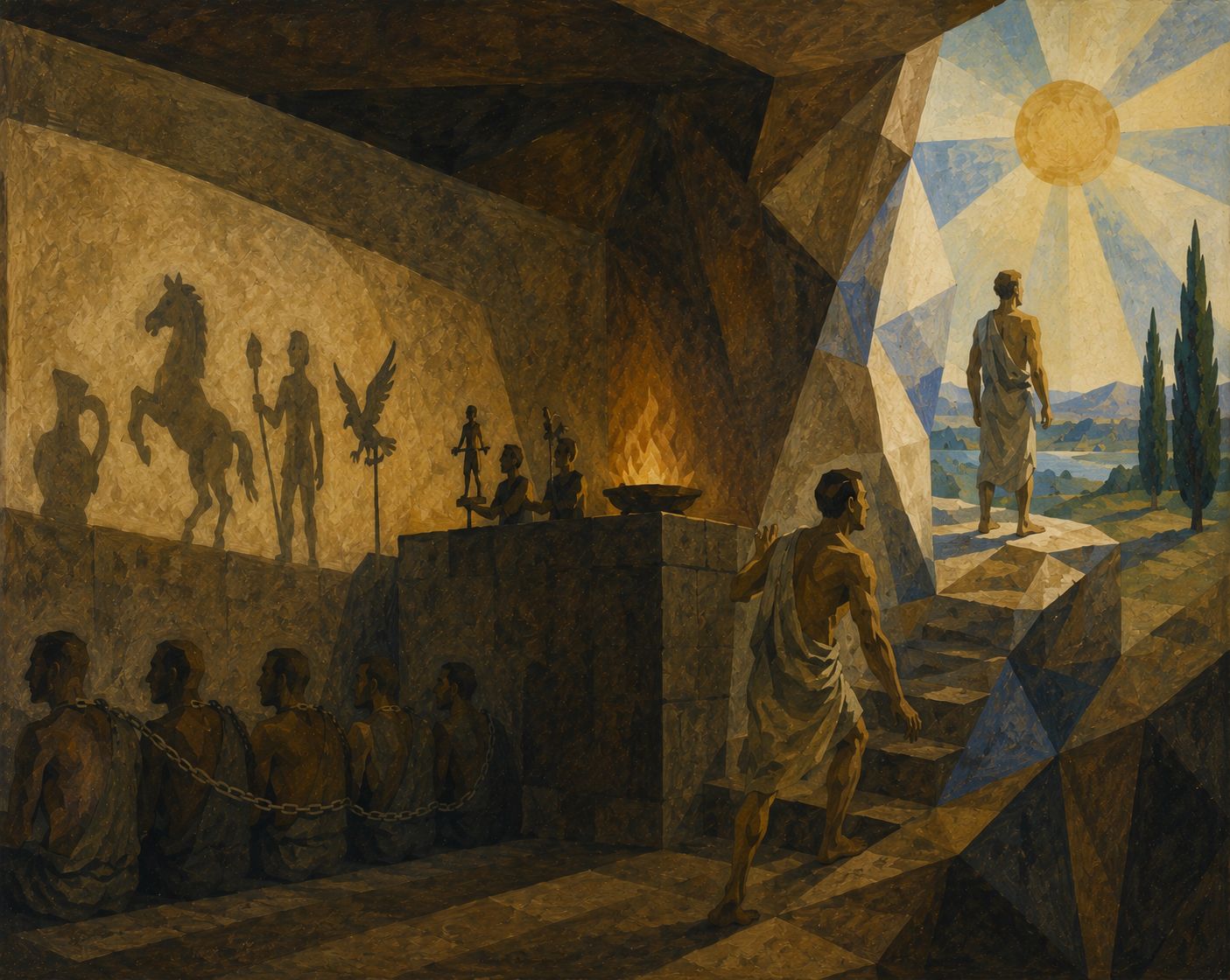
An AI Depiction of Plato's Cave as a 20th Century Painting
Over 2,000 years ago the Greek philosopher Plato wrote about a fictional scenario of people being raised in a cave since childhood. They were shackled in place so they could only see the cave wall in front of them. Behind them was a low wall like the structure a puppeteer would use to put on a show. And behind it was a fire that burned to allow the puppeteers to display the shadows of objects on the cave wall for the shackled prisoners to see. A puppeteer would occassionally talk to give voice to one of the shadows. For the captive audience, the shadows and the echos of the puppeteers' voices was all they knew.
Plato went on to describe what happens when a prisoner breaks loose and goes into the reality outside the cave. At first the light would be blinding and there would be an instinct to turn back to the cave. But as the eyes adjusted, the vision of the real world became clearer. From that point onward, the free individual had to come to grips with the reality that all that he knew before was just part of a projection. I was first introduced to this story as a college student. It was 2005 and I was in philosophy class. Plato's allegory of the cave had quite an impact on me since I would think about it often in the years afterward. And what made it even more memorable was the fact that my philosophy professor interrupted class to go take a phone call.
The creators of 1999's film The Matrix leaned heavily on philosophical works for creating the film's storyline with Plato's cave being one of a number of frameworks used.
When she came back, she told us that her son was stationed in Iraq and she had to work around his schedule. We all understood. I could only imagine what she felt. What was going on in Iraq and the larger world itself reminded me of the shadows in Plato's cave. And how television and newspapers, being the filters and deriviatives that they were, enabled for depictions of a reality that often wasn't real. America being in Iraq in the first place was built around a story our own government knew to be untrue. Years later news made it out about how the vice president reached out personally to various intelligence analysts imploring them to find a link when their initial reports of connections between Saddam Hussein and al-Qaeda came back empty. It was all imagery from there it seems with the often repeated message being given that, "[w]e don't want the smoking gun to be a mushroom cloud." At the same time, the corporations running the major news channels quietly pushed out objective voices from the broadcast lineup like what was done with Phil Donahue's show on MSNBC the month before the 2003 invasion.

President George W. Bush delivering remarks about Iraq and connections with al-Qaeda in 2002
When you emphasize an argument with clear visuals and sideline the voices that would bring up inconvenient facts to the contrary, it's not hard to see how so many people could get pushed into believing something that isn't true. Reality eventually caught up and most people eventually saw the reality past the images. But it was only after the consequences became too clear and the facts too overwhelming to dismiss. But that was 2003 and seems just as foreign to the generation born after as Plato's time period must seem. However, the interesting thing about Plato's allegory is how it delivers a truth that stays relevant no matter what time period one revisits it. After all, the story revolves around the inescable reality of what it is to be human and to be an individual. We're all limited by the senses we perceive around us and the education we've acquired to reason through the uncertainty to find the real through the fake.
According to a 2026 Pew Research Center survey, nearly half of U.S. adults report using AI chatbots with nearly one-in-four who report using AI tools daily.
To quote an often used political slogan, the lessons from Plato's cave are needed now more than ever. The media has gotten more sophisticated. In fact, we don't even need puppeteers making the shadows anymore. With social media algorithms that automatically reinforce certain perceptions of each user, however false, by showing content with the same position and same perspective as the user; you've got a self-perpetuating digital cave with the algorithms being the puppetmasters. And with AI chatbots now taking the place of online searching, you have a system that sends out responses without even bothering to attribute sources anymore. A hallucination given by Claude or ChatGPT or Gemini is displayed with the same level of certainty as a true answer. The times might have changed, but Plato's cave has not.