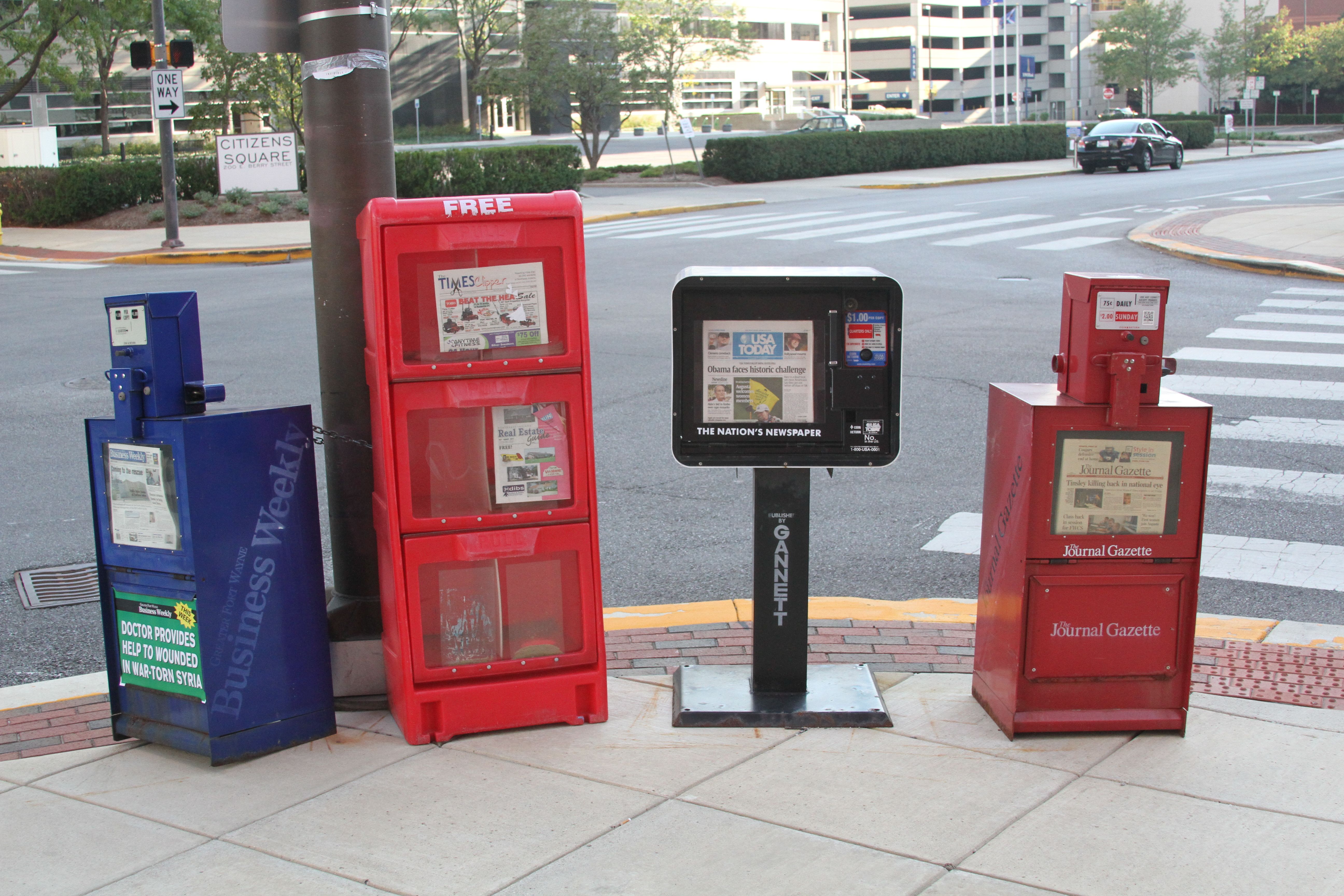
A group of newspaper vending machines.
Over the past 30 years, American newspaper ownership has consolidated into the hands of a small number of chains, private equity firms, and hedge funds with the results painfully visible in nearly every downtown in the country. Total newspaper employment has fallen more than 70 percent since 2005, with over 270,000 jobs eliminated. And nearly 40 percent of local newspapers have closed down competely, leaving roughly 50 million Americans in so-called "news deserts." The pattern after a takeover clear and seems to follow a playbook: the physical paper shrinks resulting in fewer sections, fewer pages, and story deadlines moved earlier to cut overtime. With the newsroom shrinking even faster. A study of major papers between 2005 and 2022 found that acquisition by an investment owner cut newsroom staff by an average of 14 percent, with the deepest losses falling on general-assignment and political reporting. These are the beats that are supposed to check government and corporate power through investigative coverage. Instead, newspapers are filled more with human interest stories. The chains doing the consolidating today like USA Today (formerly Gannett), Alden Global Capital's MediaNews Group and Tribune Publishing control the dominant paper in hundreds of American cities.
The conventional explanation is that the internet simply killed the business model. Newspapers depended overwhelmingly on print advertising. But with the rise of online advertising and websites like Craigslist, print advertising shrank due to the competition. The timeline seems to fit into a neat narrative with newspaper ad revenue peaking around 2005, just as broadband adoption crossed 50 percent of U.S. households and platforms like Facebook (2004) and later Twitter (2006) began pulling attention and dollars away from print. It's a clean story: technology disrupted an old industry, and the old industry lost. But if you look closer at the bottom lines of the newspapers and when they started seeing financial strain, the story gets messier, especially with many papers showing a positive balance sheet right up until a buyer took them over.
Newspapers have closed at a rate of roughly one every day and a half for the past 20 years. Nearly 2,000 newspapers shut down between 2004 and 2018 alone.
That's because a great many papers weren't slowly bled by declining ad revenue so much as they were suddenly loaded with debt they'd never carried before. The 2006 sale of Knight Ridder, then the second-largest U.S. newspaper company, is a prime example of this pattern. to The McClatchy Company bought Knight Ridder for roughly $6.5 billion. But a huge chunk of that purchase used debt instead of cash to finalize the deal--about $2 billion in debt to be more precise. Almost as soon as McClatchy bought the papers under Knight Ridder, it began selling them off with a dozen being sold withing weeks of the acquisition. The proceeds of those newspaper sales went toward paying down the acquisition debt rather than into newsrooms. The pattern repeated a year later with Sam Zell's buyout of Tribune Company with it financed mostly through a structure using the Tribune's own employee stock plan and future revenue to carry the actual weight and risk of the $8.2 billion deal. Tribune, a company generating real profit before the buyout, filed for the largest bankruptcy in American media history just one year later. Over and over, papers that had been financially stable only began showing problems after a leveraged buyout. So if a company is buying a working, profitable paper, why do they load it with debt heavy enough to sink it in the first place?
The answer lies in what the new owners did with what the paper owned. Once the debt is in place, the new owner uses the cash from the Newspaper's revenue and assets to service it. This is why almost immediately newspaper jobs are cut right after the buyout. But the real prize is extracting the paper's physical assets such as the presses and the parking lots. And of course, the building itself, which is often owned outright after a century of downtown real estate that's now worth far more than the newspaper itself. Gannett (now USA Today Incorporate) sold at least six newspaper buildings to Twenty Lake Holdings within a single year. The money rarely flows back into the newsroom since it services debt or flows up to the parent company and its investors. And the paper is left far worse than before. The newspaper has been turned from often a family run business with ties to the local community that once owned its headquarters to now having to pay rent every month to whoever bought the building out from under it.
The Asheville Citizen-Times' printing press was scrapped for metal just two years after Gannett spent $3.5 million upgrading it. The press shut down in January 2009, and printing moved out of state — years before the building itself was even sold.
What happened to a newspaper in Asheville, North Carolina, shows exactly how this plays out on the ground. The Asheville Citizen-Times had operated out of its own building for 85 years before Gannett sold it in 2018 as part of that same wave of building sales. Twenty Lake Holdings bought the property for $3.2 million and flipped it within days to a local developer for over $5 million. The Citizen-Times then leased back space on the second floor from the new owner, and stayed as a tenant for six more years until the lease expired, when it finally vacated the building for good and moved into a coworking space inside a bank. The paper that once owned an entire downtown headquarters now rents a fraction of a floor. The money from the sale went to a hedge fund's real estate division and the local investor on the other end of a lucrative flip. The shrinking size of the buildings the newspapers work in show what the new owners actually think of the newspapers they're buying.