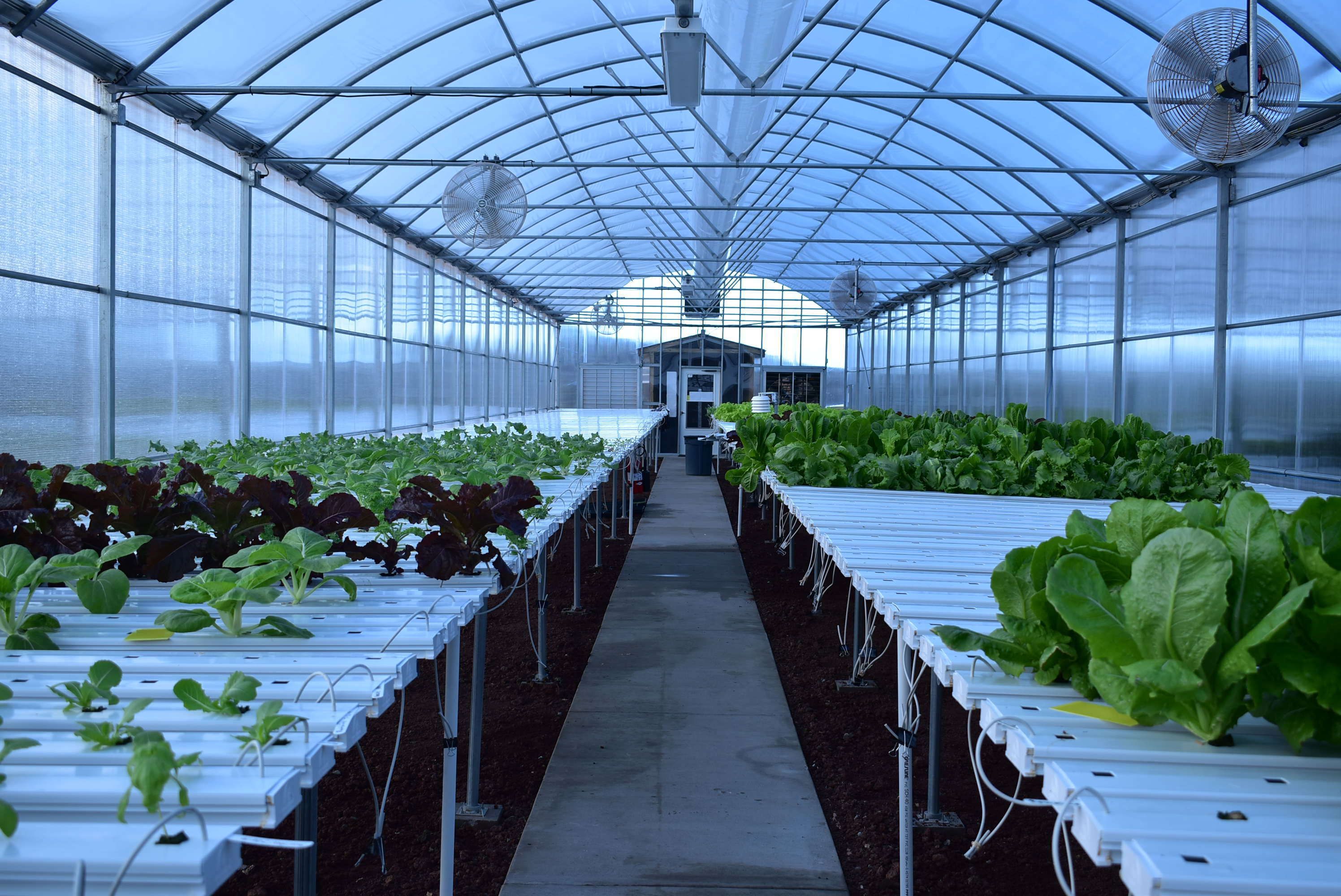
Hydroponics facility on Ascension Island. Photo created by US Space Force.
There is a technology that could cut agricultural water use by up to 95 percent, eliminate the synthetic fertilizer runoff that is polluting the Mississippi River and the Gulf, and remove the need for the pesticides linked illnesses and cancers across rural America. And this technology exists today. Companies overseas are building it at scale, and at least one, an Italian company, is profitable and is supplying grocery stores in the United Kingdom. Countries with little room to spare, like the UAE and Singapore, are treating it as national imperatives. Meanwhile in the United States, the only real industrial scale entity has suffered bankruptcy with its vision being limited to being literally focused on a micro scale. The technology is called vertical farming. And it's been around a long time and should have gone mainstream decades ago. But oddly, something always seems to come up whenever it starts to break out to mass adoption.
The phrase "vertical farming" was coined in 1915 by USC geologist Gilbert Ellis Bailey. But it meant something different to him: using dynamite to loosen deep soil layers instead of stacking crops upward. The technology that is the origin of the vertical farming we know today originated when the University of California Berkeley professor William Gericke made headlines in 1929 growing seven-meter tomato vines in nutrient solution instead of soil. This was formally named "hydroponics" in 1937. The needs of World War II took the technology out of the laboratory and put it to use on remote islands in the Pacific as US military forces pushed back Imperial Japan to its national boundary. Hydroponic farms sprouted on Wake Island, Ascension, and Iwo Jima to provide soldiers with needed fresh vegetables despite the lack of arable soil to grow them in.
Long before Silicon Valley ever tried to reinvent indoor farming, the U.S. Army was already quietly running an 80-acre industrial hydroponics operation in occupied Japan. At its 1952 peak, it pumped out over 8 million pounds of fresh food a year—a massive military-grade scale that many modern commercial vertical farms still can't match.
After Japan's surrender, the Army built a version to meet the needs well beyond the scope of an island. By 1946, the Eighth Army was constructing an 80-acre hydroponic operation split across two sites in occupied Japan--one in Tokyo and another at Otsu, near Kyoto. It was designed to harvest enough for eight servings per soldier stationed across Japan and Korea. The reasoning was as much medical as agricultural since centuries of Japanese farmland fertilized with human waste left conventional local produce at risk of carrying typhoid and other disease-causing bacteria. Hydroponics offered a controlled and safer alternative. Similar Army hydroponic farms followed U.S. troops guarding oil infrastructure in Iraq and Bahrain, and by 1952, at the height of the Korean War, the Army's hydroponics branch was producing more than eight million pounds of fresh food a year for its forces. Then it vanished from public memory almost as quickly as it had scaled. The occupation of Japan ended in April 1952, and as the emergency conditions that justified feeding an entire foreign army through hydroponics disappeared, so did the institutional will behind the program.
Ask nearly anyone in the vertical farming industry what the technology is good for, and you'll get a grocery list, a very small grocery list. They'll say you can produce lettuce, basil, spinach, and microgreens. These are the crops that grow fast and weigh almost nothing, which reduces the size and initial investment needed to get a profitable operation going. Regarding wheat, rice, and corn, which are the staple grains that actually feed most of the world; investment firms treat these as off the dinner table (I couldn't help but use the pun). They say those staple crops are already cheap to produce and take too much energy to grow indoors to ever make financial sense. But they calculate it in the artificially priced market of today where government subsidizes the production of those crops and use specifically engineered strains designed to occupy vast Iowa fields insted of vertical ones. And even under their compromised math, a scientist says the numbers actually point to vertical farming being profitable even under those conditions.
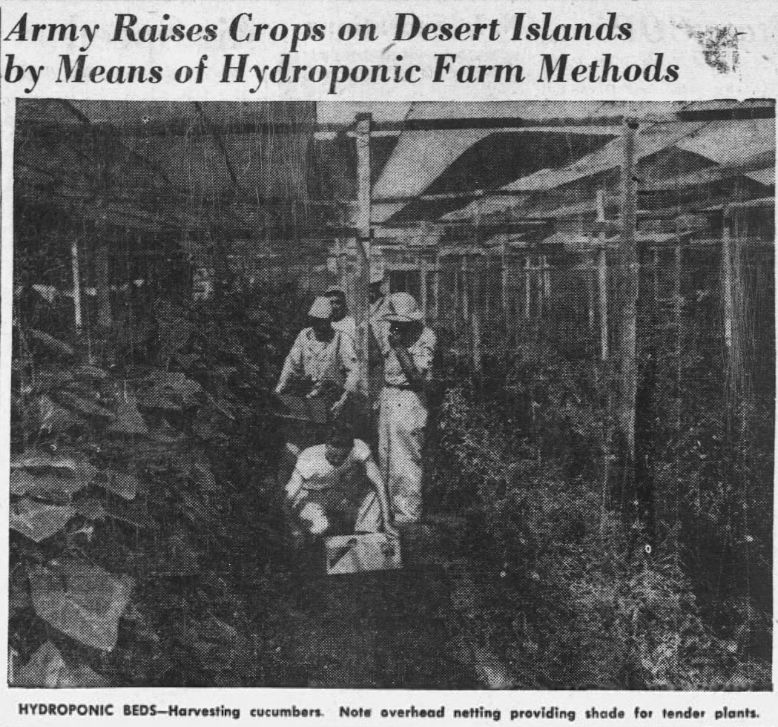
Newspaper clipping of a US Army hydroponics facility in 1947.
Dickson Despommier is a professor of public and environmental health at Columbia University. He's widely credited as the person who popularized the modern idea of vertical farming back in 1999. In his 2010 book, The Vertical Farm: Feeding the World in the 21st Century, Despommier lays out a vision on a grand scale. He proposes multi-story buildings, built in or near a city, that can produce as much food as a thousand acres of traditional farmland. And the practical reality of doing it in a closed environment avoids down-times because of changes in seasons or loss of crops due to floods or frost. He points out that roughly 30 percent of the world's crops are lost every year to bad weather, pests, and spoilage during shipping. Add in the elimination of diesel-burning farm equipment and long trucking routes, he argues the economics look less like a money pit and more like an investment in a food system that doesn't fail when something goes wrong outside.
And this isn't purely theoretical anymore. In China, researchers are already testing a real-world version of this idea. At a government-run facility in Xinjiang, in the country's far west, scientists are growing a specially bred short-stalked ("dwarf") variety of rice on stacked shelves instead of in flooded paddies. Normal rice takes 120 to 150 days to grow to harvest whereas this version is ready in just 60. The executive running the project has said her team is now starting to experiment with dwarf versions of wheat and corn as well, the exact crops that skeptics in American investment firms say can never work indoors. From the War Department supplying troops across Asia in the 1940s to far west China today, vertical farms are proven to work. But the America of today doesn't seem to care.
But profitability is a strange thing to throttle a promising idea with, because profitability is rarely just a fact that exists. Profitability is more of a choice about where to point money and patience. Facebook wasn't profitable for years and no one really had much of a clue how make it profitable initially. But it attracted investors who saw something important to them--a platform where people voluntarily shared their personal information as well as their social lives. Those investors saw how they could capitalize and plowed hundreds of millions of dollars over years until they could turn it into the targeted ad platform that is today. The difference between "unprofitable now" and "will never be profitable" isn't a spreadsheet, it's whether someone with capital and patience decides the outcome is worth funding through the years it takes to get there. For a technology that could reduce water use by 95 percent and stop poisoning American rivers, that's a bet worth someone making.