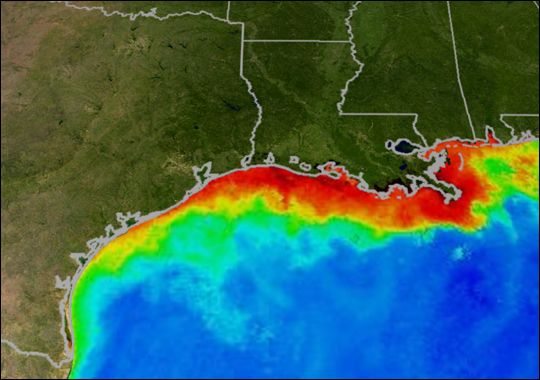
Imagery of the Gulf Dead Zone. Photo created by NOAA.
There is an area of the Gulf of Mexico off the Louisiana and Texas coasts that has no life. Oxygen levels near the seafloor in this area collapse below what's needed to support fish, shrimp, crabs, and other marine life. Scientists call this phenomenon scientists hypoxia, but everyone else simply calls it a dead zone. In 2017, this dead zone reached a record of around 8,000 square miles. To put this in perspective, that's larger than Rhode Island, Delaware, and Connecticut combined. In this area, bottom-dwellers die where they sit. And fish and shrimp flee, taking away the ability for local fishermen and shrimpers to make a living. The phenomenon was formally documented in 1972, off the Louisiana coast. Some researchers, using sediment core analysis, argue the underlying conditions actually began taking hold as early as the 1950s. But that's an estimate reconstructed decades afterward. What we know for certain, is that scientists caught it happening in real time by the early 1970s and it's been happening ever since.
But the dead zone is only the most visible symptom of a much larger crisis. Long before nutrient-laden water ever reaches the Gulf, it travels through the Mississippi River and its tributaries, doing damage the entire way. Excess nitrogen and phosphorus fuel toxic algae blooms in rivers, lakes, and backwaters closing waterways to fishing and swimming. Fish kills occur directly within the river system. Chronic agricultural nitrate contamination breaches safe drinking water standards for millions of rural residents relying on basin aquifers and river sources, which expose the populations to elevated risks of methemoglobinemia ("blue baby syndrome") and specific types of cancers. Economically, the damage ripples through inland fisheries, recreation, tourism, and water treatment costs across ten states, long before any of it becomes a dead zone problem.
Nitrogen gas makes up 78% of the air you're breathing right now, yet it's so chemically standoffish that virtually nothing on Earth can use it directly — which is exactly why humans had to invent an entire industrial process just to convince it to bond with anything useful.
The conventional explanation for all of this points to the rise of synthetic fertilizer, and specifically credits the Tennessee Valley Authority. It seems like a tidy story. You'll see people writing about how a New Deal-era public agency, the Tennessee Valley Authority, developed and freely shared fertilizer technology that transformed American agriculture, but also created the dead zone problem in the process. But that story is a bit too tidy. And it also leaves out the real cause of the problem. And part of it involves converting public war production to peacetime private profits.
During World War II, the U.S. government built roughly a dozen massive plants to produce ammonia and ammonium nitrate. But these weren't for farms. They were using these to produce explosives to fight the wars against Germany and Japan. When the war ended, that enormous production capacity was no longer needed. Private chemical companies like Allied Chemical and others moved in, by leasing or purchasing these taxpayer funded plants at huge discounts. What these corporations now controlled was an industrial capacity designed primarily for creating one substance. It's at this point that nitrogen became the backbone of American fertilizer. They had a product so they needed a market. Nitrogen is one of several key nutrients in fertilizer, but it wasn't necessarily the one agronomists considered most urgently needed. In fact, the Tennessee Valley Authority had been focusing their research more on phosphate based fertilizers since that was the substance their researchers concluded was most needed. The corporate take over of old munitions plants and converting them for the agriculture market pushed nitrogen front and center.
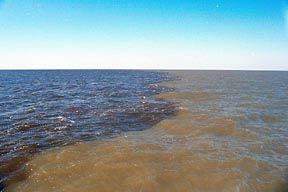
Photo by NOAA of a dead zone with sediment from the Mississippi River carrying fertilizer to the Gulf of Mexico.
From there, the trajectory is clear to see. As nitrogen fertilizer production scaled up through the 1950s and beyond, its use on American cropland climbed along with it. And by the 1970s, the dead zone was documented by both scientists studying it with instruments and fisherman living it with the drop in their revenue. And afterwards, the dead zone continued growing. Meanwhile, the chemical fertilizer industry itself became enormously profitable, consolidating over time into a handful of dominant firms controlling the majority of national nitrogen output. It's a fascinating story of how an industry turned leftover wartime infrastructure into massive profits. But the profits came at the expense of others downstream and spread across ten states. In a way, it's a story that is all too common involving concentrated profits and diffused costs.
Reversing this problem has proven difficult. Federal and state task forces have set so-called "nutrient-reduction targets" for decades. Nutrients, by the way, is the term both the industry and government use when discussing the particular pollutants. They point to how nitrogen and phosphate are used as nutrients for plants naturally so they're nutrients. But that's like saying arsenic is a "dietary supplement" because trace amounts of arsenic are often naturally found in human and animal metabolism. Regardless, proposed solutions range from wetland restoration and to complicated payment schemes to incentivize the use of less potent fertilizers. There is, however, one approach rarely part of this conversation — one that could solve the crisis in both the river and the Gulf simultaneously. It would also completely remove the need for chemical pesticides as a bonus. That solution deserves its own discussion and will be discussed in another article. For now, the important thing to know is that the dead zone problem isn't something that had to happen for us to have increased crop yields. Instead, it's the result of private companies maximizing profits from public infrastructure they bought for pennies on the dollar.