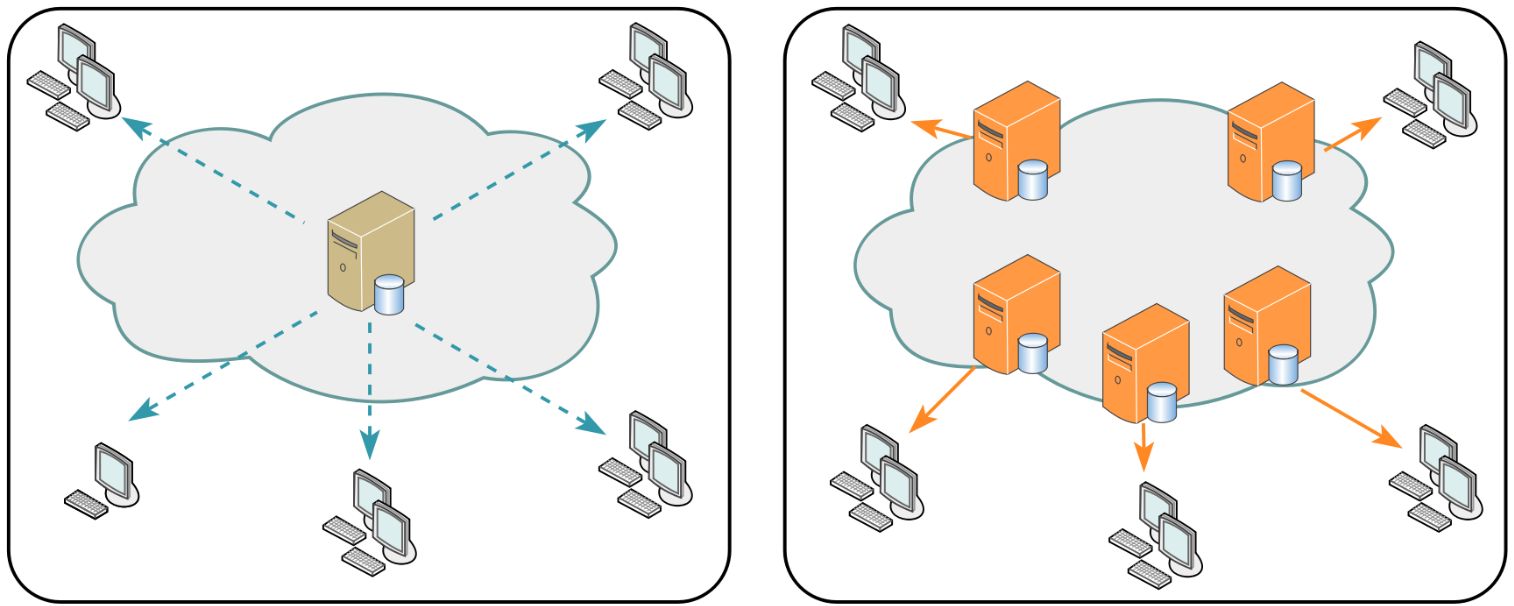
Traditional web server model vs. content delivery network model.
If you went back to the first decade of the 2000s and looked at the internet economy, it would look very different from today. And I'm not just talking about the smaller social media presence and the lack of YouTube. From individual blogs to niche websites about building model train sets or whatever suited your fancy, there was so much more to choose from. You actually had more diversity of places to visit with people actually visiting them. And the numbers show it plainly. A 2003 Nielsen/NetRatings report from 2003 found that the average user visited 53 unique sites per month. Now, compare that with the consolidation that has taken place sense. Recent studies on platform concentration--to include one conducted from June 20024 through December 2025--found that nearly 50% of all browsing time was spent on just a handful of websites with the now familiar suspects of Google and Facebook being part of that list. So anyone looking to make money from their own website is already at a disadvantage due to how aggregators and middlemen like social media sites hoover up most of the traffic. And for the dwindling number of users who actually click to visit an indpendent site, another type of entity is taking even that visit away. And it's something that is claiming to help you.
In 1998, the World Wide Web was toward the end of the beginning of its march to mass adoption. With movies like You've Got Mail making it part of mass media story lines and news headlines highlighting President Clinton's email from the White House to astronaut John Glenn on the International Space Station, the internet was moving to the mainstream. The inventer of the World Wide Web, Tim Berners-Lee, saw mass adoption as both a good thing and as a problem. As a faculty member at MIT, Berners-Lee reportedly challenged his colleagues at the university's Laboratory for Computer Science to come up with a solution to the so-called "World Wide Wait" problem. The problem, as he saw it, was when a large group of people flooded to a website all at once, which caused a bottleneck and crashed a server. And it was this challenge that the founder of Akamai, a company formed in 1998, pointed to as the inspiration for its creation. Akamai, which is from Hawaiian meaning "smart" or "clever," is widely viewed as the first content delivery network (more often referred to by its aconymn--CDN).

Bill Clinton writing an email to John Glenn, 1998.
When a person signed up for the service, they would use a tool called an "Akamaizer" that scanned the website's code and text and modify the links for heavy, static assets like images and video files so they no longer pointed to the customer's own server. In effect, this was moving parts of someone's website to this other company for them to display it from their servers while the HTML and text displayed from the customer's server. This didn't change the fundamentals of the publisher's visitor logs since even with parts of the site being served elsewhere, it was still mostly the site sitting on their server processing the request. Although this solution wasn't actually necessary for most website owners since most didn't have very many heavy assets like videos, it at least made sure that the creator still had full visibility on his site's visitors and registered the visit. But CDNs would change in a way that took both visbility and credit for visits, which left publishers losing not only market share but also any real measure of monitoring their website's true reach.
By 2004 the problem identified by Tim Berners-Lee back in the 1990s was mostly solved by improvements at the individual server level. Both server archicture changes like the rise of multi-core processors as well as software changes like the introduction of Nginx (pronounced as "engine-x") increased a server's ability to meet simultaneous demands as well as increase the speed in which it did it. Despite this, more companies were entering the CDN space to fix the now--at least for most--mostly outdated problem. And they weren't doing it by just taking parts of a webpage like Akamai originally did. They were now taking the whole thing to serve from their network servers instead of the publisher's server. In effect, the middleman became the one serving the site. And what this meant to those subscribing to this solution was a loss in both their independence as well as revenue. But we'll get to that soon enough since we first need to trace this phenomenon's rise.
The first-ever online banner ad, which ran on HotWired in 1994 for AT&T, had a click-through rate of 44%. Compare that to today's average of around 0.05%, which reflects a decline of roughly 99% over three decades.
The problem went from enterprise scale to the individual website owner starting in 2010 with the rise of Cloudflare and CDN mass adoption generally. The company--and others like it that followed--promised faster website loading speeds while also using security as an additional marketing point. And adoption rose rapidly because many of these new CDN providers offered a price that was easy for anyone to afford. Many of these "free tiers" boasted of basic DDoS protection as well as fast delivery via their servers. And they seemed to offer these things with no cap. When you look at an offering like this, you have to ask yourself what exactly are they getting out of it that they aren't telling you since nothing in life is truly ever free. But that question will have to linger for a different article since our focus is on what it cost personal and even commercial website owners. The mass market CDN providers' rise, with Cloudflare leading with an estimated website market capture as high as a quarter of all websites, has a clear correlation with the decline of website owners' revenue.
In 2010, the year after Cloudflare was founded and other CDNs began to get mass adoption, the number of blogs in the United States was somewhere in the neighborhood of 60 million. This number pieces together Technorati's 2010 State of the Blogosphere report showing half of blogs being American and the total number of blogs, as reported by BlogPulse at the time, being over 152 million. I used Technorati's 50% figure of American blogs and brought it to 40% to be more conservative. I then applied the 40% number to the 152 million figure, which gives me a little over 60 million. And when you compare that number to what's operating in the 2020s, you have considerably less. Unfortuntely, we don't have numbers from this decade (this should already tell you something). The latest number we have--or at least one I actually treat even mildly seriously--is from 2016 and shows a steep decline. According to that 2016 report by eMarketer and Squarespace, there were roughly 28 million blogs in America. So from the numbers we could put together, a clear downward trejectory is evident. I know the data isn't perfect but with these kinds of things, it's all we got.

Tim Berners-Lee, the inventor of the World Wide Web. 2016.
So obviously, the incentive structure for maintaining a personal blog changed between 2010 and that later 2016 figure because the world of economics teaches us that incentives increase a behavior instead of decreasing it. With that being the case, there was something decreasing the incentives of blogging or even holding any type of independent website for that matter. And in the context of the "full page CDNs" as I call them, it was the loss of a website owner's attribution to their own content. And this happened (and still is) through various mechanism. For instance, there have been reports of ad tracking/analytics scripts being disrupted by the CDN's JavaScript optitimization tools. In other words, the way these CDNs increase page loading speed sometimes break the ability for ads to serve properly or even be counted as being viewed. But the biggest disrupter of them all is the fact that the publisher's site is on someone else's server being delivered by that other person. This creates a blackhole for the publisher and gives all the data and attribution (at least at the server level) to the Content Delivery Network company. When you look at it in these terms, it's simply a middleman getting all the economically useful information from a site while you do all the work. That's how promises of speeding up websites has contributed to their destruction. But CDNs are just one piece of the puzzle. The other pieces will have to wait for their own articles.
The word "blog" was Merriam-Webster's official Word of the Year in 2004, the same year Nginx — the server software that helped make CDNs less necessary for most small sites — was first released to the public.