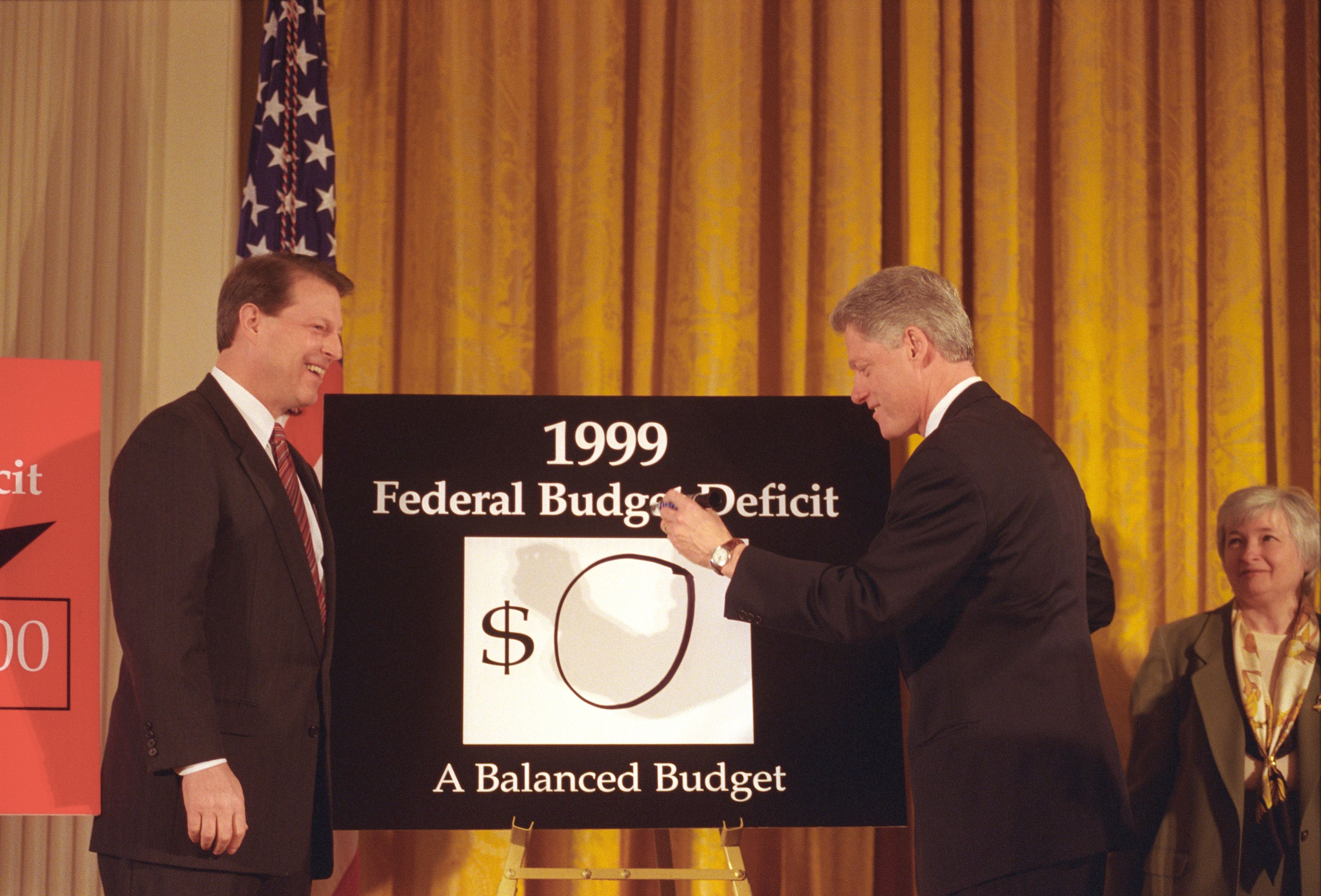
President Clinton announces a federal budget surplus in 1999.
In the year 2000, America was a country on top in almost every economic and political metric. Technologically, the country was seeing the rise of a network of digital connections that made the exchange of messages, news, and media inexpensive and reliable. Despite being digital, the infrastructure needed for the growing internet was still physical to include thousands of miles of fiberoptic cables. Household income and spending power both had been rising year after year for 7 years straight. In terms of the national budget and national debt, each of those two numbers were going exactly where you would want them to go. The budget had been going up but in a good way. The US Treasury had been running surpluses ever since 1998. And those surpluses were projected to continue into the indefinite future. With that surplus came the ability to pay down the national debt and even start thinking of larger national objectives to achieve with the increasing resources. And in terms of industrial capacity, America was at its manufacturing peak with somewhere above 380,000 factories.
Now, contrast that with where America stands in the mid-2020s. The national debt continues to grow hand in hand with spending on things that tend to weaken American power instead of enhancing it. For instance, both the federal government and even many state governments hand out subsidies to corporations that use up valuable local resources while those very same corporations export more jobs overseas and choose temporary foreign workers over American ones. In terms of the American companies themselves, many maintain a phantom headquarters abroad where they park cash to avoid US taxes (Ireland being one of the more popular locations for this). And manufacturing has decreased not just in sheer numbers but also in real outcomes. The Department of Defense is forced to buy computer equipment manufactured in China--a country that is our biggest geopolitical rival. Even most of our antibiotics aren't even made in America anymore. Americans are forced to rely on foreign intervention to treat simple bacterial infections.

Shipping containers at a US port, 2004.
So how did all of this happen? How did we go from being on top of the world to where we can't even produce our own medicines anymore? Some would have you think the answer is complicated. There's economic theories that must be reviewed and mathematical modeling to incorporate to get some insight certain experts would say. And even then, the analysts at the institutional investment firms and their specialized economists would provide a report full of hedges. And they do actually do this. After all, many of the academics and researchers that get paid to provide economic analysis do so from the position of maximizing market capture for the gains of private players. Through that analysis, dodging taxes by locating to Ireland or sending jobs to countries that have the cheapest labor even if they are totalitarian regimes is a matter of logic. And it's a logic with the only value benchmark being one of pure profit. That's a business motive. And it is completely different from what makes and grows a nation-state or supports the well-being of a nation's citizens. After all, if we ran the country like a business we would not have the artifical intelligence platforms and space-based communication devices we have today. The basic science and infrastructure were funded through national efforts, not business ones.
The 2012 film Looper originally set a key sequence in Paris, but rewrote it to Shanghai and cast a Chinese actress after Chinese studio DMG Entertainment came aboard as a financing and distribution partner. China's box office alone brought in more than the film made in the US.
But that's the theory behind what caused the situation America finds itself in 2026. The actual mechanics of what happened to push both jobs and factories elsewhere is where I'll spend the rest of my focus. And surprisingly, alot of the political and economic pressures that accelerated the closing of both America's mainstreets and factories had a convergence in a small southern state. It was in Arkansas where Wal-Mart, the first truly global store was born. Sam Walton was a driven man and his drive was obviously inherited by the leadership that took over after his death in 1992. What didn't seem to make it with that drive was the national bounds he always kept. It was the second generation of Wal-Mart corporate leadership that aggressively pushed suppliers to go beyond what they physically could do in America in terms of production costs. In an interesting exchange in the 2004 PBS Frontline episode, "Is Wal-Mart Good for America," a US sock manufacturer was candid about being pushed by the retail giant to turn to China for manufacturing. Around the same time, a former Governor of Arkansas who became president was pushing to finalize a permanent trade agreement with China which ensured little to no tarrifs. And on October 10, 2000, President Clinton signed the Permanent Normal Trade Relations to China bill into law.

George W. Bush in China, 2001.
But of course, it goes beyond Arkansas and beyond Wal-Mart. In November 2001, a different president sent out a press release about an action he took by certifying China's compliance with trade rules. This was a bit more technical, but it basically cleared the way for China to have another layer of entry into the "free trade" relationship with America. It was a necessary step for China's entry into the World Trade Organization. And China made it into the trading club within days of President Bush's announcement. By late 2001, China achieved two layers of institutional guarantees protecting China's pipeline into the American economy. And those protections were signed off by two presidents--one Democrat and one Republican. As for American manufacturers and the American workers that relied on the factories for jobs, they didn't get much protection. I could go on about the relationship between the outsourcing of jobs and loss of technical capacity in America that followed. I could even expound more on the loss of not just medications productions but even the larger biomedical edge America had following that agreement. I could show various reports and numbers and other data. But I think the best way to convey the impact is to return to the year 2000 where this article began. That was the peak of US factories in America. The year 2000 was also the last time we argued about budget surpluses.