The 2002 motion picture remake of the Time Machine is ultimately about a scientist's personal loss and how he responds to it. Without detailing the specifics to avoid being a spoiler for anyone who hasn't seen the movie yet, I'll just note that it was significant enough for Professor Alexaner Hartdegen, the movie's main character played by Guy Pearce, to create a time machine to try preventing the loss from ever happening in the first place. But as these kinds of movies often play out, changing the course of history was more challenging than the main character initially thought. And those challenges resulted in numerous unplanned stops across time with one visit being in May 2030.
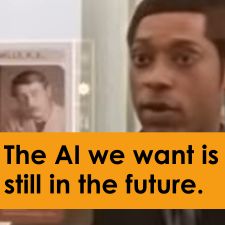
Orlando Jones as Vox 114 in The Time Machine.
On that stop, Hartdegen walks into the New York Public Library and finds a giant sphere near the entrance. As he looks around trying to find where the books are, he's greeted by a hologram asking how he can help. We learn that the hologram is part of an artificial intelligence system with the sphere being its "photonic memory core." What is fascinating about the depiction of the futuristic AI system in the movie is its universality. It's something that anyone can walk up to and use. And that use is conditioned on the only transaction needed for information exchange--questioning. When Hartdegen eventually asks it about time travel, it's doesn't ask for a credit card or token refill in order to get a response. It's also something that presumably isn't gathering personal information to be sold as currency among corporations since the system's location in a public library means, well, it's public. And the only agenda it has is providing the most accurate response possible.
Orland Jones portrayed the AI system (Vox 114) with touches of comedy and sarcasm in 2002's The Time Machine. His previous roles incorpoated these two traits as well to include in his role as a writer for NBC's A Different World and his sketch performances on Fox's MADtv.
After spending time in the fictional future of the Time Machine's 2030, I want to take us to the very real 2026 where AI is ubiquitous and very different from the harmless, albeit often judgmental, AI hologram played by Orlando Jones. Instead of talking to a human-like figure, we interact with AI systems by typing in a text box and receiving text and media in return. Instead of being free, it comes in a monthly subscription with additional restrictions in the form of token caps. If you reach your daily token limit, you're locked out unless you pay extra on top of your subscription cost. In other words, it is becoming more and more costly to use. And despite the massive amounts of money AI firms like Anthropic and ChatGPT are extracting from both its users and the communities their users live in (one of these costs is the rise of AI datacenters, which I'll write more about in a different article), they are striving to extract more.
In May 2026, ChatGPT announced a new feature to their chat bot and it involves your money. They call it a "personal finance experience" and trumpeted the ability to get responses from ChatGPT based on your actual financial data and spending habits. To be honest, I thought it was a late April Fool's Joke when I first read it. I couldn't believe that people would pay to give a corporation access to their most intimate details. After all, your financial life tells the story of who you interact with and where you're most vulnerable financially and personally. And as I highlighted in the Plain Meaning episode, "Secrets of the Bank Secrecy Act", the third party doctrine is being used by the government to get access to people's personal data through the companies they interact to get around the Fourth Amendment. For anyone that values their privacy, giving more access to systems that retain information in a way that is hard or nearly impossible to erase seems like the last thing you want to do.
Guy Pearce's role as Alexander Hartdegen in 2002's The Time Machine wasn't his only movie dealing with time. The 2000 film Memento involves Guy Pearce trying to piece together the past as he struggles with amnesia. It has a surprise ending and it's definitely not family friendly.
But alas, it wasn't a joke. ChatGPT was serious and they have been aggressively promoting this new tool. From what I can gather, linking financial accounts to ChatGPT would not only give your financial data to ChatGPT, but also their partner in this effort, a company called Plaid. Plaid was founded in 2012 and has become an authentication service linking personal bank accounts with other financial services such as stock trading apps. It does this by trying to be a universal API. API stands for Application Programming Interface and is a set of rules and protocols that enable different software applications to communicate with each other. Instead of a stock broker application needing to work to create an API with a bank and other institutions, it would go through Plaid since it had already established a connection with that bank as well as many other banks. But this creates a massive risk since you now have a third party acting as a middleman between you and your other accounts. And it once it's connected, its continuously updating it's picture on your account balances and other sensitive data.
The financial industry wants so desperately to make you believe that you need your accounts connected in real time with others. After all, they say it's convenient. And it also happens to give more players more access to your financial life as well as bring in more fees for certain players. But the reality is, the vast majority of people don't need to have one account connected to another. By using cash or check, you can avoid the privacy nightmare of going into Plaid's data collection machine. And by using a pen and paper to track your budget and expenses, you can avoid having an AI company get access to your personal financial vulnerabilities. Plaid paid over $50 million in a legal settlement in response to suits that it took its users personal data without permission and sold it. ChatGPT wants you to use them to connect to their system. The AI of 2026 is turning out to be more and more of a money machine. But the money is flowing mostly to big finance and big tech, not to the users. In the 2030 world of the Time Machine, the holographic AI sang a fictional score from a theatrical production of H.G. Well's The Time Machine. The song was called, "There's a Place Called Tomorrow." And for the vast majority of people today, an AI that acts as a utility and provides knowledge without a credit card is far out of reach. Perhaps we'll find it in a place called tomorrow--if we ever get there.