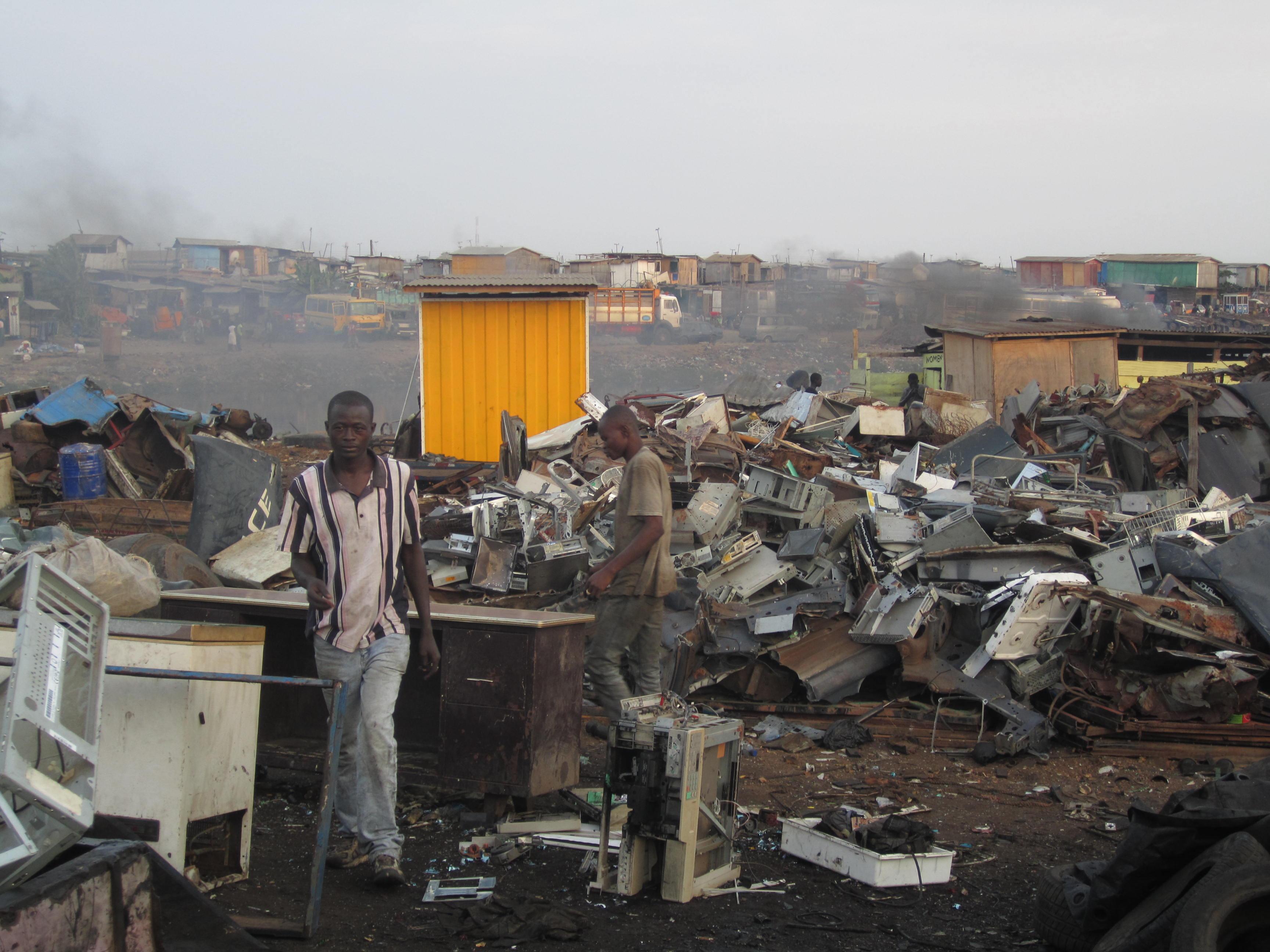
Scattered electronic waste in Ghana.
Americans didn't always need to be told to recycle. The movement grew from a combination of environmental awakening, public spectacle, and a real crisis over landfills. Although Earth Day 1970 planted the seed, it was the chaos of the late 1980s that turned recycling into a national trend. In 1987, the Mobro 4000 barge spent months wandering the Atlantic and Gulf coasts. It was rejected by port after port before returning to New York where a judge decided what to do with it. Dan Rather called it "the most watched load of garbage in the memory of Man." Johnny Carson joked about it nightly. The image of a civilization drowning in its own waste was projected onto millions of American TV screens. Meanwhile, the anti-incineration movement was fighting plans for 300 large incinerators across the country. The landfill crisis made recycling feel urgent and necessary. Many cities and states across America began implementing recycling programs to deal with the problem.
What recycling looked like for most Americans in the 1980s was very different from what it would later become. In many ways, it worked much better. And by multiple metrics, it actually was better. Households separated their materials based on composition. Paper went in one bag, glass sorted by color in another, and cans and metals went into a third pile. The recycling trucks that came by to pick up the materials had multiple compartments. The material that reached processing plants arrived mostly clean and easy to process. Independent scrap yards, family-run paper traders, and regional processors grew and brought in revenue that added to local economies. Reynolds Metals operated over 700 aluminum buy-back locations nationally. Paper mills in the Midwest and Ohio Valley accepted recovered fiber. And glass manufacturers reused the cola and milk bottles gathered from sorted collection programs to make new bottles. By 1989, more than 1,000 municipal recycling programs existed nationwide. And aluminum recycling had become so efficient that Reynolds was actually recycling more cans than it manufactured. The economic benefits were real and the entire system was fully American from curbsides to factories.
The 1990s, not surprisingly, saw recycling boom as the economic benefits became more and more evident. By 1992, more than 5,000 curbside collection programs were established nationwide. The national recycling rate jumped from 10 percent in 1985 to nearly 26 percent by 1995--and continued climbing. States began enacting mandatory recycling requirements, and the conversation shifted from whether to recycle to how to make it universal. But during this boom, we also saw the beginnings of the end even if we didn't know it at the time. As the profits of recycling became undeniable, a curious thing started happening to the waste management industry. A wave of consolidation turned waste management from a description into a proper noun. Waste Management Incorporated acquired more than 3,000 small family-owned haulers during the decade and ended up as an inter-connected network owning large swaths of collection, processing, and landfill disposal operations across the country. And as it consolidated, it began cutting out America from the most crucial step of the recycling cycle. This resulted in a net lose for America and nothing but increasing gains for China. And the go between that made this possible appeared right at beginning of the last decade the system could be called American.
At its height in the late 1980s, Reynolds Aluminum Recycling Company collected more aluminum from its buyback efforts than Reynolds Metals used to produce beverage cans. Recycled aluminum requires only 5 percent of the energy needed to produce aluminum from scratch.
In 1990, a Chinese entrepreneur named Zhang Yin moved to Los Angeles and began buying scrap paper from garbage dumps and shipping it to China in otherwise-empty cargo containers returning after delivering consumer goods to the United States. Her company, America Chung Nam, would eventually become the largest exporter of freight from America by volume. And instead of finished products, that freight was composed of paper, plastics, and basically anything else Americans were throwing out. Although her story is often told as an immigrant success story built on a strong worth ethic and entrepreneural drive, it's not that simple. Her father had deep connections with Communist Party members from his time in the Red Army during the Chinese Communist revolution. Internal rivals pointed to those connections for her fast rise within China as she forged numerous joint ventures with state-owned Chinese companies in the late 1980s. And her time after her departure from America adds even more to the picture with her numerous positions within China in the mid-2000s and later. Zhang eventually became a member of the Chinese People's Political Consultative Conference, a political advisory body for the Chinese government. It is widely recognized as a strategic extension of the CCP's united front operations and functions as a conduit for CCP-aligned influence both domestically and internationally. Beyond that organization, Zhang took a position as a standing committee member of the All-China Federation of Returned Overseas Chinese, which is a Chinese Communist Party organization focused on influencing overseas Chinese communities. Finally, it's difficult to overlook the alignment with her 1990s activities in America and the pressing problem the Chinese government was actively working to address at the time. And that problem was a massive need for raw materials to feed China's strategy of replacing America's factories with its own. But that doesn't mean she didn't find help in America. After all, she couldn't have moved massive amounts of US recyclables to China without US entities taking part.
Waste Management's pursuit of the recycling market and its massive expansion in the 1990s was never just for environmental aims. In reality, it's move into recycling was more about cornering every aspect of a market that touched literally every citizen. And they used single-stream recycling as a way to lure more and more cities to contract with them. They made promises of being able to take care of trash pickups as well as recyclables all without the need of any sorting. The reason single-stream was so attractive was because it was so convenient as it reduced the work on the families rolling out their garbage for collection. It was also surprising to many since sorting from one stream at the processing end added complexity and cost. Yet, Waste Management made claims it could add this convenience while simultaneously delivering the service more cheaply than the local companies across America that had been processing sorted recyclables for years. But the secret that fueled those promises were that they were based on lies. As the accounting scandals and illegal dumping scandals proved later, Waste Management Incorporated was run by a leadership that was willing to break the law to increase their bottom line. Instead of building an infrastructure to keep the recycling chain squarely in America, they out-sourced to China. China had slave and prison labor that could operate at a fraction of the cost of operations in America. The result was the collapse of recyling in America and the concentration of profits for a small number of individuals within the waste management industry. The two sides began merging even more by the late 1990s and early 2000s with the move and recruitment of Waste Management executives into Zhang's US-based company, America Chung Nam.
The $1.7 billion fraud that Waste Management's founders ran throughout the 1990s was the biggest in US corporate history until being eclipsed by WorldCom a few years later. The fraud involved the same auditor that was involved with the WorldCom and Enron frauds as well--Arthur Andersen.
In 2018, China seemingly pushed back at the importation of recyclables. China implemented what it called its National Sword policy. On January 1, 2018, China banned 24 categories of solid waste that it had previously accepted from Western nations, including mixed paper, post-consumer plastics, unsorted fiber, and various textile and metal categories. For the materials not covered by the outright ban, China imposed a new contamination limit of 0.5 percent. Prior to National Sword, China was accepting contamination levels of up to 10 percent. The United States alone had been sending nearly 4,000 shipping containers of recyclables to China every day. That flow collapsed almost immediately. In 2017, roughly a third of Waste Management's recovered paper had gone to China. By May 2018, the figure was nearly zero. But China wasn't getting out of the recycling business. Instead, they were moving the dirtiest parts of it outside the country while still receiving the end product of clean and usable raw materials. And this becomes clear when you look at what was happening around Southeast Asia prior to the 2018 Chinese policy change.
The groundwork had been laid years before National Sword took effect. Nine Dragons Paper, the company built by Zhang Yin from her US recycling trade operations, moved into Vietnam in 2008 where she acquired a controlling stake in a Vietnamese paper mill called Cheng Yang. American recovered paper that could no longer ship directly to China traveled instead to Vietnamese and Malaysian facilities, was converted into recycled pulp, and re-entered China through the Guangxi border. It's at that border crossing where Nine Dragons built a new 7 million ton per year paper mill designed to consume what those Southeast Asian mills produced. The dirty work of collecting, sorting, and cleaning contaminated Western fiber now happened outside China. The usable output, however, continued to flow in. In Africa, the pattern was the same even if the materials were different. In Ghana, the circuit boards and copper wire that young migrants from northern Ghana burned and stripped were collected on request from Chinese buyers operating through the port at Tema. The Ghanaian scrap dealers who collected and sold those circuit boards did not know what was being done with them but believed they were being exported. Academic fieldwork by Western research teams confirmed that the recovered materials including copper scraps and mixed metals were being sent primarily to China, where further refining occurred.
If you find any of the articles useful, please share with others. Also, send an email so we can keep in touch for special articles and episodes. Email: jeremy@plainmeaning.com
And finally, in the US we see the new pattern with the widespread purchasing of recycling facilities across America. Zhang Yin's Nine Dragons Paper, within months of National Sword's implementation, acquired paper mills in Maine, Wisconsin and West Virginia. Other Chinese companies opened plastics recycling facilities in Alabama and South Carolina. Rather than buying American scrap and processing it in China, Chinese-owned companies were now in full control of the American recycling infrastructure from pickup to processing. The dirty polluting part stayed in America while the desired end product--clean and usable raw materials--flow to China. And since these facilities are Chinese owned, the profits move to China as well. While many local communities welcomed these "investments" by highlighting the local jobs they would produce, the actual reality is the opposite. When you look at the consolidation of the infrastructure that has been taking place since the mid-2010s from Chinese owned companies in America, you see that recycling industry jobs in the US have actually gone down. According to Bureau of Labor Statistics data compiled by the Federal Reserve Bank of St. Louis, employment in US paper mills fell from 88,700 jobs in 2022 to 82,900 in 2025. In scrap metal recycling, the picture is the same with reports showing the sector declining at least 4 percent annually on average between 2021 and 2026. There is no American benefit in any of what China is doing in the recycling chain regardless of what local officials may be led to believe. To put it quite simply, America needs to start taking out its own garbage again. And that also means separating and processing its recyclables too.