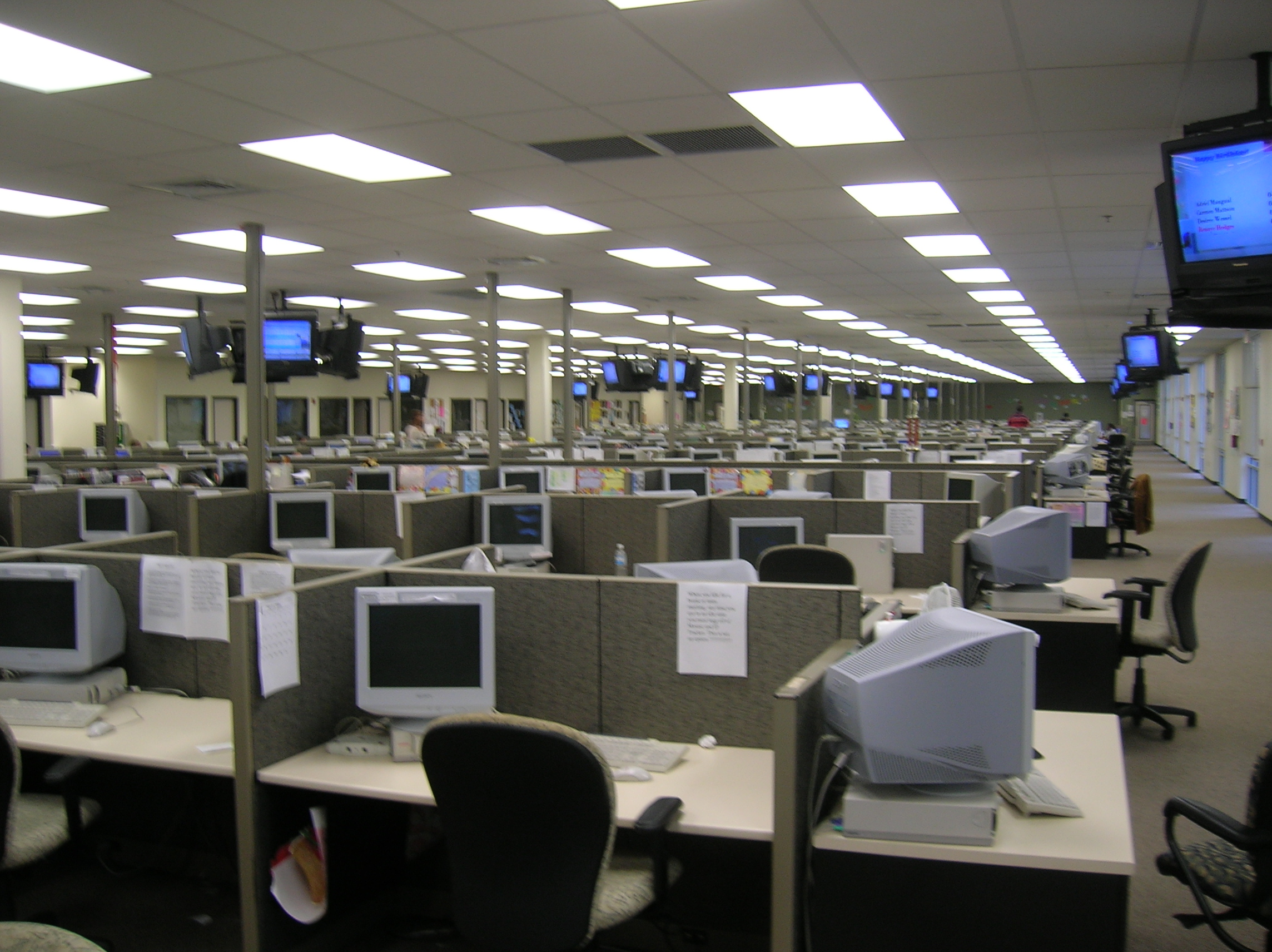
A call center.
Nearly every American who has shared their information with an American corporation has had their personal data processed by workers in India, Eastern Europe, or China. The United States spends tens of billions of dollars on what is referred to as business process outsourcing. This includes basically everything you can imagine. Hundreds of thousands of American jobs are sent over seas every year. Medical records, financial transactions, legal documents, biometric scans, and Social Security numbers flow daily across borders to processing centers operating under foreign laws and foreign governments. And if you think more automated processes or even Artificial Intelligence (AI) will stem this flow, think again. But we'll get to that part toward the end. Right now, we need to talk about what these outflows of personal data is costing America beyond just jobs.
In 2005, employees at a call center in India--which was providing services for Citibank--memorized account PIN numbers during service calls and transferred hundreds of thousands of dollars from American account holders. That same year, an employee at a Delhi-based firm called Infinity e-Systems sold the account numbers and passwords of over a thousand bank customers. These breaches didn't require a hack or any malware. They required only the access that American companies gave them.
The risks extend far beyond just criminal purposes. FBI Director Christopher Wray remarked in 2023 that if you are an American adult, it's more likely than not that China has stolen your personal data. One of the largest single thefts was the Equifax breach, in which Chinese state actors obtained personal information on nearly half of all Americans. But there's some data China can simply get by simply paying for it. Data brokers are companies that collect and sell personal information. And surpringly, selling this data to foreign companies or to companies that then export this data is not illegal in the United States. Dozens of data brokers operating in California alone were found to be selling American data to foreign actors, to include entities linked to China, Russia, and North Korea. Bulk personal data enables foreign intelligence services to identify Americans vulnerable to recruitment as spies, map the movements of military personnel, and conduct influence operations that are hard to recognize until after the damage has already been done.
Pier 1 Imports started in San Mateo, California in 1962. Its first customers were post-World War II baby boomers looking for beanbag chairs, love beads, and incense. The Fort Worth retailer whose mailing list ended up in Beijing in 1982 got its start selling counterculture novelties.
The industrial scale moving of America's personal information can be traced to 1982 and a Dallas-based company called Pacific Data Systems. Pier 1 Imports, among others, began handing off its mailing list processing to the company, which then sent the work to a Chinese facility. On the surface, mailing lists don't seem too provocative or threatening. But from a defense perspective, being able to target down to the individual level the shops one frequents or the interests they hold through their magazine subscriptions allow for the building of personality profiles that can later be exploited. But of course, the exporting didn't stop with magazine mailing lists. And the moving of both focus and resources to China wasn't purely a corporate phenomena since there was a political component that enabled the business outsourcing in the first place. In 1972, President Richard Nixon made his famous trip to China thus reopening ties that had been closed since the Communists took power. The thinking in Washington was that this opening would benefit America by not only increasing the strain between the two largest Communist powers but also open up a new market for American goods. In other words, it was supposed to work out where the Chinese were buying American goods. But China had other plans and high-profile thought leaders in the US continued to push the move toward China even as it became clear the Chinese were looking to replace American factories instead of buy from them.
If you find any of the articles useful, please share with others. Also, send an email so we can keep in touch for special articles and episodes. Email: jeremy@plainmeaning.com
Henry Kissinger, Nixon's National Security Advisor and the main advisor pushing for Nixon's trip, established Kissinger Associates the same year Pacific Data Systems opened their operations in China. Kissinger would spend the rest of his life lecturing to both the corporate world and even future presidents about the importance of deepening ties with China. The academic world largely echoed Kissinger. In 1983, Harvard Business School professor Theodore Levitt published "The Globalization of Markets" in the Harvard Business Review. It provided the intellectual framework that recast the export of jobs and production as visionary strategy. Companies must learn to operate, Levitt wrote, as if the world were one large market. He pointed to regional and national differences as superficial. But he and others clearly didn't mention the real differences that exist in culture, laws, and the value of human life. For instance, there was no mention of how markets can be distorted and twisted with certain players like China using slave and prison labor to create the "price efficiencies" those and others touted.
The Ahmedabad call center scammers didn't just impersonate the IRS. Their scripts covered the IRS, USCIS, the Canadian Revenue Agency, and the Australian Tax Office, and included tips on handling victim suspicions. They were packed into a six-page document refined through thousands of fraudulent calls. One operation was making $150,000 a day before it was caught.
Washington eventually noticed, but only barely. And even then, it was confined to only a small part of the much larger problem. In April 2005, Representative Edward Markey sent a letter to the IRS Commissioner describing "a regulatory black hole" around the offshore processing of American tax data. He introduced the Personal Data Offshoring Protection Act, which would have required companies to notify Americans and obtain their consent before transferring personal information outside the United States. The bill went nowhere but even this wouldn't have done much since the real solution is to make the process forbidden. In 2024, President Biden issued an executive order directing the Justice Department to restrict transfers of biometric, health, financial, and geolocation data to countries of concern. But it wasn't a law and it allowed exceptions. Currently, there is still no comprehensive federal privacy law. Identity verification companies handling American passport scans and facial biometrics routinely ship the process overseas. In fact, a number of the ones used for processing the personal identity of many Americans are actually not American companies at all. And should online age verification be implemented, the problem would only get worse. The personal data theft of Americans is a solvable problem. But for us to get to the solution, we first need to acknowledge that national borders still matter. And more importantly, that personal privacy does as well.