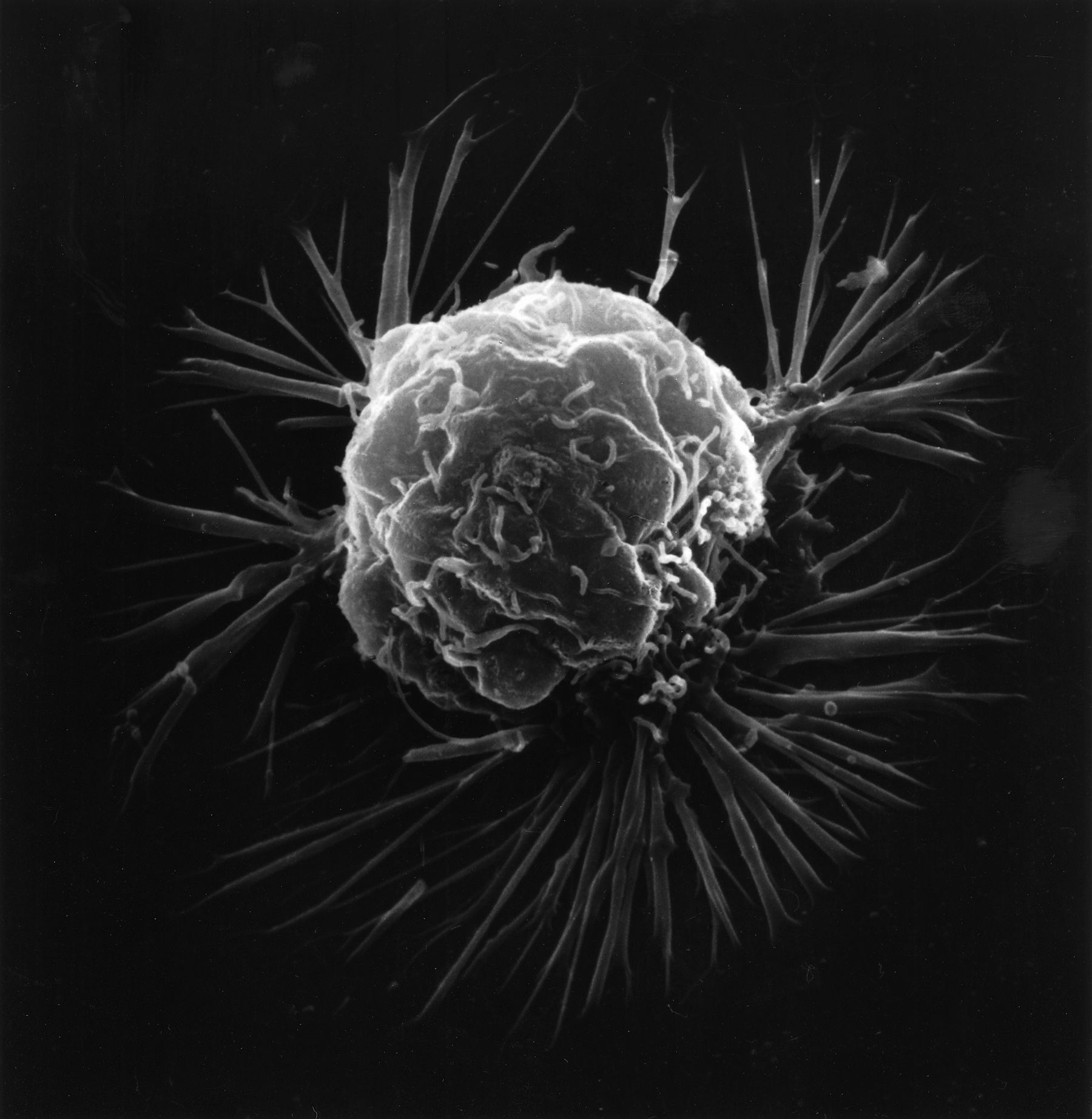
A cancer cell.
Every year Americans spend more than $200 billion on cancer drugs. A course of chemotherapy for pancreatic cancer costs around $40,000. A single immunotherapy infusion often costs $15,000 or more. A patient will normally be given 8 or 9 infusions of immunotherapy within a year. Cancer has become one of the most profitable diseases in human history. The landscape of cancer drugs is mostly one filled with things that manage the disease rather than curing it. So what happens when something genuinely promising appears that actually could cure it?
The answer to this question is found in peer-reviewed journals, federal court filings, and congressional reports. The truly breakthrough cures--not treatments, but cures--face challenges that go beyond those that simple treatments face. In most instances, they face hostility and attack from those you think would be the most welcoming: doctors and researchers. This is strange since those schooled in the world of the scientific method based in enlightenment ideals would be expected to embrace new ideas instead of shun them. They would be expected to support research and trials to find out what works instead of deciding just from mere mention that something is a failed idea. But rejection and ridicule is seemingly the norm along with the delaying of real progress and treatments by decades that come with it.
For example, William Coley observed in 1891 that a patient's inoperable sarcoma disappeared after a severe bacterial infection. He then began deliberately injecting cancer patients with bacterial toxins to stimulate immune responses. Although he documented hundreds of tumor regressions, most of his peers dismissed his work as anecdotal with radiation oncologists actively campaigning against him. The American Cancer Society formally listed Coley's toxins as an unproven cancer treatment in 1965. His daughter spent her life fighting to preserve his research through the Cancer Research Institute. It was not until James Allison received the 2018 Nobel Prize for proving that the immune system could cure cancer that the National Cancer Institute formally acknowledged Coley's work as a breakthrough. They called it a "forgotten cure."
The $2.6 billion figure that the pharmaceutical industry constantly cites as the cost of developing a new drug and is used to justify high drug prices comes from a study conducted by the Tufts Center for the Study of Drug Development using cost data provided by the pharmaceutical companies themselves. An independent study published in the British Medical Journal using actual trial cost data found the median cost of a pivotal clinical trial was only $19 million.
But it's not just resistance from fellow scientists and doctors that stop progress. The Food and Drug Administration, the entity that is supposed to assist in the advancement of treatments to improve the well-being and health of Americans, seemingly creates some of the strongest road blocks to new treatments and cures. And those road blocks don't just manifest in the form of complicated regulations or bureaucratic inertia. In many instances, the FDA actually attempts to put those exploring new cures in jail. And often, they pursue these drastic actions not out of concerns over health but too often what appears to be the protection of the profits of certain companies.
Dr. John Najarian was a University of Minnesota transplant surgeon who had spent two decades developing and distributing Minnesota antilymphocyte globulin. This was a drug that doubled the one-year survival rate for kidney transplant patients from 40% to 80% and had become the global standard of care at over 100 transplant centers worldwide. SangStat Medical Corporation, a Silicon Valley start-up connected to a French bio-technology firm, raised its Series B venture capital round in July 1991 specifically to enter the North American transplant market with a product that was a direct competitor to the drug distributed by the University of Minnesota. Within months of this funding round, Dr. Najarian and the University of Minnesota found itself under surprising scrutiny. After over 20 years of being under FDA inspection and providing reports about its medication, the FDA suddenly imposed a clinical hold on the drug in 1992. The FDA then pursued Najarian with a multiple-count federal indictment that threatened to send one of the most accomplished transplant surgeons in America to prison. And it wasn't because the drug didn't work or was harmful, but basically for paperwork violations and profitability disclosures. The federal judge presiding over the case let his feelings be known. He voiced his skepticism by stating he had "some question as to why we are here at all, quite frankly." The jury acquitted Najarian on every count. But it was during that hold and FDA's court case that the competitor drug was able to enter the US market. Without the hold, the competitor drug would have had to compete with Minnesota's drug during clinical trials. But with Minnesota's drug on hold, the foreign competitor only had to compete against a less effective one. And what was the result? SangStat's Thymoglobulin turned out to be more expensive and less effective than the treatment that the public university in Minnesota had been offering for decades.
John Kanzius, the man who built the most celebrated experimental cancer treatment device of the early 21st century, had no medical degree and no laboratory. He built his first prototype using his wife's pie pans, copper wire, and a modified radio transmitter in his garage in Erie, Pennsylvania. The device he built with pie pans attracted the endorsement of a Nobel laureate, produced near-100% cancer cell kill rates in peer-reviewed animal trials, and inspired $15 million in donations from ordinary Americans. After being acquired by a venture-backed firm, his cure was watered down into basically a warming pad to support established treatments like chemotherapy.
And if derision by physicians invested in the established treatments and a hostile FDA isn't enough, you still have US hedge funds and private equity firms to contend with. For small publicly traded biotechs developing genuinely disruptive therapies that could eliminate recurring treatment revenue rather than supplement it, the financial markets represent a third front in a war against cures. The mechanism used is often called short and distort. It's basically the inverse of the better-known pump and dump stock scheme. It involves a hedge fund taking a large short position in the target company's stock. A short position is a bet that a stock's price will fall rather than rise. Instead of buying first and selling second, a short seller sells first and buys second. They're basically selling something they don't own. A short seller approaches a broker and borrows shares of a company — say, 100,000 shares of a small biotech trading at $10 per share. The short seller immediately sells those borrowed shares into the open market for $1 million. Now the short seller has $1 million in cash but owes the broker 100,000 shares that must eventually be returned. If the stock falls to $2 per share, the short seller goes back into the market, buys 100,000 shares for $200,000, returns them to the broker, and keeps the $800,000 difference as profit. The lower the stock falls, the more money the short seller makes.
A small pre-revenue biotech developing a cancer treatment has its entire operational existence depending on its ability to periodically return to public markets and sell new shares to raise the cash it needs to fund its operations like clinical trials. If its stock price is destroyed, it loses its major source of funding. The company is often destroyed. And the short seller profits from its destruction. But beyond the fact that the hedge fund is selling something it doesn't own (this would normally be considered fraud in nearly every other context), the hedge fund is not just sitting by hoping the company will fail. And this is where the "distort" part of the scheme comes in. One of the most notorious participants in these schemes is Andrew Left utilizing a firm he called Citron Research. Once a short position was taken by Left or one of his associates, he would then release a report that was actually a hit piece on the company in order to raise doubts about the company. And according to some filings in court, these hit pieces were more than just negative reports but often served as a marker to others that the company in focus was being targeted by powerful short-sellers. In other words, these reports seemed to be used as coordinating tools to swarm particular businesses. And the short-sellers would make even more money if the company they targeted went bankrupt. And bio-techs were some of the most targeted companies because of the long-term nature of research needed to bring a product to market. Any regulatory setbacks or delays were used as part of the "short and distort" schemes.
If you find any of the articles useful, please share with others. Also, send an email so we can keep in touch for special articles and episodes. Email: jeremy@plainmeaning.com
Of course, all this brings up the possibility that established competitors could have been involved. The giant pharmaceutical firms with dozens of drugs that require multiple treatments would lose out tremendously should new and disruptive cures come to market. So obviously not just short sellers gain with the destruction of new and emerging bio-technology and medical device companies. But for now, we only have enough information and facts to point to the short sellers being directly involved. But that doesn't mean we can't point out how the giant pharmaceuticals win in all this even if they aren't directly part of it.
The problems outlined in this article are numerous. But they are not without solutions. Two reforms in particular would fundamentally shift the balance toward cures and away from the status quo. The first involves the FDA itself. The agency has every structural incentive to say no. Its mandate of ensuring that no harm is done combined with the ever-increasing influence of established pharmaceutical interests within its ranks, means the FDA is and will always be predisposed to obstruct rather than accelerate new therapies and cures. The only effective counterbalance is a separate agency with an entirely different mandate, which is focused purely on identifying and developing cures. Critically, this agency must exclude industry insiders entirely. The moment you bring in pharmaceutical industry experts, you bring in people whose professional formation is rooted in economics rather than science. Evaluation from this perspective is centered around dollars and cents instead of the extension of days of individual lives. An institution staffed solely by scientists and researchers, insulated from industry influence and mandated to pursue public domain cures, would provide a genuine counterweight to both FDA obstruction and industry attacks on emerging therapies.
The second reform is simpler--short selling should be made illegal. If you borrowed a neighbor's car and sold it to someone down the street, hoping to buy it back more cheaply after the price dropped, that would be fraud in any jurisdiction in America. Yet hedge funds do the equivalent every day by borrowing shares they don't own and then selling them into the market. As this article has shown, small biotechs developing genuinely disruptive cancer therapies are among the most vulnerable targets of these schemes. Destroy the stock price and you destroy the company, the research, and the patients who were waiting for the cures that were so close to being in their hands. Eliminating short selling would protect not just emerging biotechs but the other American industries and companies that have been casualties of these coordinated financial attacks.
There are other reforms worth pursuing. But these two are a good first start. The choice, in the end, is not complicated. We are either serious about finding cures, or we are more interested in protecting the revenue streams of those who profit from managing disease. It's time to choose cures instead of treatments.