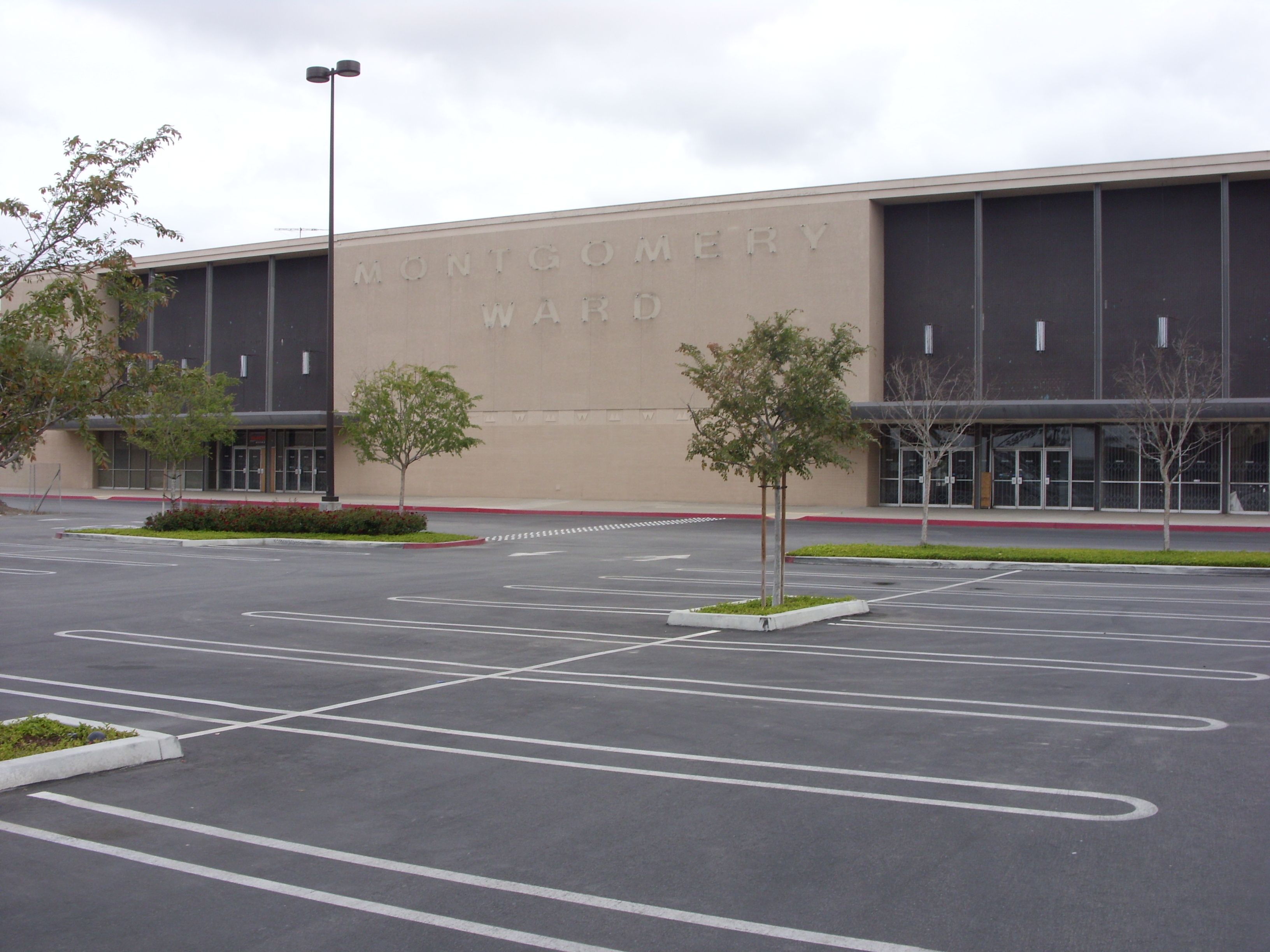
A vacant Montgomery Ward Store at Bella Terra mall in Huntington Beach, CA.
The American shopping mall, once the undisputed cathedral of consumer culture is in an advanced state of collapse. The United States has around 700 malls remaining in the mid-2020s. This is down from over 2,000 at its historical peak. And the ones that remain open are empty of stores with many deterioriting physically due to lack of maintenance. The largest holders of this deteriorating landscape read like a roll call of American real estate power. Brookfield Properties, Simon Property Group, Kimco Realty, and SITE Centers are among the leading shopping center operators in the United States. Simon is the clear leader holding an interest in over 170 million square feet of commercial leasable area. But that's one group of owners. They are the ones that hold the still thriving malls--the malls that are near trendy or affluent locations and often well maintained and full of shoppers. In the mall industry, these are usually described in terms of their sales figures and they have have a letter classification. They're known as Class A malls. But these are the exceptions to mall success in America. The vast majority that remain are mostly empty and falling apart.
Meanwhile, overseas, the mall is anything but dying. Asia-Pacific stands out as the dominant region in global shopping center growth due to its rapidly urbanizing population and increasing disposable income. There's a strong retail appetite with new mega-malls opening regularly in South Korea, Japan, Singapore, and across Southeast Asia. European cities, meanwhile, maintain a two centers of commercial centers of gravity that Americans have essentially abandoned. They have the historic town center, which Americans simply call downtown. And, they have suburban shopping centers thriving within the same areas. London has Westfield Stratford and Oxford Street. Paris has Les Halles and the Marais. People in those cities shop physically, socialize commercially, and support spaces. American cities increasingly have neither. We see the same pattern in China as well. Their malls are thriving. And all of these foreign areas have an internet just as robust and commercial as the US. China has thriving malls even as nearly half of its retail sales are happening online. South Korea and the United Kingdom are similarly heavy e-commerce users and also still have stong physical retail activity. The internet is everywhere. But the decline in malls only seems to be in America. The answer for this obviously is something other than the internet. And when you look at the balance sheets and realeastate transactions, you see that the real cause lies in the tax code.
Amazon converted 25 malls into fulfillment centers between 2016 and 2019 alone. The stores that used to sell you things are now the warehouses that ship you things. The community gathering place became a sorting facility.
To understand why American malls are being held empty and run into the ground for profit, you have to go back to the legal architecture that made it profitable to do so. The Tax Reform Act of 1986 was a watershed moment. That law created passive activity loss rules that transformed where the most profits could be found within real estate. Before 1986, investing in rental real estate was an automatic major reduction in tax obligations. Rich investors could invest money in real estate, use losses from those investments to offset income from unrelated activities, and end up sheltering massive amounts of wealth. Section 469 of the Tax Reform Act targeted this abuse by restricting passive losses. But the real estate industry struck back almost immediately. In 1993, the real estate industry successfully lobbied for a special rental income exemption from the passive loss rules, creating a tax benefit for money-losing real estate investments. Then came the 2017 Tax Cuts and Jobs Act, which handed the industry yet another tool to skimp on taxes. Under Section 199A of the new tax law, REIT owners became eligible for a deduction equal to 20 percent of their "qualified REIT dividends." That deduction was originally scheduled to expire at the end of 2025 but was made permanent by the "One Big Beautiful Bill Act" on July 4, 2025. The accumulated effect of these strengthened an already perverse incentive. It meant that owning a declining, largely empty mall actually makes you more money than running it successfully.

If economics teaches us anything, it teaches us the power of incentives and how they can drive particular actions. And the predictable result of the incentives that US tax law provides is now visible across the entire span of the United States. And if you thought it couldn't get any worse than an empty mall, then obviously you don't know about how most of them are increasingly delinquent too. The new owner of Fairlane Town Center in Dearborn, Kohan Retail Investment Group, amassed $2.1 million in delinquent property taxes, and DTE Energy posted a shut-off notice at a mall entrance warning tenants that electric and gas services could be terminated. The Westwood Mall in Michigan's Upper Peninsula faces unpaid electric bills, additional tax debt, and a collapsed roof that forced the entire facility to close, with property taxes for 2024 and 2025 remaining unpaid — a total of over $312,800 still due, gaining interest each month. A struggling mall was recently acquired by Dillard's after their previous owners were known for "not paying their utility bills, not paying property taxes." This is not a series of isolated incidents. It's a clear pattern. And if you were looking at it beyond just plain economics, it would also seem that the intent is to ensure that the mall could never be brought back again.
The endgame of this ownership model is a permanently destroyed mall. The lifecycle follows a pattern that involves buying cheap, extracting whatever cash flow remains, and selling off surrounding parcels and even parts of the mall itself. Whatever's left is often sold to an industrial developer. Eastland Center in Harper Woods, Michigan was a 64-year-old community landmark. It was that region's economic center of gravity. And it was acquired by Kohan in 2018. The company let it deteriorate until it finally closed it entirely. It was sold to a warehouse developer who demolished it and replaced it with distribution centers now leased to e-commerce companies. The gathering place is gone forever. And even if a better owner had wanted to step in, the physical repairs needed and the back taxes and utilities makes it unattractive to those who would be interested in running it as a mall again. But contract structures also seem designed to make it nearly impossible as well. Malls were often built under legal agreements with their anchor stores that run with the land for decades and require near-unanimous consent to change how the property is used. This often gives bankrupt department stores veto power over any recovery plan. What looks like simple neglect is better understood as a process of permanent destruction. And there's an entity that profits at every stage of the destruction cycle. The Kohan group is usually at the end of that cycle.
Marshalltown Mall in Iowa had its power cut off in November 2023 after the Kohan Group failed to pay the electric bill. It sat without electricity for more than a year. Kohan eventually sold it in early 2025. And walked away with a $6 million profit.
Kohan Retail Investment Group has been referred to as "the last owner a mall sees." They often invest little if anything in the malls they purchase. They allow the facilities to deteriorate while, at the same time, selling off outparcels of it. The company has attracted consistent attention for delinquent tax and utility payments at many of its properties. The numbers are hard to track but the Kohan group has owned up to 50 malls at one point and still holds at least a few dozen as of the writing of this article. The firm faces numerous lawsuits in a half dozen states for overdue taxes, unpaid utility bills, and dangerous conditions. The pattern is consistent enough to seemingly make up a strategy that you can almost predict beforehand. Kohan has a habit of paying off its bills at the last minute--only after the city or others bring formal legal action against them. At the Washington Square Mall in Indianapolis, Kohan paid over $1 million in 2018 to avoid a planned tax auction. At Lycoming Mall in Pennsylvania, Kohan paid nearly $60,000 in 2019 to settle delinquent water and sewer bills and stop an auction. Cities and counties find themselves nearly powerless because taking formal action against a mall owner takes huge resources in time and legal costs. It's a complicated process that requires code enforcement hearings, tax foreclosure proceedings, and litigation. And it can often take years. In the meantime, the owner continues to collect whatever rent trickles in, continues booking depreciation against other income, and dares local government to spend the resources to stop them.
The business model inside the walls is just as calculated. When Kohan or similar distressed-mall buyers acquire a property, they ususally cut deals with the anchor stores. The anchor stores are usually the 3 or 4 biggest retail spaces of mall that are at either end and one of the sides. These spaces are usually filled by department stores like Dillard's or Belk (and previously Sears before it was brought down by predatory "investors."). At Crystal River Mall in Florida, Kohan bought the entire mall in 2012 for $2.8 million — and within two years had already sold off the former Sears anchor space separately to Rural King for $775,000, recouping more than a quarter of his total purchase price from a single parcel while still owning the rest of the mall. The community got a farm supply store where a department store used to be. Kohan got his money back before he'd done anything else.
If you find any of the articles useful, please share with others. Also, send an email so we can keep in touch for special articles and episodes. Email: jeremy@plainmeaning.com
The anchor stores have always been the largest drivers of traffic to malls and thus, traffic for the smaller shops in between. Those anchor portions are now often sold off separately, generating an immediate cash return at the point of acquisition. What remains is the interior mall space, which the new owner fills by luring small businesses with cheap or even free rent. These tenants are usually local entrepreneurs operating hair salons, specialty food shops, and pop-up clothing stores. And they often invest their own money to make the deteriorating, neglected space habitable. They repair drywall, install lighting, and patch leaking ceilings. And they often do this at their own expense in the hopes of attracting business. But once the lease term ends, which is usually after a year or so, the mall's owner raises the rent. The tenant either pays the inflated price or leaves. If they leave, the owner is left with a renovated space they never paid to improve, ready to run the same cycle on the next entrepreneur. At the Town Center at Cobb in Georgia, tenants paid a monthly $350 utility fee to Kohan in addition to their base rent. An attorney later argued in a lawsuit that the money should have gone toward the electric bill but actually didn't. Instead, the mall ended up having power shut off. When a mall finally becomes legally or physically impossible to continue, it is sold. The community is left with a hulking ruin where lively commerce might have been or some industrial warehouse.