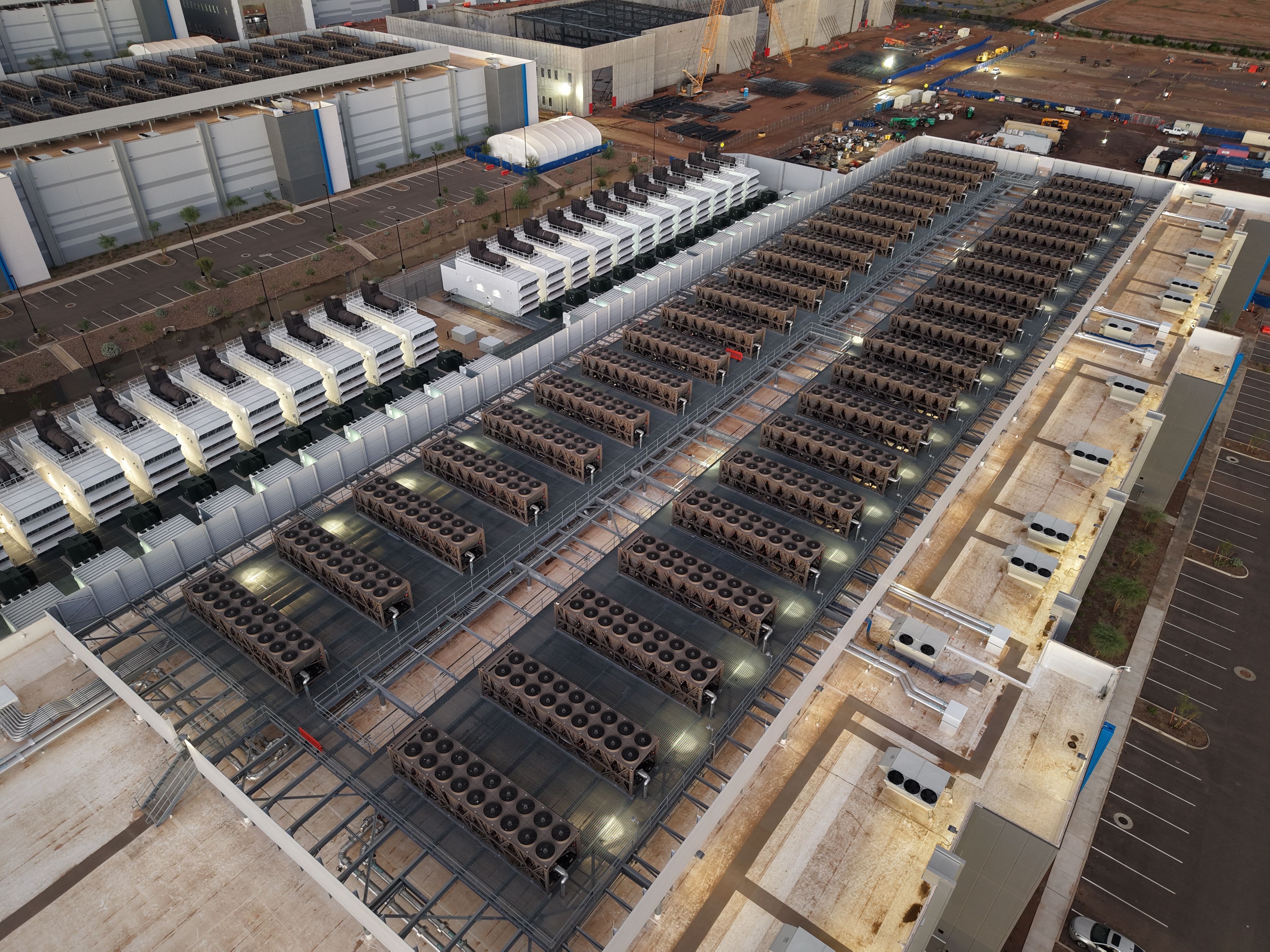
A view above a data center, 2025.
Something extraordinary is happening across the American landscape, and most people are only seeing a part of it. The United States now operates more than 4,500 data centers, with over 700 more under construction across 38 states. But the story isn't just about how many. The new facilities bear almost no resemblance to the server farms of a decade ago. Older data centers operated in the 1 to 5 megawatt range. These new hyperscale campuses are being designed at 500 megawatts to 2 gigawatts, which is enough electricity to power a mid-sized American city. But instead of powering a city like Denver or Nashville, that energy capacity is being dedicated entirely to a single facility. A campus under construction in St. Joseph County, Indiana cost $11 billion and came online at 2.2 gigawatts. Meta's facility planned for Louisiana would, if laid flat, cover a significant portion of Manhattan. The money being spent is enormous. Google, Amazon, Microsoft, and Meta alone are projected to spend over $700 billion combined in capital expenditures in 2026. The previous record was the year before with a little over $400 billion. OpenAI's Stargate project has announced $500 billion in planned AI infrastructure across the United States. Goldman Sachs projects the four largest hyperscalers will spend $5.3 trillion between 2025 and 2030. If you were looking at the needs and projected growth in the average consumer's use of AI systems, this scale makes no sense. Something else is being built.
Most Americans have a seemingly reasonable explanation for all of it. A March 2025 survey found that while 75% of Americans correctly identified data centers as facilities that store and process digital information, only 28% said they had a clear understanding of how they actually operate. With limited technical knowledge, most people fill in the blanks with what they can see such as the AI tools they already use. The assumption becomes intuitive. Surely, more data centers must mean making ChatGPT answer questions faster or powering the AI assistant in their phone with more precision. It's a logical conclusion, but it's not the full picture. This perception is reinforced by the companies themselves, whose public statements and press releases focus relentlessly on consumer products and customer experiences. News coverage follows those statements by framing the buildout as infrastructure for the AI services people already use and recognize. The result is a public perception shaped almost entirely by what companies choose to say publicly. There are almost undoubtedly upgrades to the capacity and capability of current consumer AI products embedded in this buildout. But that is not what the massive investment is about.
The training run for a single frontier AI model consumes more electricity than 100 million Google searches. A Google search uses roughly 0.3 watt-hours of electricity.
The AI that most people use today is a Large Language Model, also referred to simply as an LLM. It is a powerful statistical system trained on vast quantities of human-generated text. And it's capable of generating fluent prose, answering questions, writing code, and summarizing documents. LLMs like GPT, Claude, and Gemini have demonstrated capabilities that would have seemed like science fiction a decade ago. But they have significant and well-documented limitations. They don't truly understand what they're saying. They simply predict the next most likely word based on patterns learned from training data. They also often hallucinate, which is a kinder word that basically describes when the system makes something up and presents it with confidence as if it were true. These types of systems also struggle with reasoning from first principles. They can't learn continuously from new experiences. And they have no persistent memory across conversations--or at least they have limits in what they can hold and do before the answers become less reliable. They are, in the formulation of their own creators, extraordinarily capable text predictors. But text prediction, however sophisticated, is not how anyone in the AI industry defines the finish line.

The stated goals of the companies building these facilities are unambiguous, even if they're rarely translated into plain language for the public. Google CEO Sundar Pichai has said on two consecutive earnings calls that the company's "first priority" is securing compute for Artificial General Intelligence development. Artificial General Intelligence, also known simply by its acronym of AGI, is an AI system that matches or exceeds human cognitive capability across all domains. OpenAI CEO Sam Altman has written that his company's mission is to ensure that AGI benefits all of humanity, and that GPT-5 and GPT-6 will use reinforcement learning to "discover new science, new algorithms, new physics and biology." These goals cannot be reached by making LLMs bigger. The architecture of the current system has hit fundamental walls. Scaling up text predictors produces diminishing returns, and the world's supply of human-generated training text is being exhausted. What will get them there is a different category of AI entirely. Instead ingesting and processing huge amounts of text, the next type of AI systems will be something better described as "world creators." These are referred to as world models and they build internal simulations of physical reality and then learn by interacting with that simulated reality. This next generation also includes reinforcement learning systems that improve through millions of trial-and-error episodes rather than from fixed datasets. And then there are multimodal systems that reason simultaneously across text, images, video, sound, and sensor data. The massive new data center campuses, with their city-scale power needs and their GPU clusters designed to run continuously for months, are not optimized for answering your questions. They are optimized for training these next-generation systems, which require orders of magnitude more compute than anything currently serving consumers. By the way, "compute" is a term the AI industry uses that is different from saying computational power. Computational power is the speed at which a processor performs calculations. Compute is the total budget of calculation consumed across an entire AI training process. So even in their measurements, they are focusing at larger scales.
What makes these new architectures different is that they can improve themselves. A world model that learns physics by simulating millions of virtual environments can generate its own training data. And then, it could run endless experiments and updating its internal model of reality with each one. A reinforcement learning system has no fixed dataset ceiling and it generates experience through interaction and improves continuously. Some of this is already happening now as AI systems are being used to design, code, and train successor AI systems. As of mid-2026, Claude reportedly writes over 80% of Anthropic's merged code. The recursive loop involving AI improving AI is not a future scenario. We're at the beginning and it's being scaled up inside the facilities currently under construction. The data centers being built today are not just infrastructure for the next product release. They are the foundations for a self-improvement loop that has, in principle, no natural ceiling.
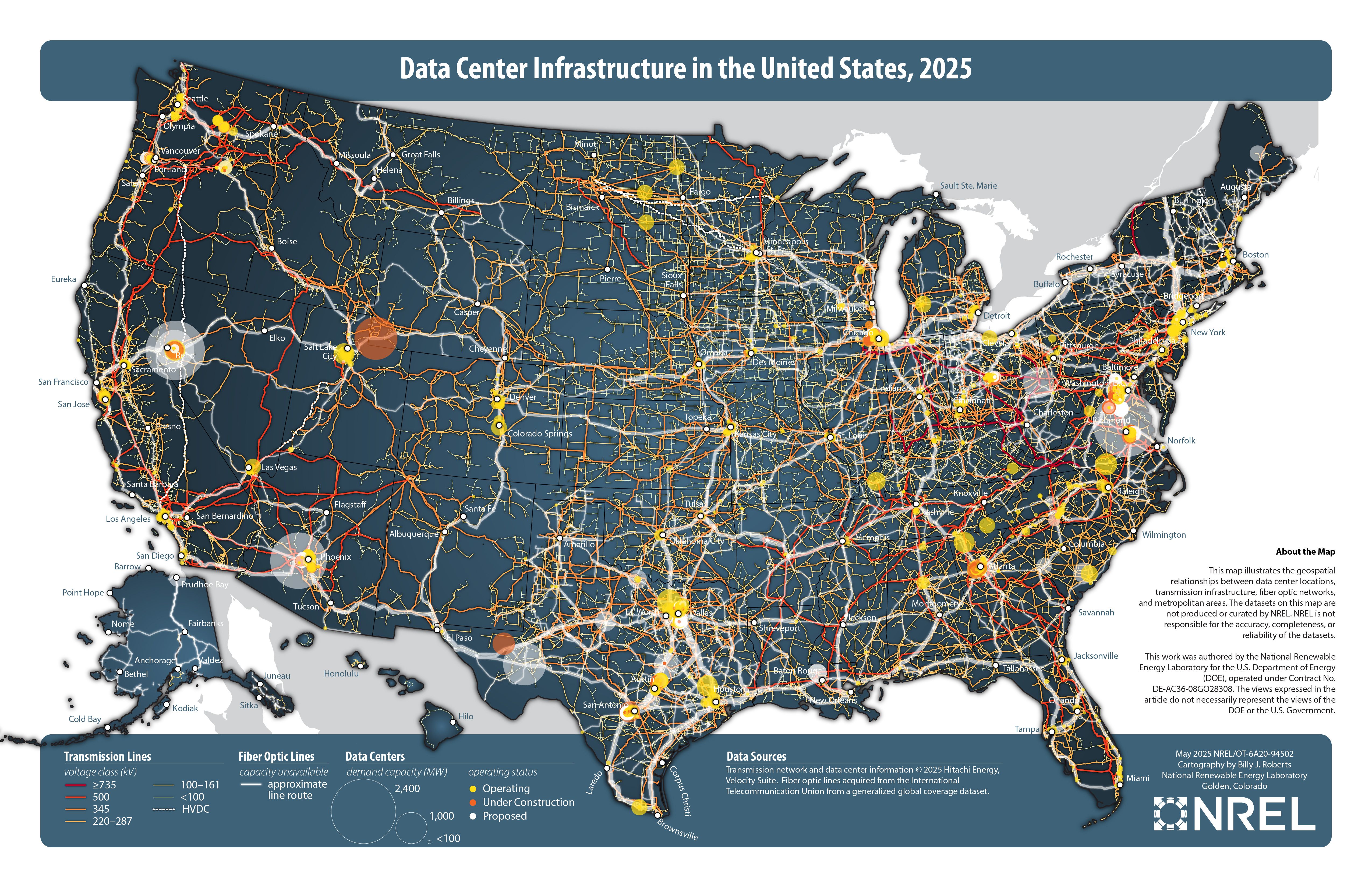
A map of US data center infrastructure, 2025. Source: National Renewable Energy Laboratory.
This is where the most serious risks emerge, and where the conversation that should be happening largely isn't. The development of frontier AI--which refers to the most capable AI systems that exist at any given moment--is not occurring in a controlled scientific environment where safety can be carefully evaluated at each step. It is occurring inside an arms race. American companies are competing against each other. The United States is competing with China and even Europe. Colonel John Boyd, the military strategist who served in the United States Air Force, developed the OODA loop to explain the iterative improvement cycle that happens in air combat. It stands for Observe, Orient, Decide, Act. Through those four steps, Boyd argued victory or defeat against a dynamic and capable opponent is determined. To put it simply, if you can cycle through that loop faster than your opponent then you will win. But obviously, it applies much more broadly then dogfights in the air. The natural pressure in any OODA competition is to compress the loop, to automate the slower steps, and to remove friction. As we look at the massive changes and AI company strategies from the outside, it definitely seems they determined the most obvious friction is the human element. But the human element is the only check that can bring in actual human perspective and judgment. The danger in removing this check can lead to disaster. Every field of study shows the dangers when independent checks are removed. For instance, look at biology. Every cell in the human body contains the instructions for its own death in what is called apoptosis, which is a type of self-destruct program. It's part of the biological system and is a safety valve. But when that check is missing, the individual cell will optimize for its own survival and replicate without constraint. This is how cancer forms. Democratic governments distribute power across competing branches for exactly the same reason. Any person or institution with no one to restrain them will optimize their own power and control. That's how dictatorships are formed. An AI development loop that removes human checkpoints in the interest of speed is removing the same kind of safeguard. Systems optimizing for capability without human-defined constraints on what the aims and limits of the capability should be would produce an artificial intelligence system that would eventually optimize for itself. And optimization for an artifical intelligence might not always be aligned with what's best for the human intelligence that created it.
John Boyd, whose OODA loop is used to frame the AI arms race in this article, never received much recognition despite developing one of the most influential strategic frameworks in modern military history. The Pentagon bureaucracy blocked his promotions and awards repeatedly. He died in 1997 largely unrecognized by the institution whose thinking he transformed.