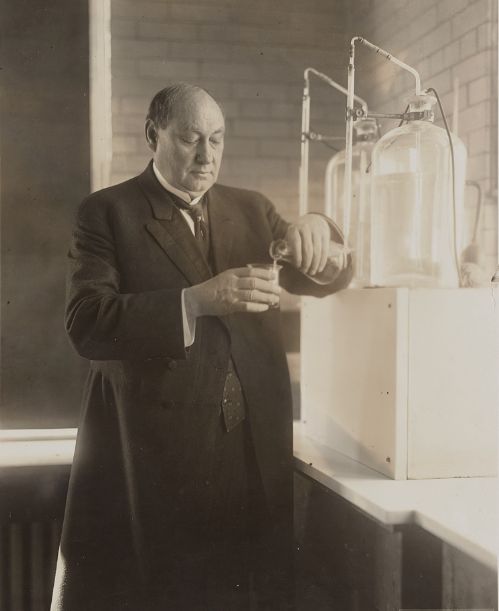
Harvey Washington Wiley, a US government chemist that was an early proponent of regulating food additives.
For most of American history there was no federal food safety law, and for most of that history there didn't really need to be one. Food was grown within a day's travel of where it was eaten. And it was often sold by someone whose name you knew, and with it being consumed before it could spoil. A loaf of bread was flour, water, salt and yeast. But then came industrialization. As railroads, canning and refrigeration changed the distance food could travel and how long it could survive once it arrived, food started to become a commodity that came from people you never met. Individuals and businesses started studying and changing the chemistry of the food itself. As early as 1820, the chemist Frederick Accum had catalogued the fraudulent adulteration of bread, beer, and other products in London. He named the companies responsible. He also identified what he viewed as the cause--the rise of complexity. Food production followed the trend of nearly every other economic activity in the sense that its operations were divided in efforts to increase efficiency. This way of organizing industries is popularly known as division of labor. But Accum noticed something else happening beyond increased efficiency. With a product's harvesting or processing being spread out over multiple entities, you had increasing opportunities for taking shortcuts or even committing outright fraud in order to maximize gains. By the end of the nineteenth century the American version was worse. Perhaps in some ways because the chemistry had improved. Formaldehyde preserved milk. Arsenic and lead brightened candy. Copper sulfate gave canned peas the cheery green of the French product. Spices were cut with ground coconut shells. Some coffee samples tested by government chemists were found to contain no coffee at all. What was supposed to be whiskey was found to be ethyl alcohol tinted brown with tobacco extract instead. But at that time, these actions weren't illegal.
In a season 2 episode of the science fiction television show Fringe, Walter Bishop — played by John Noble — goes grocery shopping in Boston. He reacts with rage when he reads that a toaster pastry contains potassium bromate and yells out the various health effects caused by it to a bewildered supermarket attendant.
But pubic attention would eventually lead to regulation. In 1898, during the Spanish-American War, the Army's commanding general, Nelson Miles, testified to an investigating commission that refrigerated beef shipped to troops in Puerto Rico should be called embalmed beef. He referenced the statement of an Army medical officer regarding the meat appearing to have been preserved by injected chemicals in order make it look fresh when it wasn't. The Secretary of War resigned amid the outcry. Meanwhile Harvey Washington Wiley, chief chemist at the Department of Agriculture, had spent two decades pressing for a federal law. In 1902 Congress finally gave him $5,000 to find out what preservatives actually did to people. He set up a kitchen and dining room in the basement of his Washington office and recruited twelve young men who agreed to eat only his meals, submit to medical examination after each one, and waive any right to sue if injured. A sign at the entrance advised that only the brave could eat the fare. Borax came first, then salicylic acid, sodium sulfite, sodium benzoate, formaldehyde, copper sulfate, each dose escalating until someone reported vomiting or dizziness. The press named them the Poison Squad and covered them for five years. Then in February 1906 Upton Sinclair published The Jungle, which was aimed at highlighting the exploitation of immigrant labor. But the details about the conditions in a meat processing plant made more notriety about food quality instead. Within months Congress passed the Pure Food and Drug Act and the Meat Inspection Act, both signed on June 30, 1906. Enforcement went to Wiley's Bureau of Chemistry, which was the first federal body charged with ensuring that food sold to Americans was safe. It's the predecessor of the Food and Drug Administration, which took that name in 1930. The law was thin by modern standards. It barred adulteration and misbranding, but required no one to prove anything was safe before selling it.
By the 1950s thousands of substances were entering the food supply that no one had tested. Congress's answer, in 1958, contained the most stringent definition of an unsafe food ever written into American law. Representative James Delaney of New York, who had chaired hearings on chemicals in food since 1950, secured a single sentence in the Food Additives Amendment: no additive shall be deemed safe if it is found to induce cancer when ingested by man or animal. Where the rest of the statute asked whether a chemical was dangerous in the amounts people actually consume, Delaney asked only whether it caused cancer at all. It defined poison as a property of a substance rather than a property of a dose. The chemical and food additive industry lost the fight about the definition but won anyway. The same amendment exempted substances "generally recognized as safe," grandfathering everything already in use. Everything the food industry was already selling--including potassium bromate--was allowed to continue being used in food. Through the Food Quality Protection Act of 1996, Congress created another exemption that allowed pesticide residue to be in foods sold to Americans.

The result is a food supply that other wealthy nations have banned. Potassium bromate, the flour oxidizer, causes tumors in every animal species tested and is banned across the European Union, the United Kingdom, Canada, China, Brazil and India. It remains federally legal in American bread up to 75 parts per million. Titanium dioxide was pulled from European food in 2022 after the European Food Safety Authority concluded it could not rule out damage to DNA. In America, it remains in candy, frosting and coffee creamer. Propylparaben, an endocrine-active preservative, was removed from the EU food supply in 2006 but is openly used in the United States. Butylated hydroxyanisole has been listed by America's own National Toxicology Program as a likely human carcinogen for decades while the FDA left it in place. The FDA finally ordered a new review only in February 2026. The pattern goes beyond just the food people eat. Ractopamine, a growth drug banned in 160 countries, is fed to American pigs.
But not only are clearly dangerous chemicals being allowed into the things Americans eat, both the Federal Government and even a number of states have worked to restrict even speaking about it. When Vermont's first-in-the-nation GMO labeling law took effect on July 1, 2016, Congress passed a federal standard within four weeks that preempted that state's law and barred any other state from requiring such labeling. It also let companies satisfy the federal version with a QR code instead of words on the package. Thirteen states passed "veggie libel" laws that let food producers sue you for saying their product isn't safe. The Texas version defines "false" as anything not based on reasonable and reliable scientific inquiry, and gives a defendant nothing back even if the suit against them fails. Oprah Winfrey beat one of those suits in 1998. The health impact of all this will require its own article. For now, it's sobering enough to know that products that are verified to be dangerous and banned in many parts of the world continue to be sold for Americans to eat. And in some states, if you speak up about it you run the risk of being sued.